
There is no shortage of recent literature across the political spectrum warning of the profound cultural crisis confronting the West and the erosion of the moral assumptions that once bound society together.
Douglas Murray writes of The Madness of Crowds and a self-destructive War on the West. Frank Furedi analyses the phenomenon as an Identity Crisis a century in the making. Ryszard Legutko argues that The Demon in Democracy is the same ideological impulse associated with the totalitarianism that once blighted Eastern Europe. It is a view that is echoed by Roger Scruton, for whom many of the West’s current fashionable thinkers are little more than Fools, Frauds and Firebrands.
Alexander Boot explores The Crisis Behind Our Crisis. Peter Hitchens contends that The Rage Against God is responsible for the cultural degeneration. Mario Vargas Llosa blames the lax personal and moral discipline in society, and the loss of critical thought among the intellectual elites, for the Death of Culture, while Matt Goodwin emphasises the cumulative impact of mass immigration, declining national identity, and political disengagement in what he describes as a form of national suicide.
These and many other writers, despite their different emphases, make valuable contributions to our understanding of the West’s predicament, highlighting the role of long-term processes such as secularisation, institutional change, and cultural diversification.
The fracturing of the sacramental vision
But such theorising often mistakes symptoms for causes by telling us much about the manifestations of the West’s decline but far less about the deeper forces that have eroded the shared bonds that once held Western societies together. These works identify many of the symptoms and accelerants of civilizational decline, but they can leave unanswered the question of fundamental causation.
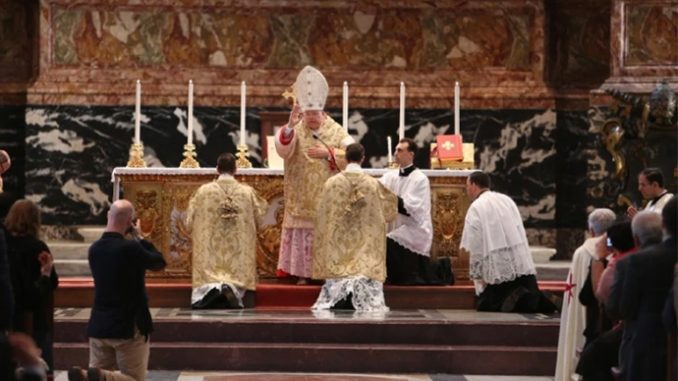
This is true even of discussions on the erosion of Christian values. After all, Christendom, as understood in the medieval world, had long been challenged by forces such as humanism before it was finally shattered by the Reformation of the sixteenth century, which became the precursor of more socially destructive forces. Indeed, the most profound break was not institutional but liturgical and, as such, the fundamental cause of the West’s civilization crisis does not lie principally in modern politics or ideology but with the rejection of the Mass and the doctrine of the Real Presence in the Eucharist.
More than any subsequent political or intellectual movement, it was this liturgical revolution that fractured the sacramental vision that had shaped Western civilization for over 1500 years, paving the way for destructive forces to take advantage of the West’s shattered unity and impose their own visions on society.
The word ‘Mass’ is derived from the Latin missa, which means dismissal, specifically from the conclusion of the service. That conclusion is marked by the declaration Ite missa est, which means ‘Go, it (the Church) is sent’.
At first, the term did not have the theological weight that it would gain in the Middle Ages when it was used to refer to the entire liturgy and was connected to St. Matthew’s teaching of ‘a mission’ to spread the gospel throughout the globe.1 As it was increasingly formalised and standardised, however, the Mass became the centerpiece of community worship, reinforced by a liturgical calendar of feast days, many of which, such as the feast of Corpus Christi, introduced by Pope Urban IV in 1264, take on the quality of a social drama with dramatic rituals and processions.2
In this sense, the Mass exerted a profound influence on the development of Western civilization, notably through the Eucharistic worship of Christ, who was professed from the very beginning of the Church by Church Fathers such as Ignatius of Antioch, Justin Martyr, Cyprian of Carthage, Cyril of Jerusalem, and Augustine of Hippo, to be truly present in the consecrated Host. Having developed through centuries of theological reflection and conciliar refinement at the Fourth Lateran Council in 1215, the doctrine received its most systematic scholastic exposition in the work of Thomas Aquinas (1225-1274) during the late thirteenth century.3
It was subsequently given its definitive formulation as a dogma of faith by the thirteenth session of the Council of Trent in 1551, in response to challenges from the Reformation. Although Christians of the early and medieval Church did not articulate the doctrine of the Real Presence as developed in scholastic form, they nevertheless understood that the consecrated Eucharist was the body of Christ and therefore truly holy.
Yet to emphasise the formative role of Christian worship in the development of Western civilisation is not to diminish the enduring significance in this process of the West’s Greco-Roman inheritance. Rather, it is to highlight the emergence of Western civilization from the interaction of the two, with Christianity preserving, re-shaping, and transmitting many attributes of Classical culture within its own distinctive theological and moral vision that conferred on the West a distinctively Christian identity.
For instance, Plato’s notions of visible objects directing the mind to higher things served to illuminate justification for icons, while Aristotelian metaphysics assisted Thomas Aquinas in building his theological system to illuminate the doctrine of the Real Presence through the concept of transubstantiation, while still holding Christian revelation as supreme.
The Mass and Western culture
Housing the lyrical beauty of the liturgy itself was the architectural magnificence of cathedrals, churches, and chapels adorned with masterful works of art, and that resonated to the sound of sacred music.
More precisely, can Gregorian chant, for instance, be decoupled from the beatific visions of Heaven that enraptured its composers? It is difficult to imagine that El Greco, Raphael, Michelangelo, Leonardo, Verdi, Mozart, or the cathedral masons would have followed the career paths they did had they not been drawn towards the spiritual magnificence of the Church beyond the material world? Would the van Eyck brothers have bothered with their wondrous Ghent Altarpiece if there was nothing to worship on the altar? Would any of these treasures have emerged without the desire of their creators to beautify worship during the Mass and honour the majesty of Christ present in the Blessed Sacrament?
An answer to these questions can perhaps be glimpsed from the bleak surroundings of the once great Catholic cathedrals and churches that were stripped of their previous cultural glories during the Reformation, their walls whitewashed, their niches emptied, their altars smashed, and their stained glass removed. Or, as the Church of England’s Directory of Public Worship of 1644 stated, there is ‘no place capable of any holiness under pretence of whatsoever dedication or consecration’ and by the same logic states ‘There is no day commanded in scripture to be kept holy under the gospel, but the Lord’s day, which is the Christian Sabbath.”4
One simply needs to imagine how barren the Western cultural landscape would be without the Mass to beautify it. In short, to understand the fullness of Western civilization, it is essential to recognise how the Mass helped to shape not only the West’s religious life but also its outward appearance, articulated by its moral and cultural identity. The Reformation and the Enlightenment may have sought to free themselves from its liturgical authority, but even these rebellions were framed by a world that the Mass had already made and which it was going to continue to influence for years to come.
Here, it is useful to engage with historians such as Christopher Dawson, Henry Mayr-Harting, Peter Lasko, Jacques Le Goff, and Eamon Duffy, who demonstrate the centrality of the Church’s liturgical life to medieval society.5
Even among those who no longer profess their Catholic faith, there is an increasing appreciation of the cultural legacy of Christendom, whose profile has been raised by the appointment as Prime Minister, self-confessed ‘cultural Catholic’, Andy Burnham 6 just as the praise extended to it had done a few years ago by atheist biologist Professor Richard Dawkins. For these people, the cultural fruits of the Faith are too immense to dispense with altogether.
Yet the muddled thinking behind the Cultural Christian phenomenon is all too clear. ‘I’m Catholic by upbringing’, notes Burnham, ‘but I’m not particularly religious now. My kids go to a Catholic school, so I still believe in the values and the grounding it gives you, I’m a very big believer in that.’ In much the same vein, Professor Dawkins declared, ‘There’s a distinction between being a believing Christian and a cultural Christian,’ Professor Dawkins declared. ‘I love the hymns and Christian carols. I sort of feel at home in the Christian ethos.’
So far so good. But then he added: ‘It’s true that statistically the number of people who believe in Christianity is going down. And I’m happy with that. But I won’t be happy if we lost our cathedrals and beautiful parish churches.’7
A similar trend can be observed in the groupthink of political elites. In a speech in May 2012 honouring the Charlemagne Prize recipient, German career politician Wolfgang Schäuble, Christine Lagarde, the managing director of the International Monetary Fund, likened Schäuble’s efforts to strengthen European unity with those of Charlemagne.8 Stranger still, she made no reference to the liturgical foundations of Charlemagne’s ‘intellectual and cultural revival’ lest it undermined the secular fantasies associated with the work of the modern Charlemagnes. To imply that Charlemagne’s was a secular Renaissance is to expose the intellectual vacuity or deliberate deception of those who do, in turn exposing the folly of their identity-forming programmes.
Such sentiments exemplify a broad tendency to value the fruits of Christianity while questioning or rejecting the supernatural beliefs that nourished them.
Christendom and the Mass
Such cultural piggy-backing, or, to borrow the fashionable expression ‘cultural appropriation, undoubtedly provides its adherents a degree of cultural reassurance in an age of growing uncertainty.
In Professor Dawkins’s case, it offers a sense of continuity and security against the Islamic influences that he fears. Or for the likes of Ms Lagarde, it reflects the hope that secular institutions can replace Christianity as Europe’s prime identity-forming force. Yet to admire the magnificence of Christendom while simultaneously dismissing the ‘mumbo-jumbo’, to quote the post-War British Prime Minister Clement Attlee,9 is intellectually negligent and self-defeating and a misunderstanding of much of the formative process of Western civilization. It is like saying, argued the American cultural commentator Rod Dreher, that one enjoys the fruits of a farm but one is happy that farms are closing and that gardens are not being planted.10
It is, moreover, to disarm oneself utterly in defence of that which is deemed worthy of protection. To put it another way, those who disregard the driving force behind the culture they find admirable, reduce themselves to casual bystanders in a growing process of cultural decay and are guilty of the single most grievous act of national and cultural suicide–destroying the very source of the civilization they claim to defend.
The abrogation of the Mass, which had been the central feature of Christian worship since the time of Christ, was arguably the utmost revolutionary act of the Protestant Reformation and a defining expression of its anti-clerical sacramental theology. Its impact extended far beyond the nature of worship to the very character of Christian civilization. The fruits of Catholic cultural legacy were not created in a vacuum. Motivating those who produced them was a belief in the supernatural, in something beyond the material order that manifested itself in the Word made flesh, an idea so derided by the cultural Christians. Cultural Christianity is a symptom of modernity and is likely to grow as people increasingly gravitate towards what they perceive to be virtuous and magnificent in the face of a mounting civilizational crisis.
Christendom was both a culture and a civilization, combining a shared Christian worldview with political, social, and institutional structures that it helped to shape. As a culture, Christendom was characterised by a common religious belief, moral values, artistic and architectural traditions, and an intellectual outlook centered on Christian theology. These were nurtured by the Church and supported by the State. As a civilization, Christendom developed its own political systems, academic and legal institutions, economic networks, and generated a wealth of artistic and architectural traditions, all profoundly influenced by Christian thought.
Although the Mass was not the sole driver of Western cultural development, it was a significant force in the organisation of wealth, labour, creativity, and intellectual endeavour. It is insufficient, therefore, to celebrate the cultural achievements of Christendom while overlooking the Mass as their primary source, from which the traditional social and cultural order, so prized by many cultural Christians, emerged. Accordingly, to recognise Eucharistic liturgy as a principal formative force of civilization is not simply an act of faith but an acknowledgement of a creative influence that is difficult to deny.
Endnotes:
1 Matt. 28:19-20
2 For analysis of the sociological aspect of the Mass, see John Bossy, ‘The Mass as a Social Institution 1200-1700’, Past & Present, August 1983, No. 100, pp. 29-61.
3 For a detailed discussion of the theology of transubstantiation see, Miri Rubin, Corpus Christi: The Eucharist in Late Medieval Culture, (Cambridge, Cambridge University Press, 1991), pp. 12-35; On Aquinas, see Reinhard Hutter, Aquinas on Transubstantiation: The Real Presence of Christ in the Eucharist: 13 (Thomistic Ressourcement Series), (The Catholic University of America Press, Washington DC, 2019).
5 Christopher Dawson, The Formation of Christendom (San Fancisco: Ignatius Press, 2008, org.pub by Sheed and Ward, 1965); Henry Mayr-Harting, Ottonian book illumination: an historical study, (London: Harvey Miller, 1999); Peter Lasko, Ars Sacra, 800–1200, (New Haven: Yale University Press, 1994); Jacques Le Goff, Medieval civilization, 400-1500, Trans., Julia Barrow, (Oxford, UK; Cambridge USA: Blackwell, 1994); Eamon Duffy, The Stripping of the Altars: Traditional religion in England, 1400-1580, (New Haven and London: Yale University Press, 2005, 2nd edition, first 1992).
If you value the news and views Catholic World Report provides, please consider donating to support our efforts. Your contribution will help us continue to make CWR available to all readers worldwide for free, without a subscription. Thank you for your generosity!
Click here for more information on donating to CWR. Click here to sign up for our newsletter.
Leave a Reply
You must be logged in to post a comment.