
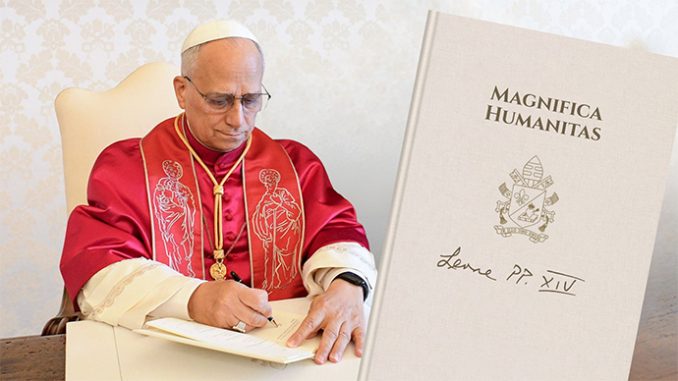
St. Augustine uses the image of two cities to define the central conflict that runs throughout history between the self-love that constitutes the City of Man and the divine love that forms the City of God. Unsurprisingly, the first Augustinian Pope, Leo XIV, shapes Magnifica Humanitas, his first encyclical, around this image: “Humanity, created by God in all its grandeur, is today facing a pivotal choice: either to construct a new Tower of Babel or to build the city in which God and humanity dwell together” (1). In contrast to Babel, a tower meant to demonstrate humanity’s prideful power to reach the heavens, Leo presents Nehemiah’s rebuilding of Jerusalem’s walls as a model of peaceful cooperation for the glory of God and the common good.
Though Leo offers a sweeping vision of the challenges facing the world today in Magnifica Humanitas, he particularly highlights the all-encompassing rise of digital technologies, especially artificial intelligence. To help the reader grasp the vision of this long encyclical, spanning 40,000 words, I’d like to offer a brief overview of four of his main points.
Look to the past for wisdom for the future
Leo released the encyclical 135 years to the day following his namesake Leo XIII’s Rerum Novarum. Rerum addressed the “new things” of the Industrial Revolution that were reshaping both the economy and family life. To offer the Church’s wisdom on the challenges faced by society in the late 19th century, Leo XIII returned to key elements of scholastic thought, especially those of St. Thomas Aquinas (see his encyclical Aeterni Patris), and applied them in new ways, laying the foundation for Catholic Social Teaching.
Leo XIV spends a good amount of time summarizing the contributions of his predecessors (chapter one) and laying out the key principles of Catholic Social Teaching that they articulated (chapter two): the dignity of the human person, the common good, the universal destination of goods, subsidiarity, solidarity, and social justice.
Spending the first two chapters on the Church’s teaching over the last 135 years indicates that even though we face new problems, we do not have to pull solutions out of thin air. Catholic Social Teaching brings the Church’s transmission of divine revelation to bear on pressing questions within time and history. It is “a living reality, in dialogue with history, cultures, and sciences. At the same time, it enshrines a core set of unchanging truths. For this reason, it can be considered a form of wisdom that is capable of guiding the personal and societal lives of believers even today” (46).
Humanity is the standard for evaluating technology
The title of the encyclical itself points to the grandeur of humanity, created by God in his own image and likeness. Throughout, Leo often points to the need for standards to safeguard society from the dangers of subordinating the person to anonymous computation that prioritizes efficiency above all else. Machines can perform many tasks more quickly and effectively than humans, but the goal of technology must remain human-focused and subservient to the true good of humanity. “Humanity — in all its grandeur and woundedness—must never be replaced or surpassed. We can embrace the technological progress that alleviates suffering and unlocks new possibilities, provided that we do not abandon the very essence of our humanity, namely the capacity for relationship and love” (126).
Although he offers many points for consideration, we can focus on two major principles for evaluating and guiding new developments. First, technological innovations “must be evaluated by asking a crucial question: Do they truly help individuals and peoples to become more humane and fraternal, while respecting our common home and future generations?” (24). Technology can advance the common good if it serves rather than undermines humanity’s communal flourishing. To do this, we require “moral and social discernment that safeguards the primacy of the human person, in order to ensure that it will always be human intelligence, with its conscience and freedom, that guides technical innovations and responsibly determines their use and limits” (97). We cannot simply relinquish control of the most important aspects of our lives, for this would subordinate the person, our dignity and even our highest aspirations to mechanical forces.
Unity and peace as overarching goals
Leo insists that technology should promote the good of all, not just the few. One of the greatest threats of AI is that it could become subordinate to the interests of a powerful elite, whether corporate or political. In response to this threat, Leo articulates a primary principle: “Our first task is neither to demonize nor idolize technological tools, but to utilize them on the basis of a fundamental principle, namely that truth is a common good and not the property of those with power or influence” (137). Rather than displacing human agency, new technology must enable more people to participate in fruitful work and relationships.
Throughout his pontificate, Leo has positioned himself as a pope of peace. Magnifica Humanitas bears this stamp, noting that warfare is becoming more impersonal and detached from moral thinking. He, therefore, challenges us to prioritize peace even more strongly: “In an increasingly interdependent world, peace is not simply one issue among others, but a prerequisite for the universal common good and a test of the moral maturity of peoples, especially of those who bear responsibility for governing” (182). Without this kind of commitment, human dignity may become subject to algorithms more than a commitment of conscience.
Build a new civilization of love through daily action
Finally, Leo provides hope that, despite enormous challenges, we are not simply helpless. He reflects that “a subtle temptation may emerge, namely the thought that the problems are too big and we are too small, and that our choices, therefore, cannot make a difference” (212). Human culture is ultimately grounded in spiritual realities that shape our aspirations and guide us through adversity. Leo addresses all of humanity in the encyclical, inviting everyone together to build a city based on love. “The civilization of love will not arise from a single or spectacular gesture, but from the sum total of small and steadfast acts of fidelity that serve as a bulwark against dehumanization” (213).
To fight against dehumanization, we must prioritize actions that reflect human dignity, refusing to relinquish life to impersonal forces. The Holy Father makes an appeal in this regard: “I invite everyone to cherish places and times where physical presence remains crucial, such as shared meals, Christian community gatherings, time spent with the lonely and serving the poor” (239). This requires us to “reflect critically, choose and love freely, and form authentic relationships” (233). Leo speaks of this as a kind of education we all must undertake as we “learn how to engage with the digital world in a human way,” and as we guide our children to develop a sense of responsibility to guard their dignity (238).
Leo XIV’s first encyclical clearly lays out some of the pressing challenges ahead, while encouraging us to avoid despair by doing our own part to build a city that rejects the pride of Babel and preserves the God-given grandeur of our humanity.
If you value the news and views Catholic World Report provides, please consider donating to support our efforts. Your contribution will help us continue to make CWR available to all readers worldwide for free, without a subscription. Thank you for your generosity!
Click here for more information on donating to CWR. Click here to sign up for our newsletter.
Leave a Reply
You must be logged in to post a comment.