
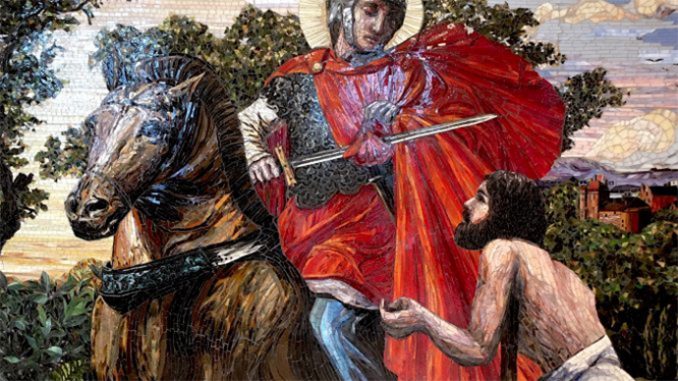
Catholics might be surprised to learn that the Church recognizes hundreds of soldiers as Saints and Blesseds. While the Catechism of the Catholic Church reminds us of our Christian duty to avoid war (see nos. 2307-2308), the Church has honored the heroic virtue of soldiers since its very beginning.
In light of recent arguments made by Catholic leaders against war, and even Pope Leo’s statement that “Peace is holy, not war”, one might find it surprising that the Church has canonized so many men whose vocation involved fighting. However, the Catechism of the Catholic Church (no. 2310) points out that:
Those who are sworn to serve their country in the armed forces are servants of the security and freedom of nations. If they carry out their duty honorably, they truly contribute to the common good of the nation and the maintenance of peace.
Even the Bible honors soldiers like King David, Saint Longinus the Centurion, and Saint Cornelius the Centurion. King David was a brave fighter and a successful general. He might not have committed adultery if he had been leading his men in battle instead of staying home and inviting the beautiful Bathsheba over for dinner. David, however, proved his humility through his subsequent repentance.
Longinus is the traditional name given to the soldier who pierced Christ’s side with a spear on Good Friday. He is considered a saint because he made an act of faith by proclaiming Christ to be the Son of God. Cornelius was baptized by Saint Peter himself and, according to tradition, was later named a bishop. All these men are listed in the Church’s official list of saints, the Martyrologium Romanum.1
However, most of the soldier-saints who are recognized by the Church are not in the Bible and can be roughly grouped into six categories.
Early Church martyrs
By far, the largest number of these soldiers died as martyrs during the days of the early Church. After all, paganism was the official religion of the Roman Empire for centuries, and the legal toleration of Christian beliefs was not granted until the year 313. Soldiers, like everyone else, were summarily executed if they refused to renounce their faith in Christ. According to tradition, Saint Sebastian of Rome (d. 288) tried to convert the emperor to the faith and died trying.
There are other stories demonstrating these saints’ bravery. Saint Besa of Alexandria was a third-century soldier who died protecting two Catholics from an angry mob. During the same century, four soldiers were on duty at court in Alexandria, Egypt, when an old man was brought before the judge. The man was visibly trembling and began denying his Catholic faith. The soldiers on duty—Saints Ammon, Zeno, Ptolomy, and Ingen—publicly declared themselves to be Christians, probably to encourage the older man to remain steadfast. All five men were immediately executed.
By the year 320, at least 322 Catholic soldiers had died as martyrs. There is also an unknown number of soldiers who died in two additional outbreaks of persecution. For example, we know that Saints Maurice, Exsuperius, Candidus, and Victor were soldiers of the Theban Legion and were serving in Agaunum in the year 286. While we know the names of these four men, we don’t know the names of the soldiers who died with them. The nearby city has been called Saint-Maurice, Switzerland, in his honor for many centuries.
The largest number of known martyrs—200 men—died in Sinope in the fourth century. Why would soldiers be executed in such large groups? That is best explained by the deaths of one of the most famous groups of martyrs, the Martyrs of Armenia, also called the Martyrs of Sebastea.
Roman generals often ordered their soldiers to participate in pagan sacrifices before entering battle to request the assistance of pagan gods. Forty Catholic soldiers who were serving in Sebastea in Armenia (modern Sivas, Turkey) in the year 320 refused to do so. It was winter. The forty men were stripped naked and forced to lie on a frozen lake. A fire and a warm bath were prepared nearby to tempt the men to renounce their faith. One man gave in to the temptation and jumped into the bath; the temperature difference killed him immediately. However, another soldier—apparently not even a Christian before that point—was so moved by their bravery that he chose to take the place of the dead man and join them in martyrdom. It took hours for all forty of them to die.
Converted soldiers
Some of these saints began serving as soldiers as young men, but did not end their lives as soldiers. Saint Pachomius (d. c. 347) was a pagan soldier in the Roman army in the fourth century and was living in miserable conditions. When the nearby Christian community saw the poverty of these soldiers, they brought them food. Pachomius was converted to the faith by their disinterested charity, became a hermit after his military service ended, and lived for many years as an abbot in the Egyptian desert.
One of the most famous former soldiers is Saint Martin of Tours (c. 316-397), who divided his own cloak and gave half of it to a shivering man on a cold winter’s day. Later that night, Martin dreamed of Jesus Christ, who indicated that He had been that poor man. Martin immediately sought Baptism. He became a monk and was later ordained a bishop. By the time he died, Martin had become famous for his generosity to the poor and for the miracles that resulted from his prayers. The conversion of Saint Ignatius of Loyola (1491-1556) from soldier to priest and religious founder is just as well known.
Quite a few men have left military service and then chosen to become hermits, monks, and priests. These saints include: hermit Saint Gummarus of Lier, Belgium (d. c. 775); Benedictine monk Saint Albert of Pontida, Italy (d. c. 1096); Carmelite religious brother Saint Nuno Álvares Pereira of Lisbon, Portugal (d. 1431); and religious founder Saint Albert Chmielowski of Poland (1845-1916).
It’s not clear what moved these men to embrace religious life. Perhaps battlefield experiences played a part in their decision. When Saint Obitius of Brescia (d. 1204) was serving as a knight, he had a close experience with death, followed by a vision of hell. He then decided to leave his wife and children (with her permission) and spend the rest of his life as an oblate.
Kings and knights
The medieval period was often not a peaceful one. While many men fought senseless battles during the Middle Ages for the sake of their own pride and greed, there were also many good, holy kings, dukes, and knights who fought for the honorable goal of protecting other people.
King Saint Eric IX (d. 1161) was martyred by pagans because of his attempts to bring the Catholic Faith to Sweden. Saint Ferdinand III of Castile and Leon (1198-1252) engaged in many battles as he wrested control of Spanish territory from Muslims. Saint Louis IX of France (1214-1270), perhaps the holiest man who ever reigned as a king, died on his way to participate in a Crusade, hoping to recover Christian control of the Holy Land.
Although medieval military religious orders have been controversial at times, these orders began for the honorable causes of protecting pilgrims, maintaining order, and caring for the sick in the Holy Land. For example, Blessed Hugh Canefro (d. c. 1233) served as a soldier and religious of the Order of Saint John of Jerusalem for many years before he returned to Italy and became the administrator of a hospital.
Among these medieval men, there is one lone woman—Saint Joan of Arc—but her story is so remarkable that she deserves a separate article.
Unworthy soldiers
Of course, not every soldier lives honorably and follows the Ten Commandments. Some future saints picked up the worst of the bad habits often associated with military life before they turned their lives around.
Saint John of God, also called Juan Cuidad (1495-1550), had abandoned his faith and was living an immoral life when he experienced a conversion. He began to care for the sick and eventually founded the Brothers Hospitallers of Saint John of God. Similarly, Saint Camillus de Lellis (1550-1614) had become addicted to gambling as a soldier. He repented and founded his own religious order to care for the sick.
There are other examples too, such as Saint Joannicus of Mount Olympus (762-846), who lived a dissolute life as a soldier for twenty years before becoming a monk, and Saint Laurence Loricatus (d. 1243), a soldier who accidentally killed a man, repented, and became a hermit.
Later martyrs
When Muslims sought to take control of the Holy Land in the year 638, two large groups of Christian soldiers were killed and are considered martyrs. But in later centuries, soldiers have sometimes simply been rounded up along with other Catholics during times of persecution, just as happened in the days of the early Church. After all, anti-Catholic governments are not pleased when members of the military refuse to obey their anti-Catholic laws.
Such martyrs include Blessed Adrian Fortescue (1476-1539), a knight who died a martyr for his faith under King Henry VIII’s persecution of Catholics; Saint Paul Tong Viet Buong (c. 1773-1833), a soldier who was martyred under the persecution ordered by the Vietnamese emperor Minh Mang; Saint Paul Ho Hyob (1796-1840), a soldier who died for his faith in Korea; and Saint Pontian Ngondwe (d. 1886), a soldier who was executed for his faith in Uganda.
Military chaplains
In more recent years, the Vatican has made a point of honoring priests who served as military chaplains at the risk of their own lives. Blessed Daniel Brottier (1876-1936) was a French missionary priest who served as a missionary in Senegal and then as a chaplain during World War I. While Daniel didn’t die in battle, Blessed Secondo Pollo (1908-1941) did; he was shot as he attempted to minister to a dying soldier on the battlefield in World War II.
But perhaps the most remarkable beatified military chaplain is Blessed Rupert Mayer (1876-1945). Born in Stuttgart, he became a Jesuit priest and served as an army chaplain during World War I. He refused to leave his men, even in dangerous situations, and lost his leg in battle. When Hitler came to power, Father Rupert continued to speak out against Nazism. He was finally arrested and sent to a concentration camp. When his health began to decline, the authorities became afraid that the death of a famous war hero would spark protests. They sent him to another prison and put him in solitary confinement. Rupert survived the war, but he died several months later.
There are other brave soldiers, kings, knights, and chaplains in the Church’s calendar throughout the liturgical year. On July 2, for example, the Church remembers Saints Processus and Martinian. According to tradition, these two men were soldiers in the Mamertine prison in Rome and were converted to the faith by Saint Peter himself when he was imprisoned. The two men later died as martyrs for the faith and were buried in the Roman catacomb of Pope Damasus.
As we Americans celebrate our 250th anniversary, we can ask God to bless our country and thank Him for the American soldiers who have fought for our freedom. And we can pray that the witness of these saintly soldiers will inspire Catholics who serve in our military today to become Christlike men and women, even on the battlefield.
Endnote:
If you value the news and views Catholic World Report provides, please consider donating to support our efforts. Your contribution will help us continue to make CWR available to all readers worldwide for free, without a subscription. Thank you for your generosity!
Click here for more information on donating to CWR. Click here to sign up for our newsletter.
Leave a Reply
You must be logged in to post a comment.