
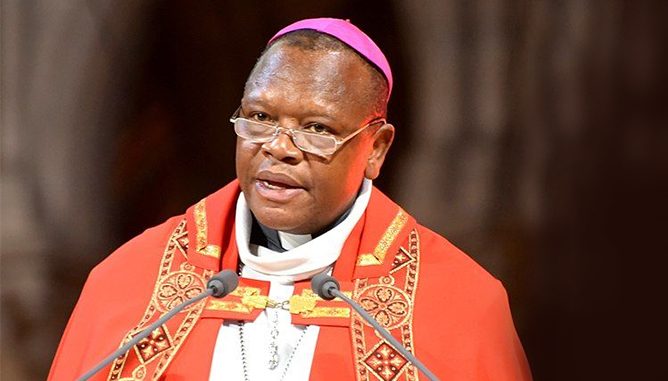
Two incidents in a space of one day have again ignited tensions between the state and the Catholic Church in the Democratic Republic of Congo (DRC).
The first, on Sunday, November 22nd, involved Congolese Cardinal Fridolin Ambongo, who was barred from celebrating Holy Mass for young people at the Tata Raphaël Stadium in a move qualified as a “provocation” by the Cardinal.
The second incident was even more outrageous, with police using tear gas to disperse bishops, priests, and lay people who were engaged in public but peaceful protests to demand the enforcement of a court ruling over a Church-owned piece of land in the Tshamalale neighborhood.
On November 22, 2026. The Solemnity of Christ the King was supposed to bring together thousands of youths from the Kinshasa Archdiocese to the Tata Raphaël Stadium, where Cardinal Fridolin Ambongo was set to celebrate Holy Mass.
But just hours prior to the Eucharistic celebration that would also mark the Diocesan Youth Days in the archdiocese, authorities informed organizers that they couldn’t access the sports arena, citing security concerns.
Police effectively sealed off the premises on Sunday, November 22. The Congolese Cardinal, however, insists that all administrative preconditions were fulfilled for the celebration of the Mass at the venue.
“We have a letter from the Minister for Youth authorizing us to use the stadium free of charge. We also have a message from the Home Office instructing the police commander to take all necessary measures to ensure security during the celebrations,” Cardinal Ambongo told journalists.
He explained how frustrated the young people were when they arrived at the stadium only to be prevented from entering.
“So, you can imagine the anger and shock the young people felt,” the prelate laments, explaining that he had to calm the irate youths in order to preserve the spiritual significance of the day.
“My first duty was to calm the young people’s anger so that we would not miss the main event, which was the Eucharistic celebration of Christ the King of the Universe and, at the same time, the diocesan youth day.”
The Prelate dismissed the government’s claim that security was at the heart of their action, explaining that Catholics are naturally very peaceful people, and an Eucharistic celebration should never have given rise to concerns about insecurity.
“The problem was not related to security,” Cardinal Ambongo stated, citing the absolute order that reigned when the celebration was ultimately relocated to the Campus of the St. Raphael College.
“We celebrated Mass Yesterday [Sunday November 22] with all these young people, without a single police officer present. And there were no incidents. So, for us, it is clear that the problem was not related to security,” Cardinal Ambongo said, and qualified the actions of the authorities as “a provocation.”
While the Tata Raphaël Stadium event was simply cancelled without violence, a more outrageous approach was adopted on Monday, November 23rd, in Lumumbashi, to disperse a peaceful protest.
Bishops, priests, religious, and laity took to the streets to protest the non-enforcement of a court order barring individuals from encroaching on land hosting the Saint Paul Interocean Major Seminary, which trains future priests for the region.
Police took the extraordinary decision to tear-gas the protesters, a move that further drew the ire of the Church.
The Archbishop of Lubumbashi and President of the National Episcopal Conference of Congo (CENCO), Archbishop Fulgence Muteba, has also raised concerns of his own, citing restrictions to the celebration of Mass and the detention of archdiocesan employees. The archbishop’s residence has also been surrounded by security forces.
“A march can be dispersed, but the Church cannot be dispersed,” said Cardinal Ambongo. “Tear gas can be fired at believers, but the truth cannot be suffocated. Pastors can be intimidated, but the Word of God cannot be gagged!”
“We cannot accept that force should take the place of the law, or that violence should become the response to those who demand justice,” he stated.
He said that those who imagine themselves able to intimidate the Church and stifle her word are deeply mistaken about the target.
“The Church is not the enemy of any power, but it will never be complicit in injustice. Its mission is to proclaim the Gospel, defend human dignity and make heard the voices of those whom others seek to silence,” the cardinal stated.
The Catholic Bishops’ Conference of the DRC, CENCO, in a statement, urged the faithful to defend their faith in the face of what’s now seen as state persecution of the Church.
“Tear-gassing bishops and peaceful protesters at prayer, preventing His Excellency Bishop Fulgence Muteba from leaving his residence, and even going so far as to bar bishops from entering the archbishop’s residence is a form of tyranny that our country–which claims to be democratic–truly does not deserve,” the Secretary General of the Bishops’ Conference, Monsignor Donatien N’shole said in a statement.
“To regard the Church as a political enemy is to be targeting the wrong enemy,” he said.
“The archbishops and bishops of CENCO call on the Catholic faithful, who are undeniably hurt by what they are witnessing, to remain steadfast in their faith, vigilant in prayer and ready to defend the rights of the Church and their civil rights.”
He called on the relevant authorities to take the necessary measures to guarantee the exercise of the constitutional rights and freedoms of citizens, explaining that the Church acts to promote “the common good, peace, justice and human dignity.”
Public authorities in the DRC have pledged their openness to continued dialogue with the Church even as they invoke security reasons to justify their actions.
In a statement, Patrick Muyaya Katembwe, who is the Minister of Communication and the Media, said the state is ever ready for continued dialogue to foster a more convivial relationship with the Church.
“The Catholic Church is a long-standing and institutional partner of the State,” he said in the November 25th statement.
He reaffirmed the government’s commitment to “freedom of worship, respect for religious beliefs and dialogue with the various religious denominations, in particular with the Catholic Church, which is regarded as a long-standing and institutional partner of the State.”
A day earlier, Jacquemain Shabani, the Vice Prime Minister in charge of Interior, Security, and Decentralization, in a similar attempt to ease the tense situation, told the Apostolic Nuncio that Monseigneur Mitja Leskovar noted the government’s deep respect for the Church, but also raised concerns about security in a country already stretched by conflict.
“All these regrettable events, particularly given the security situation in our country, the Democratic Republic of the Congo, where our various security services are at times compelled to take certain measures which are sometimes misunderstood (…) The Government of the Republic has the utmost respect for the Catholic Church and is committed to maintaining good relations between the two parties,” the PM said.
If you value the news and views Catholic World Report provides, please consider donating to support our efforts. Your contribution will help us continue to make CWR available to all readers worldwide for free, without a subscription. Thank you for your generosity!
Click here for more information on donating to CWR. Click here to sign up for our newsletter.
Leave a Reply
You must be logged in to post a comment.