
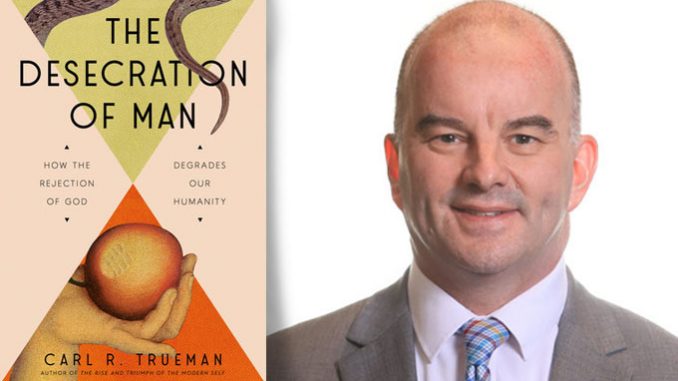
Carl R. Trueman’s most recent book is a study of the profound problems caused by a loss of belief in the supernatural and how that loss affects humanity’s understanding of itself, especially in the areas of sex, reproduction, and death.
The Desecration of Man: How the Rejection of God Degrades Our Humanity poses fundamental questions about life and belief. Early in the book, Trueman poses these ultimate questions:
To ask, “What is moral?” is to ask, “How should man behave?” And to answer that question one needs to know what “man” is. Is human life to have a particular goal or goals? Are these shared by all human beings or are they created or chosen by communities or even individuals? Do we define ourselves, or is who and what we are to some extent determined by the fact that we all share something called “human nature” that involves a given set of expectations for our behavior that constitute what we call morality?
How we view man is intrinsically linked to how we view God and religion. What makes human beings unique is our ability to give personal meaning to acts such as eating, drinking, and sexual activity. Christians believe that human beings are created in God’s image and likeness. While we are free beings, we must operate within certain moral limits. But if we do not accept that man is made in God’s image, the picture changes. Trueman states:
If God does not exist…our idea of what it means to be human must change. We do not have the limits, the obligations and dependencies, nor the given ends that being made in his image connotes. We are born free, we are defined by our autonomy, and we are masters of our own destiny. We are to decide what limits and what ends we will respect. In sum, we create ourselves.
This Promethean spirit has led to what Trueman calls ‘expressive individualism’. This mentality, he argues, causes people to see all forms of external authority as oppressive and creates an iconoclastic spirit and a desire to desecrate all that was once considered holy.
The sexual revolution as desecration
Trueman sees the most obvious area of desecration in the modern West as that relating to sex and sexuality. The sexual revolution, more than anything else, has served to undermine the Christian identity of the West. It has even been sacralized in the form of Pride parades. Yet it has essentially created a commodified humanity as Trueman summarizes very well:
…for all of the sexual revolution’s success, there is nowhere that the dehumanizing aspect of modernity’s desecration can be seen more dramatically. For at the heart of the sexual revolution lies a problem. It asserts that the destruction of old sexual codes—codes based on religious premises and a view of sex as sacred—is the path to liberation. But in practice it has turned us all into objects and things that exist merely for the benefit—for the sexual pleasure—of others. In the modern world, sex is endless, both in the sense that it is a ubiquitous obsession and in the sense that it really has no broader meaning or purpose beyond recreation.
The sexual revolution has meant more than just a change in attitude towards certain types of sexual lifestyles. A person’s sexuality has become a part of their identity as an individual, and to criticize it is to question that person’s very right to exist. Thus, we cannot simply tolerate unorthodox lifestyles—we must celebrate them:
It is not enough to tolerate sexual minorities. All differences in treatment on the basis of sexual identity must be removed. Hence, marriage must cease to be a monopoly of heterosexual relationships, employment hiring practices must be blind to sexual orientation or, in the interests of diversity, biased toward sexual minorities, and anything that hints that sexual minorities represent some kind of deviance has to be eliminated. This has implications for traditional religion: Christianity’s moral codes, for example, come to be seen as oppressive, and the God who imposes them as both offensive and implausible.
Trueman shows how the sexual revolution pursues its cause through acts of desecration, such as that seen at the opening of the 2024 Paris Olympics. Further, this revolution will continue pushing the envelope so that a practice such as abortion will move from being seen as a regrettable necessity, ‘safe, legal and rare’, to becoming a positive social good to be celebrated.
The commodification of reproduction
Another area highlighted by Trueman as causing a desecration of humanity is the rise of artificial reproduction. Foremost among these practices is that of commercial surrogacy, whereby a woman carries a child on behalf of another. Surrogacy has caused the mother to become ‘a service provider, her body the tool for the production of a commodity.’ Reproduction, one of the most intimate human experiences, has become a lucrative business:
As has been noted many times, this is the real Handmaid’s Tale—not a story of abusive religious fundamentalism treating women like nothing more than baby-making machines, but rather that of a society committed to technological innovation doing exactly the same thing. The woman is nothing more than a womb, and the womb nothing more than rental space.
As with surrogacy, so with IVF:
… just as surrogates function as containers for gestation, so sperm and egg donors are simply suppliers of raw materials…once children are the outcome of a technical medical procedure that manufactures life, the tendency to start seeing them as consumer products, as another form of commodity, is greater and greater…biological parenthood is downgraded or relativized.
Trivializing death
An excellent chapter in the book addresses the problem of death and how this, too, has been desacralized in modern society. In the affluent West, funerals have been turned into ‘celebrations of life’ aimed at distracting the bereaved from their loss rather than solemn reminders to the attendees about the reality of their own mortality.
Trueman argues that this trivializes the reality of death and is the result of a loss of belief in God. As with sex, modern society prefers to ignore the reality and consequences of death. Trueman writes:
Like the traditional sacredness of sex, death’s loss of this sense of the sacred is not a trivial cultural matter but something of great importance. Life lived without acknowledgment of the reality and power of death is life lived as a lie. It is the lie that sits at the heart of the desecration of man: the idea that we have neither given limits nor ends, that we are obliged to nobody and nothing, and that we can live this way with impunity. But death does have the last word. It is the limit that all of our technical brilliance cannot overcome. It is a sacred boundary that contradicts all our autonomous, disembodied posturing.
Be a real Christian, not a cultural Christian
Trueman concludes that the solution to the problem of desecration, which he describes so well, is a return to traditional Christianity. He acknowledges that leading thinkers of our time, including even the atheist Richard Dawkins, have embraced ‘cultural Christianity’ or acknowledged Christianity’s contribution to the West.
But that, says Trueman, is not enough. Real Christianity consists of three things: cult (attendance at a serious and reverent Christian liturgy), code (adhering to Christian morality), and creed (actual belief in Christian dogmas such as those expressed in the Nicene Creed).
Trueman’s book is a thoughtful meditation on how secular society has negatively transformed attitudes towards the human person and proposes the only true solution to the problem: a return to sincere Christian belief and practice.
• Related at CWR: “Disenchantment or Desecration? An interview with Carl R. Trueman” (April 6, 2026) by Carl E. Olson
The Desecration of Man: How the Rejection of God Degrades Our Humanity
By Carl R. Trueman
Sentinel/Penguin, 2026
Hardcover, 256 pages
If you value the news and views Catholic World Report provides, please consider donating to support our efforts. Your contribution will help us continue to make CWR available to all readers worldwide for free, without a subscription. Thank you for your generosity!
Click here for more information on donating to CWR. Click here to sign up for our newsletter.
Leave a Reply
You must be logged in to post a comment.