
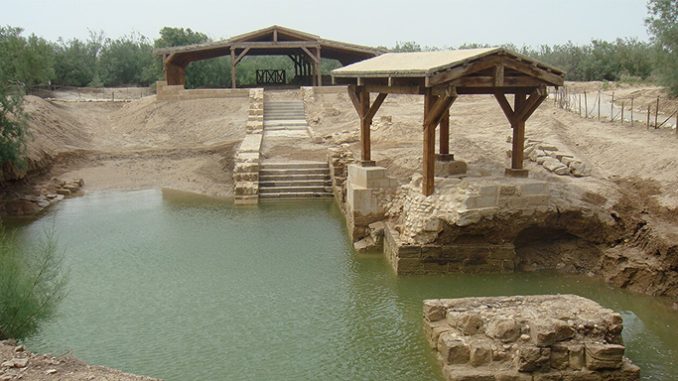
Jordan’s importance to Christian history is difficult to overstate. After all, it’s where Jesus was baptized. And it’s also where John the Baptist, who baptized our Savior, was imprisoned and beheaded.
Almost exactly 2,000 years later, Jordan has an overall population of 11.5 million, about 97% of whom are Muslim and just over 2% are Christian. Greek Orthodox is the largest Christian group in Jordan, followed by Catholics (including Roman/Latin and Melkite Catholics).
In Jordan’s 138-member House of Representatives, Christians have nine seats reserved for them—a ratio that exceeds their portion of the general population. Also, given their comparatively small numbers, Christians are very well-represented among the nation’s economic upper class.
Some cities in Jordan have areas with “a thriving Christian population,” says “Jibril,” a Jordanian Catholic man still living in Jordan.
But the Christian percentage of Jordan’s overall population has been in steady decline, currently about 10 times less than it was one century ago.
Jibril said that Muslim immigration from other countries and higher Muslim birth rates likely play a part in these changing demographics. But he also cited Christian conversion to Islam as a factor, along with Christians leaving for a different part of the world due to “instability and hostility” in the Middle East region.
Despite its vast Muslim majority, Jordan is not known as being especially oppressive to Christians. Rather, it is a place where Christians from more hostile lands in the region often seek refuge.
So when, on October 23, three terrorists gunned down a funeral procession outside a Greek Orthodox Church in Jordan’s west-central Karak region, it came as a violent jolt to a country that has been far less problematic about religious relations than many parts of the Middle East.
Jordanian authorities have since arrested the three perpetrators of this attack, which killed nine Christians and injured dozens more.
Before the October 23 incident, Jordan had gone almost ten years without a terrorist attack causing multiple fatalities. Over that time period, Jordanian authorities said they had prevented several extremist plots.
Jibril said there was “definitely” an indication that extremism was on the rise in Jordan before the recent attack. He noted that, shortly before the October 23 massacre, a member of Jordan’s parliament had said during a podcast interview, “If you accept the Christians today, tomorrow you will accept the Jews.”
While making that statement, this member of parliament described Christians as “Nazarenes,” a term which is “mostly used” by Muslims who are “quite religious and extreme,” said Jibril.
“Most Muslims I’ve met were very nice,” said Jibril. “However, there is a subset of them that are extreme enough to kill me.”
Despite these ominous elements in their population, most Jordanian Christians would say they have a high degree of religious freedom.
Jibril said he doesn’t know anyone who faced significant problems at the workplace due to their Christian faith.
“It does happen, every once in a while, that a Christian is treated differently or with prejudice,” he said. “But those typically tend to be rare occurrences.”
The circumstances can change quickly, though, if you are a known Christian convert. Jibril has, to his knowledge, never met a Jordanian Muslim who converted to Christianity. Those types of Christians are “rare,” he said, due to the “legal and social difficulties of leaving the Muslim faith.”
A study from 2015 estimated that Jordan has about 6,500 converts from Islam to Christianity.
Jordan’s penal code does not specify any penalty for apostasy. However, converting to Christianity is “not something that is recognized by the government, and those people tend to be heavily persecuted and ostracized, particularly by their own families,” said Jibril. He assumes that most people in such a predicament would seek asylum abroad.
Of course, many younger people, regardless of their religion, are seeking to leave Jordan these days because of its economic problems — including an unemployment rate over 50% for persons aged 20-30.
Jibril himself would prefer to go abroad for economic reasons. But he is less pessimistic about interfaith relations in his homeland.
“It was reassuring to see many Muslims stand in solidarity with Christians,” said Jibril, who also spoke highly of the “swift response” made by Jordan’s security forces and Jordan’s King Abdullah II. Right after the attack, His Majesty ordered an “iron fist” response to what he described as a “despicable terrorist act.”
The Jordanian monarch has a long history of opposing extremism. During the heyday of ISIS, he had spoken out against “terrorists and criminals targeting Syria, Iraq, and other countries,” further describing them as “extreme reflections of a global threat.”
ISIS, for its part, declared His Majesty an “infidel” and “an enemy of Islam,” and also called for his execution.
Jibril said that, despite Jordan’s overall sincere effort at religious coexistence, the extremism in much of the Arab world has permeated his country’s borders. And a startling number of Jordanians have proven receptive to the ideology.
In fact, Jordan had the highest per capita rate of ISIS fighters of any nation in the Middle East. Indeed, some of the world’s highest rates of ISIS recruits come from such countries as Jordan and Tunisia, which are regarded as among the more liberal members of the Arab World.
Some people from these countries have talked about a split in society that sees one segment of Muslims grow more relaxed, while another segment intensifies in their beliefs and animosities.
Aware of these social trends, the Jordanian government banned the Muslim Brotherhood in April 2025. The Brotherhood currently enjoys far more freedom to operate in Europe.
Recent days in Jordan have seen “a lot of pushback on extremist Muslims by other Muslims,” said Jibril. But there remains “a long way to go” to neutralize an extremist ideology that “needs to be defeated,” he said. “This attack doesn’t start and end with those three good-for-nothing bums.”
If you value the news and views Catholic World Report provides, please consider donating to support our efforts. Your contribution will help us continue to make CWR available to all readers worldwide for free, without a subscription. Thank you for your generosity!
Click here for more information on donating to CWR. Click here to sign up for our newsletter.
Leave a Reply
You must be logged in to post a comment.