
After safeguarding them for more than half a century, the Chaldean Antonian Order of St. Hormizd has returned a collection of historic manuscripts belonging to the former Chaldean Diocese of Akra in northern Iraq to its ecclesiastical authorities.
The formal handover ceremony took place at the Monastery of the Servant of God and Martyr Gabriel Danbo in Ankawa, Iraq, a predominantly Christian district of Erbil. It was attended by Archbishop Najeeb Michaeel of Mosul and Akra; Abbot Samer Soreshow, superior general of the Chaldean Antonian Order of St. Hormizd; and several monks.
The manuscripts were entrusted to the order in the 1960s amid the difficult circumstances and widespread displacement affecting the region, Soreshow explained in an interview with ACI MENA, the Arabic-language sister service of EWTN News.
According to Soreshow, Abdul-Ahad Rabban, a member of the order who served as its superior general and later became bishop of Akra, sought to protect the ecclesiastical heritage from being lost. The manuscripts were placed in the order’s care until circumstances would allow their safe return to the diocese.
Soreshow emphasized that throughout the decades, the order regarded the manuscripts not only as priceless treasures but also as an essential part of the Chaldean Church’s historical and spiritual memory and a legacy preserving its identity.
He explained that changing conditions over the years forced the order’s manuscript collections, including those belonging to the Diocese of Akra, to be moved repeatedly in search of safety.
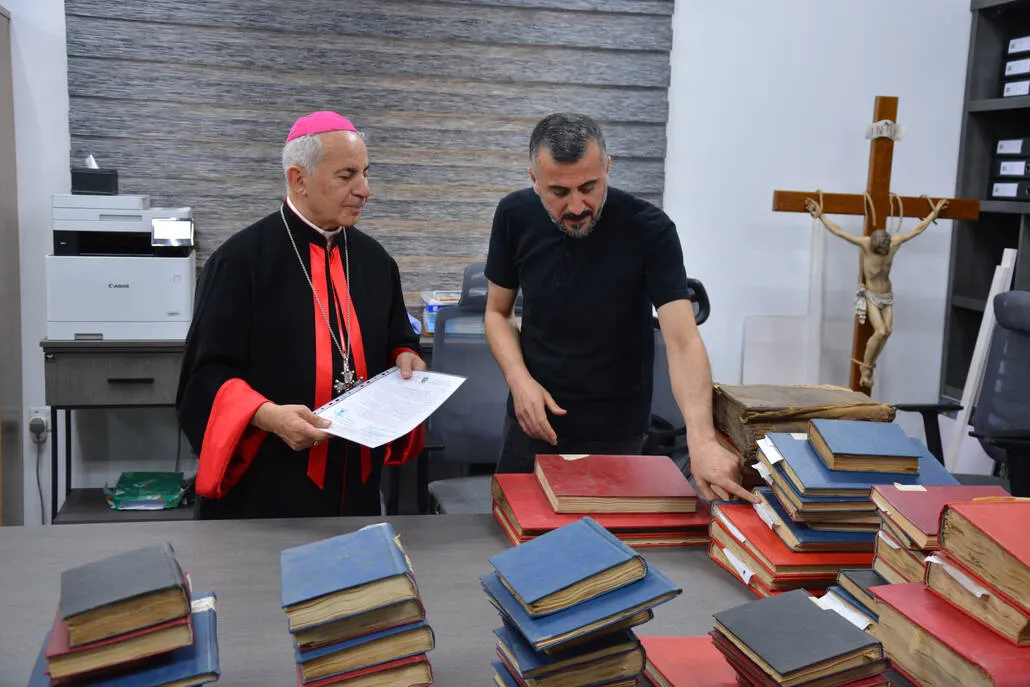
The manuscripts were transferred from the Monastery of Our Lady of the Seeds in Alqosh to St. George Monastery in Mosul and later to St. Anthony Monastery in Baghdad. Their journey eventually brought them to the order’s general headquarters in Ankawa in 2021, which houses the Scriptorium Syriacum, a cultural center dedicated to preserving Syriac manuscripts.
The repeated relocations resulted in the Akra manuscripts becoming mixed with other collections held by the order, requiring extensive efforts to identify and separate them.
Soreshow said the monks relied on earlier manuscript catalogs compiled at different times by Bishop Addai Scher, Belgian Dominican orientalist Jacques-Marie Vosté, and Fathers Yousif Habbi, Boutros Haddad, and Jacques Isaac. These cataloging efforts included work published by the Iraqi Academy in 1988.
However, the order’s work went well beyond identifying and sorting the manuscripts.
Soreshow explained that the restoration and preservation process involved cleaning the manuscripts, gathering their scattered pages, photographing and numbering them, reassembling them into complete volumes, and preparing comprehensive catalogs.
This work was particularly demanding, he noted, “especially since several copies of the same manuscript existed, many of which had been copied at the Monastery of Our Lady of the Seeds.”
The project required considerable time and effort from the Chaldean Antonian monks, who began the work in 2021 through the Scriptorium Syriacum.
The work was carried out under the direction of Father Yousif Ajim, the center’s director, with assistance from other staff members who graduated from the Department of Syriac Language at Salahaddin University in Erbil.
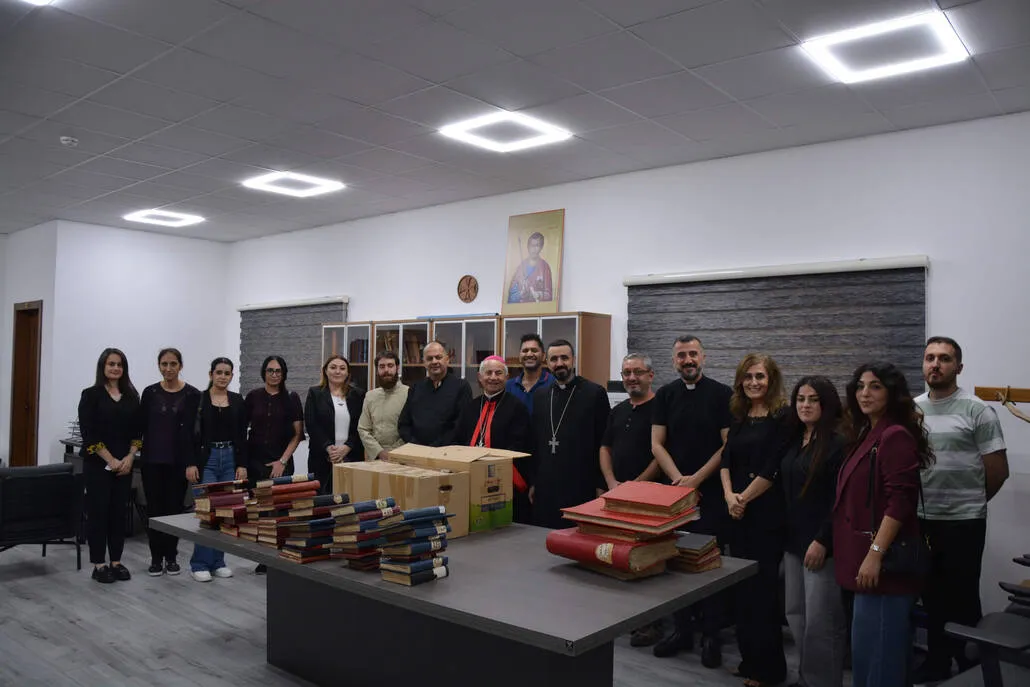
93 manuscripts returned, while 4 remain unaccounted for in the collection
According to Soreshow, the Diocese of Akra’s collection originally comprised 97 manuscripts, of which 93 were handed over to Michaeel.
Of the remaining four, three were identified in the Chaldean Patriarchate’s digitized archives, made available through manuscript digitization efforts and accessible via the Hill Museum & Manuscript Library in Minnesota.
The fourth manuscript remains missing.
Soreshow praised the commitment of both the religious order and the archdiocese to ensuring that the manuscripts remain properly preserved and accessible to researchers, scholars, and clergy, contributing to the study of Church history and the advancement of academic research.
“The smooth transfer of these manuscripts from the custody of our order to that of their diocese reflects the continuity of the Church’s mission to safeguard its historical memory and preserve its heritage for future generations,” he said.
Akra was formerly an independent Chaldean Catholic diocese. However, the unrest and conflicts that affected the region during the 1960s led to the displacement of many of its Christian inhabitants and a decline in the local Church’s presence.
In 2018, the independent Diocese of Akra was merged with the Archdiocese of Mosul, forming the Chaldean Catholic Archeparchy of Mosul and Akra, currently headed by Michaeel.
This story was first published by ACI MENA, the Arabic-language sister service of EWTN News. It has been translated and adapted by EWTN News English.
Leave a Reply
You must be logged in to post a comment.