
My son-in-law, Kyle Swensen, is an aspiring singer/songwriter and a member of the band “Barnweaver,” whose eponymous first album was released in May 2026. A few years ago, I was sitting in a hotel room somewhere when Kyle sent me a text with a link to a song, “St. Martin of Tours,” recorded on his phone in his living room. The song is a prayer in my voice to St. Martin, patron of (among other causes) recovering alcoholics. Kyle wrote the song in my voice because, as I have detailed in my recent book, Staying Sober One Story at a Time, I am a recovering alcoholic.
The chorus of Kyle’s song says:
Martin of Tours, pray for me
Pray for me, St. Martin of Tours.
I’ve got all these saints around my neck.
Every day I still need yours.
The lyric “all these saints around my neck” refers to the several saints to whom I make constant pleas for intercession, and whose images hover over my heart. They are my little communion of saints, whose petitions and succor are the source of my spiritual and moral strength.
Before my conversion to Catholicism in 1989, the notion of seeking the intercession of the saints was foreign to me. Of course, the version of the Bible I used as an evangelical minister had excised the books of First and Second Maccabees, the latter of which is the biblical foundation of prayers for and to those who have predeceased us. And I implausibly interpreted the “great cloud of witnesses” in Hebrews 12:1 merely as a metaphor, rather than the more economically sensible reference to the actual living witnesses in Heaven. When I entered the Catholic Church, of course, I affirmed that community of saints, both as an aspirant to join them and a petitioner of their prayers.
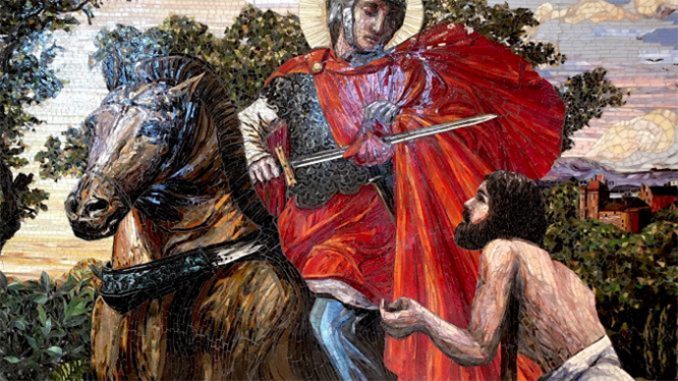
St. Martin of Tours is more typically known as the patron of soldiers and horsemen. This patronage is based on a famous story in which, as a soldier on horseback, he encountered a beggar who had nothing to cover him. St. Martin cut his own rich cloak into two pieces and gave half to the beggar. After this event, Martin had a dramatic conversion, in which he gave his life to Christ, eventually becoming a hermit and, ultimately, the Bishop of Tours in France.
For my purposes, however, St. Martin is also the patron of recovering alcoholics. It is not clear how this patronage came about, but it is probably related to the date of his feast, November 11. November 11 is a historic German holiday celebrating the end of the wine harvest and the fermentation of the first batch of wine for that year. The holiday, needless to say, involved a great deal of overdrinking, suggesting that one pray to St. Martin for, if not abstinence, at least moderation in consumption of alcohol.
As a matter of purely historical circumstance, my birthday also happens to be November 11. Thus, St. Martin of Tours is perhaps the closest of my saintly companions. St. Martin of Tours, pray that I may continue my sobriety, one day at a time.
On July 6, 1535, an English attorney mounted the scaffold on Tower Hill, just outside the walls of the Tower of London, to face his executioner. Against nearly the entirety of the clergy, nobility, and statesmen in England, he had refused to compromise the integrity of his conscience and the supremacy of the law of God. As he faced his execution, he uttered the words that have become the motto of Catholic attorneys, civil servants, and other public officials, “I die the King’s good servant, and God’s first.” Of course, that attorney was Sir Thomas More, canonized by Pope Pius XI in May 1935.
Much of what we know about St. Thomas More’s moral courage and personal integrity comes from a brief biography, A Man of Singular Virtue, written by William Roper, the husband of More’s daughter, Margaret. Roper himself was an attorney who served in various official roles during the reigns of Queens Mary and Elizabeth. But for a significant part of his life, Roper was a Lutheran, despite More’s tireless attempts to show Roper the errors of his ways through argument and persuasion. Finally, More relented in his arguments, as he wrote to Margaret,
I have borne a long time with thy husband; I have reasoned and argued with him in these points of religion, and still given to him my poor fatherly counsel, but I perceive none of all this able to call him home; and therefore, Meg, I will no longer dispute with him, but will clean give him over and get me to God and pray for him.
Roper credited his return to the Catholic faith precisely to those prayers.
There’s a lesson here. St. Thomas More was one of the great orators of his time, a highly successful attorney schooled in the arts of rhetoric and persuasion. But it was not his argument that brought William Roper back to the faith. Rather, it was More’s virtuous witness and relentless prayer. Roper was not converted by More’s words but rather by the constancy of his faith. Apologetics has a place in Christian conversation. But a life of singular virtue is the more likely means of demonstrating the grace of God and the fullness of faith. St. Thomas More, God’s servant first, pray that I may maintain the integrity of my faith against the idols of the age, political and otherwise.
In a recent interview, I was asked what my nine children mean to me. The question reminded me of an early scene in Shakespeare’s King Lear, in which Lear asked each of his three daughters how much they loved him. Goneril and Regan each heap insincere praise on their father, professing their devotion to him with grandiloquent and exaggerated cliches of devotion and admiration. Their purpose, of course, was to conceal their own selfish ambition rather than to express genuine devotion to their father.
After the disingenuous speeches of Regan and Goneril, Lear turned to the youngest daughter, Cordelia, asking what she could say that is “more opulent than your sisters.” “Nothing,” Cordelia replied. “Unhappy that I am, I cannot heave my heart into my mouth. I love your majesty according to my bond, no more nor less.”
Cordelia was disenfranchised by her irate father, and her share of the kingdom was given to the treacherous Regan and Goneril. But Cordelia’s love for her father remained unbroken and enduring. It was manifested not through flattering praise, however, but rather through Cordelia’s actions, including her ill-fated attempt to save Lear’s kingdom.
So how do I express my love for my children? By trying to emulate the forerunner to Cordelia’s silent witness of her love, St. Joseph, the earthly father of Our Lord. St. Joseph, patron of fathers and families, never uttered a recorded word in the Gospels. Yet we know his devotion to the Blessed Virgin and Jesus through his constancy and faithfulness to them. St. Joseph’s love is not revealed by words, but by his persistent devotion to his family. St. Joseph, pray that I may love my family as you loved yours.
These are not the only holy men and women whom I rely on for constant help. St. John Henry Newman was instrumental in my reception into full communion with the Catholic Church. I call upon the Madonna del Ghisallo each day as I ride my bicycle, seeking the protection and prayers of the Patroness of cyclists and travelers. Sts. Monica and Augustine are witnesses to the persistence of prayer and the continuing journey of intellectual and moral virtue.
And as the only saint whom I have personally touched, St. John Paul II is my constant companion as I strive to go higher up and deeper into the faith of our Fathers. These are the closest of that great cloud of witnesses who give me comfort, courage, and solace as I tread this pilgrim’s way.
All you hallowed men and women, pray for us. And may the souls of the faithful departed rest in peace.
If you value the news and views Catholic World Report provides, please consider donating to support our efforts. Your contribution will help us continue to make CWR available to all readers worldwide for free, without a subscription. Thank you for your generosity!
Click here for more information on donating to CWR. Click here to sign up for our newsletter.
Leave a Reply
You must be logged in to post a comment.