
Churches and monasteries around the world vary in their architecture and size, as well as in how easy they are to reach. Some stand in the heart of cities, while others are reached along daunting mountain roads or rocky trails. For pilgrims who enjoy hiking and exploring, these sites combine Christian history with outdoor adventure. The walk or climb to reach them can be as memorable as the visit itself.
Here are seven destinations across the Middle East, Africa, and Europe where the road itself becomes part of the pilgrimage.
Sumela Monastery, Turkey
Sumela Monastery rises from a sheer cliff above the forested Altindere Valley near Trabzon, roughly 300 meters (984 feet) above the valley floor. Dedicated to the Virgin Mary, the former Greek Orthodox monastery was an important pilgrimage destination for the region’s Greek Christian communities.
The buildings include a rock church, chapels, monks’ quarters, and a sacred spring. Frescoes depict biblical scenes and episodes from the lives of Christ and the Virgin Mary.
The setting reveals how the community adapted its buildings to the mountain, with rooms and balconies extending along the cliff face.
St. Catherine’s Monastery, Egypt
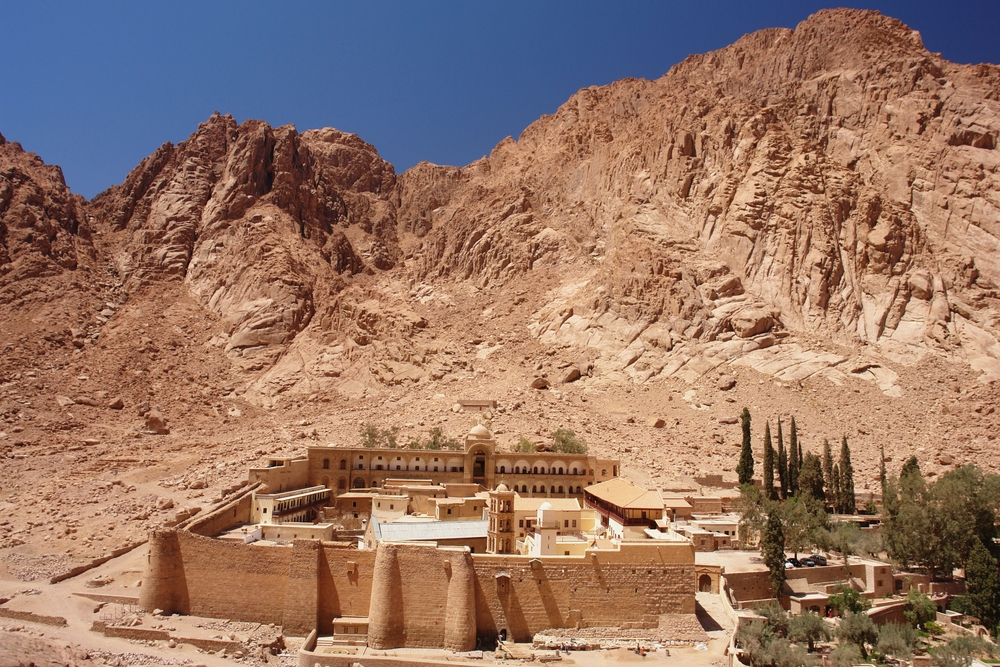
At the foot of Mount Sinai in Egypt’s southern Sinai Peninsula, St. Catherine’s Monastery preserves a monastic tradition that has continued since the sixth century. Built under Emperor Justinian, the Orthodox monastery stands at the site traditionally identified with the burning bush from which God spoke to Moses.
Its principal church, the Basilica of the Transfiguration, retains a sixth-century mosaic showing Christ with Moses and Elijah and the apostles Peter, James, and John. The complex also preserves early Christian icons and a library containing thousands of manuscripts in languages including Greek, Arabic, and Syriac, evidence of the many Christian cultures connected with Sinai.
The Monasteries of Meteora, Greece
Meteora’s monasteries crown towering sandstone formations that made the area a place of retreat for generations of Orthodox monks. Hermits began settling here by the 11th century, and monasteries were later built on the summits. By the end of the 15th century, there were 24; six remain in operation today.
Access once depended on rope ladders and nets used to lift people and supplies. At Holy Trinity Monastery, visitors now descend toward the base of the rock and then climb a staircase of about 140 steps carved in 1925. The ascent opens onto views of Kalambaka, the Peneios River, and the surrounding mountains.

Sevanavank Monastery, Armenia
Above Lake Sevan, Sevanavank stands on a peninsula that was once an island, giving its early monastic community a more secluded setting. Its two principal surviving churches were built in 874 through the patronage of Princess Mariam, daughter of Ashot Bagratuni, under the spiritual guidance of the monk Mashtots, who later became Catholicos of All Armenians, the chief bishop and supreme spiritual leader of the Armenian Apostolic Church.
The churches were dedicated to the Holy Apostles and the Mother of God. Their cruciform plans and central domes reflect medieval Armenian church architecture.
The road is gentler than a cliff climb: Visitors ascend the hillside steps to reach the churches and views across the lake. The site also has a link to Armenian Catholic history: Mekhitar of Sebaste, who later founded the Mekhitarist congregation, studied at the monastery in the late 17th century.

Abuna Yemata Guh Church, Ethiopia
Carved into a sandstone pinnacle in the Gheralta Mountains of Ethiopia’s Tigray region, Abuna Yemata Guh requires one of the most demanding approaches among these destinations: Reaching its entrance involves scaling a steep rock face.
The church is named for Abuna Yemata, one of the Nine Saints traditionally associated with the spread of monasticism in northern Ethiopia around the beginning of the sixth century. Its interior preserves wall paintings that art historians generally date to the second half of the 15th century, although local tradition assigns them an earlier date.

The Monasteries of Wadi Qadisha, Lebanon
In northern Lebanon, Wadi Qadisha, or the Holy Valley, contains monasteries, cave churches, and hermitages set among steep cliffs and cultivated terraces. Inscribed on UNESCO’s World Heritage List in 1998 together with the nearby Cedars of God, the valley bears witness to centuries of Christian monastic life and has a particular place in the Maronite Church’s history.
Our Lady of Qannoubine served as the residence of Maronite patriarchs from 1440 to 1823. Its history reflects the valley’s role as a refuge during periods of persecution. Beneath the church, a narrow crypt provided a hiding place for patriarchs; surviving wall paintings include a depiction of the Coronation of the Virgin.

Mor Mattai Monastery, Iraq
On Mount Alfaf, also known as Mount Maqlub, northeast of Mosul, Mor Mattai Monastery overlooks the Nineveh Plain. The Syriac Orthodox monastery takes its name from St. Matthew the Hermit. Tradition dates its foundation to A.D. 363 and links it to the monk’s flight from persecution under the Roman emperor Julian.
The monastery became an important center of Syriac Christian religious life and learning. Its complex includes churches, chapels, and memorials, while caves in the surrounding mountain recall the hermits who once lived there.
The mountain setting has offered refuge. In 2014, as Islamic State forces advanced in the region, Christians from nearby villages temporarily sheltered at the monastery.

This story was first published by ACI MENA, the Arabic-language sister service of EWTN News, and has been translated for and adapted by EWTN News English.