
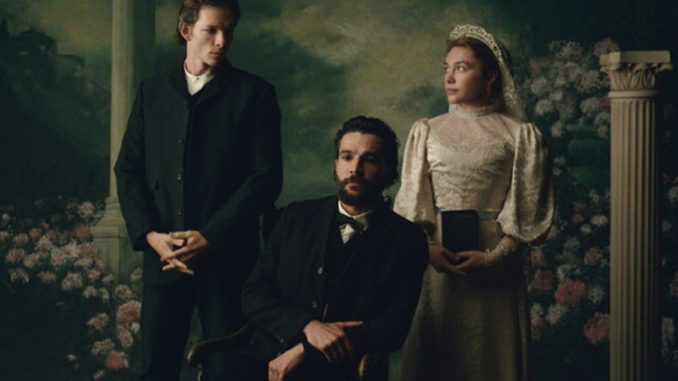
It is clear that John Steinbeck wrote East of Eden to make readers confront biblical evil. Not the softened, therapeutic version that our culture craves and is being portrayed in the new Netflix miniseries, but the ancient Edenic kind of evil that slithers into the garden and corrupts everything it touches.
The primary antagonist in the novel—the beautiful golden-haired Cathy Ames, with the heart-shaped face and the tiny rosebud mouth—is the serpent of the novel. She is a creature whose malice is essential to the story. She is the demonic force that gives the novel’s biblical drama its moral depth. But the miniseries redefines her as a wounded proto-feminist—destroying the biblical force that made the novel so compelling.
Having revisited Steinbeck’s novel several times, most recently this past summer in anticipation of the Netflix miniseries, I have always understood Cathy’s evil as absolute and irredeemable. Early in the novel, Steinbeck even hints that she is something other than human, noting the unusual swelling in the insteps of her tiny feet. By describing her little feet as having “fat insteps almost like little hoofs,” he suggests cloven feet without stating it outright. The image signals that Cathy Ames embodies the corruption that entered Eden on split hooves.
Cathy Ames truly is the demonic force in the garden of Steinbeck’s amazing novel. But while the miniseries is visually beautiful and historically compelling, Netflix has hollowed out the biblical drama at the heart of Steinbeck’s novel—and taken its very soul. By reframing Cathy as having suffered from the patriarchal system of the time (and perhaps some kind of sexual abuse as a child), viewers of the miniseries are invited to try and understand her.
In the novel, however, Cathy was not abused. Her father realizes early that his daughter is not like other children. He is uneasy about it, but the Ames family does not seem to attend church or have any real religious leanings, so he doesn’t seem able to identify what is wrong with his child. Yet he and his wife know there is something wrong with their beautiful daughter—even when she is just ten years old—they know that something in her was bent toward evil.
The father tries to intervene, tries to correct what he senses is fundamentally wrong with her. But in the miniseries, he’s recast as overbearing and punitive, and viewers are led to believe that his severity creates Cathy’s cruelty. The film adaptation replaces Steinbeck’s portrait of a father confronting a child’s innate darkness with a modern therapeutic narrative in which parental harshness explains everything. In doing so, it erases the novel’s central truth that Cathy’s evil was not caused by anything—it was there all the time. Steinbeck obviously understood Original Sin much better than the filmmakers.
But, then again, East of Eden is not, at its core, a book about women. It is a Girardian drama of rivalry—brothers locked in imitation, envy, and the desperate hunger to be chosen by their father. Steinbeck is retelling Genesis, the primal conflict between Cain and Abel, what he once called in a letter to his editor at Viking “perhaps the greatest story of all time.” The novel’s moral structure rests on this rivalry and on the figures who threaten or expose it.
And, in that respect, the miniseries is true to its roots. At the center of the story is Adam Trask, the son of a Connecticut farmer and army veteran, and his half-brother Charles, who tends the farm. In their youth—like Cain and Abel—Charles is envious of the love that their father seems to have for Adam. Complaining that the expensive pocketknife that Charles gives to his father for his birthday is unappreciated, yet the stray puppy that Adam picked up off the farm and gave to the father is his favorite gift of all, reflects the biblical truth that Abel’s gift to our Lord was more pleasing than that of Cain’s. When the father dies and leaves a tidy sum of money to be split evenly by the brothers, Cathy Ames arrives on their doorstep—and Adam is immediately smitten.
The rivalry continues, and we are constantly reminded of Genesis throughout the novel. Charles is even given the “mark of Cain” on his forehead as he suffers an accident while moving a heavy rock with a crowbar. Cathy and Adam move to California, to the Salinas Valley, and try to create their own Eden. But any Christian knows that a true paradise can never be created on this earth—especially when you are bringing your own demon along with you.
Yet neither the novel nor the miniseries leaves us trapped in the cycle of mimetic rivalry. Steinbeck’s invocation of timshel—the Hebrew word for the human capacity to break free from the Cain-and-Abel pattern—remains the hinge of hope. Redemption is possible. The adaptation echoes the truth that violence is not destiny and that imitation can be purified. And, most importantly, grace can interrupt even the oldest scripts of envy.
Some, like Cathy Ames, may not be able to be redeemed because God has given her (and all of us) the free will to choose evil. We all have the power to choose good or evil. Cathy continues to choose darkness, but the other characters begin to move toward the light. As Solzhenitsyn reminds us, “the line dividing good and evil cuts through the heart of every human being.” We all carry both possibilities within ourselves.
East of Eden remains essential reading because it restores the biblical truth of good and evil to its rightful place at the center of human life. It is not likely that Steinbeck would endorse the current cultural need to psychologize sin or try to understand why Cathy Ames was evil. Instead, Steinbeck shows that the Cain and Abel struggle is not an ancient tale but the ongoing condition of every human heart. Steinbeck reminds us that moral choice is always possible—but it always carries a cost.
In a cultural moment that prefers psychologized or therapeutic explanations to spiritual ones, East of Eden brings us back to the truth that we are moral beings who must choose between good and evil every day of our lives.
If you value the news and views Catholic World Report provides, please consider donating to support our efforts. Your contribution will help us continue to make CWR available to all readers worldwide for free, without a subscription. Thank you for your generosity!
Click here for more information on donating to CWR. Click here to sign up for our newsletter.
Leave a Reply
You must be logged in to post a comment.