
Tanis Cortens:
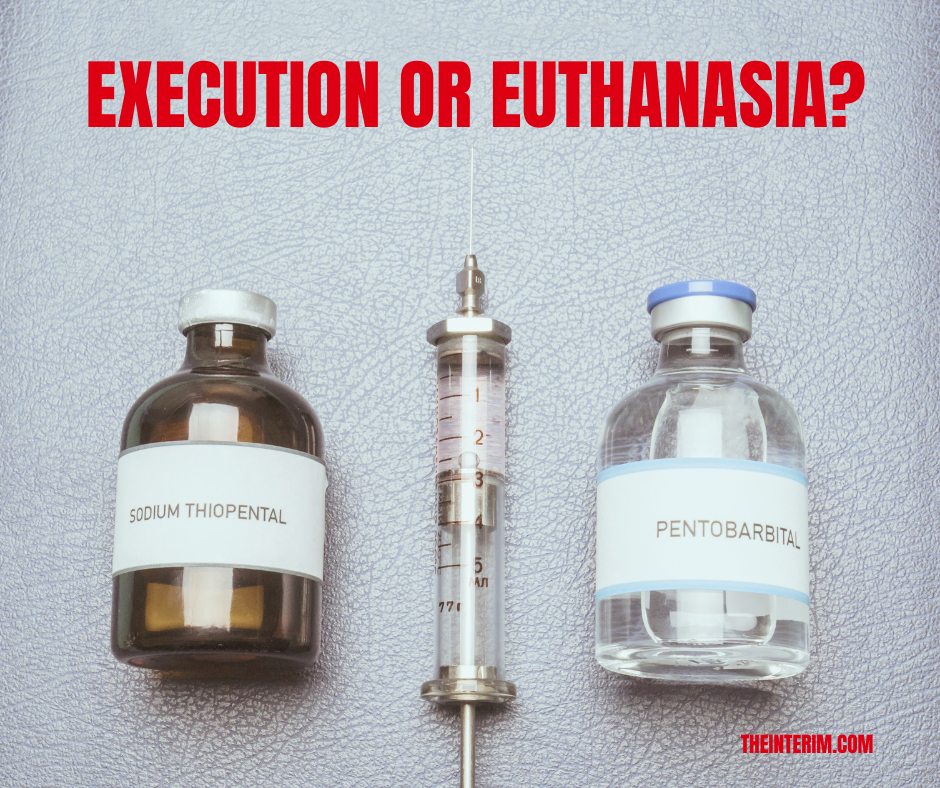
Canadian advocates of euthanasia assert that the procedure lives up to its name as a “good death,” providing a serene, elegant, and even humane way of ending suffering. Dying With Dignity Canada explains the process as follows: “The provision of medical assistance in dying (MAID) in most of Canada is by intravenous administration of a series of medications – most typically midazolam, propofol, and rocuronium. The first medication is used as a sedative, the second puts the individual into a deep coma, and the third ultimately stops the person’s heart.…The medical assistance in dying procedure is a peaceful one.” However, the truth may be better illuminated by a study of the U.S.’s primary method of capital punishment.
Anesthesiologist Dr. Joel Zivot pointed out the parallels between Canadian MAiD and American lethal-injection executions in a 2021 MedPage Today article. He wrote that he perceived death by lethal injection as a peaceful procedure until he “was given a file of autopsy reports on inmates executed by lethal injection. Upon review, I noticed a striking and surprising finding: almost all autopsies revealed that the lungs had filled with frothy fluid. This occurred if the execution was by an injection of either pentobarbital or midazolam.”
The condition Zivot noted is known as pulmonary edema, and it causes an experience akin to suffocation or drowning. An NPR investigation reviewing more than 200 autopsies of prisoners executed by lethal injection found that 84 per cent showed signs of pulmonary edema, regardless of the drug protocol used. Because the froth in the fluid implies air was still passing through the lungs at the time, pulmonary edema must have occurred before administration of the paralyzing second drug, which means it was due to the sedative.
Midazolam, used as a sedative in 32 of the executions studied, is not a general anesthetic and does not block pain. Accordingly, anatomical pathologist Dr. Mark Edgar told an American federal court in 2018 that his research suggested inmates executed with midazolam “would experience severe respiratory distress with associated sensations of drowning, asphyxiation, panic and terror.” For instance, witnesses said Arizona’s Joseph Wood gasped more than 600 times during his 2014 execution, a procedure that lasted nearly two hours. This botched lethal injection played a role in Arizona’s decision to stop using midazolam for executions in 2016.
CBC reported another such case — that of Oklahoma’s Clayton Lockett, who “writhed on a gurney, moaned and clenched his teeth for several minutes” during his 43-minute execution — in connection with a 2015 U.S. Supreme Court case concerning the constitutionality of using midazolam in executions under the Eighth Amendment, which prohibits cruel and unusual punishment. The court ruled 5-4 that it was constitutional. Two years later, however, Magistrate Judge Michael Merz declared Ohio’s three-drug regimen, including both midazolam and rocuronium, unconstitutional. The pharmaceutical company Pfizer released a statement in June 2021 condemning the use of its drugs in executions: “Pfizer makes its products to enhance and save the lives of the patients we serve. Consistent with these values, Pfizer strongly objects to the use of its products as lethal injections for capital punishment.…Pfizer offers these products because they save or improve lives, and markets them solely for use as indicated in the product labeling.” Among the drugs named were midazolam, propofol, and rocuronium.
As Zivot wrote in reply to a brief by several Canadian senators in 2021, “Lethal injection for execution and MAID are fundamentally identical tasks in that both are designed to cause death by the use of the injection of medications not specifically designed to be used to produce death.…The package inserts for Midazolam, Propofol and Rocuronium do not list MAID as an indicated uses (sic) and make no mention of dosage for the purposes of MAID.”
Rocuronium carries its own set of complications: A Miami Herald article about the 2023 execution of Donald Dillbeck quoted Maria Deliberato, executive director of Floridians for Alternatives to the Death Penalty, as she expressed her belief that “there are…major problems with (Florida’s) three-drug protocol,” which uses rocuronium as its second drug. Rocuronium’s paralytic effect makes it impossible to tell if the first drug (the short-acting sedative etomidate) wears off. This could “create the appearance of a serene death” while masking pain and suffering. Florida law forbids the use of such paralytic drugs when euthanizing dogs and cats, and Zivot wrote in his MedPage Today piece that “the use of paralytics in execution by lethal injection generally has been abandoned because of its obvious cruelty.”
Zivot went on to say that when drug manufacturers chose to stop making the common execution drug pentobarbital, Missouri intended to use propofol instead. However, Fresenius Kabi, the only U.S. supplier of propofol at the time, refused to sell the drug for lethal injection. Their website says, “While Fresenius Kabi takes no position on capital punishment, the use of our products for lethal injection is contrary both to our mission and to the FDA-approved indications for, and labelling of, our products.”
“The manufacturer reasoned that propofol was for treatment and not for death,” wrote Zivot. “Yet this is precisely the drug currently used in MAiD in an attempt to render the dying person insensate.”
Referencing his experience as an anesthesiologist, Zivot noted another problem with propofol: “Very commonly, patients complain of a burning sensation. I learned to block this painful sensation with a prior injection of a local anesthetic. MAiD uses a dose 10 times greater than what I would use in the operating room” (although a small amount of lidocaine to numb the vein is administered before the propofol).
It is also worth recalling that midazolam, the sedative used in Canadian MAiD, is not an anesthetic. In an article on the 2015 Supreme Court case, Gillian Mohney of ABC News wrote, “In a clinical setting, the drug would not be used to put a patient under general anesthesia because the drug does not produce all of the desired effects, including amnesia, unconsciousness, analgesia (no pain), inhibition of autonomic reflexes, and relaxation of muscles.”
According to the Divisions of Family Practice initiative, Canada’s MAiD protocol administers 10 mg of midazolam. The same amount was used in the 2014 execution of Dennis McGuire of Ohio before the administration of 40 mg of hydromorphone. PBS News reported that his execution took over 25 minutes as compared with Ohio’s usual 15 minutes or fewer to death.
Dr. Kent Diveley submitted a medical report regarding the execution, in which he wrote, “To render an individual unconscious, much higher doses (of midazolam) would be needed. An Anesthesiologist would not depend on a 10 mg dose of midazolam to provide for total loss of memory, or to produce an unconscious state.” Diveley said that McGuire experienced “true pain and suffering in the several minutes before he lost consciousness” owing to respiratory depression caused by the high dose of hydromorphone.
Finally, in MAiD as in Florida’s lethal-injection protocol, the paralytic rocuronium “create(s) the appearance of a serene death” — but since no autopsies have been performed on people who died by MAiD, there is no way of knowing what they experienced. Zivot concluded his article by calling for this to change: “It is time to perform autopsies on everyone that dies by MAiD, so we can determine if MAiD protocols produce frothy fluid in the lungs.…It is time to accept what the evidence available to date shows: MAiD may very likely provide a torturous death.”
Zivot testified to that effect before the Canadian Senate in 2021 as it considered Bill C-7, an act that loosened MAiD regulations and created Track 2 for patients whose natural death is not reasonably foreseeable. “I would say that it’s important that if MAID is to be used, it should be clear to the Canadian public that the kind of death that they will experience as a consequence of MAID will be something other than the way it is represented,” he said. “It could be exceedingly painful and more akin to drowning.”
Leave a Reply
You must be logged in to post a comment.