
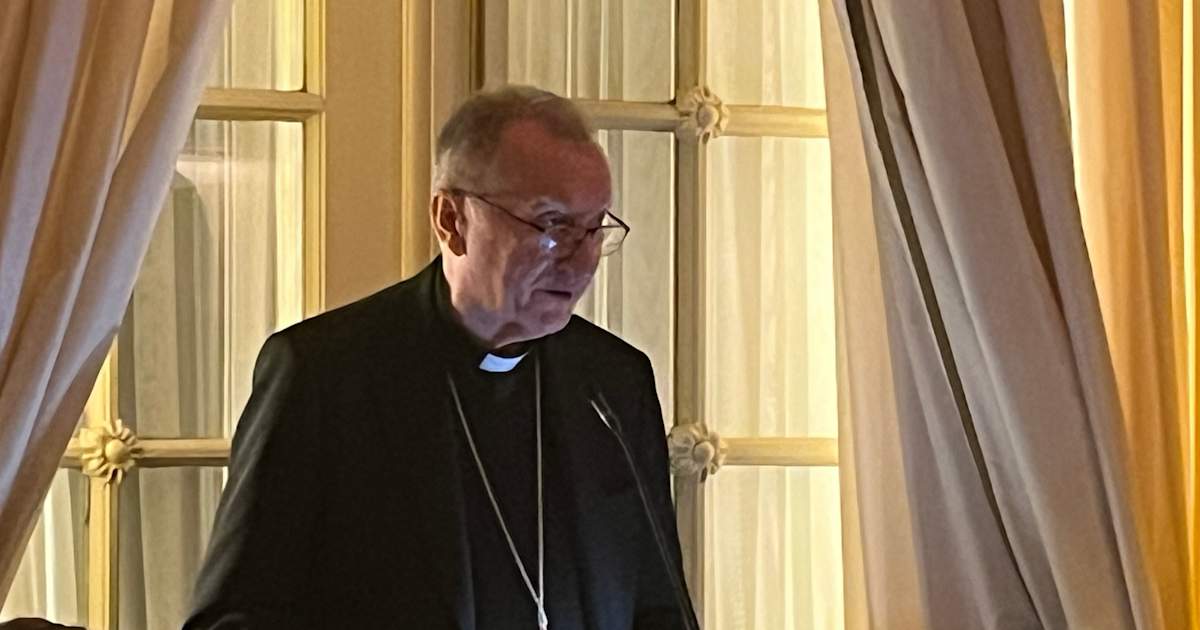
NEW YORK — The root of today’s fragmented world is not technology, excess freedom, or diversity but the loss of a common understanding of who the human person is, Vatican Secretary of State Cardinal Pietro Parolin said at a New York dinner that took place during the United Nations General Assembly’s High-level Week.
Parolin spoke Sept. 25 as an honoree of CAPP-USA, the U.S. arm of the Fondazione Centesimus Annus Pro Pontifice, a Vatican foundation that promotes Catholic social teaching and was established by St. John Paul II in 1993.
Among those present at the event were the U.S. Ambassador to the United Nations (U.N.) Mike Waltz, Knights of Columbus Supreme Knight Patrick Kelly, and the Holy See’s permanent observer to the U.N., Archbishop Christophe-Zakhia El-Kassis, who delivered the evening’s benediction.
Parolin said: “In the light of the Gospel, each generation must read the signs of its own times.”
Citing Pope Leo XIV’s encyclical Magnifica Humanitas, Parolin said modern technology is not humanity’s enemy but that dignity belongs to people, not systems or algorithms. He also recalled Rerum Novarum, the encyclical Pope Leo XIII penned in 1891 as the Church’s response to the industrial revolution and which laid the foundation for Catholic social teaching.
“In a world that builds towers, build places of encounter,” Parolin challenged his listeners. “In a world connected online and disconnected offline, be people of presence. In a world asking whether we can remain human, answer with the witness of your lives.”
He told attendees the foundation matters because its members are meant to be “bridge builders between the encyclicals … and the decisions made in daily life.”
Fragmentation and loneliness
Parolin said people “are more connected than any generation in history, and yet many of us are lonelier than ever.” Exchanging information instantly but struggling to encounter one another as human beings has led to fragmentation, he said, and families, communities, and nations are “divided into camps that no longer even speak the same language.”
He noted Pope Leo’s description of this moment in the opening lines of Magnifica Humanitas, saying: “We can either construct a new tower of Babel or build the city in which God and humanity dwell together.”
‘A fragmented world is a searching world’
Regarding the spiritual hunger many modern people are feeling, he said restlessness, especially among the young, is evidence that our hearts are made for God and cannot rest until we rest in him, citing St. Augustine.
“A fragmented world is also a searching world,” he noted.
“The human person is not self-made, but receives; he is a being created for relationship,” he said. “Leo expressed the hope that the world will come to recognize the human heart is the place where God desires to dwell.”
The Church’s social doctrine is “itself an expression of the spiritual life,” Parolin said, and results in a faith that becomes real “concern for the worker, the family, the poor, and the seeking of the common good.”
Freedom and pluralism not to blame, Parolin says
On freedom and pluralism, he rejected blaming “too much freedom” or “too many voices.”
The Church defends “freedom as a gift inseparable from human dignity,” he said, noting the Second Vatican Council’s teaching on “religious freedom as a right found in the very nature of the human person.”
But, he said, “freedom detached from truth and responsibility for others turns against itself.” Freedom, in the Christian vision, “is not the capacity to choose anything whatsoever. It is the capacity to choose the good.”
Authentic pluralism, he said, rests on dignity, the common good, solidarity, and subsidiarity. “We should respect the family, communities, and institutions through which people flourish,” he urged.
The next day, Sept. 26, Parolin addressed the opening of the 81st U.N. General Assembly, whose theme is “Restoring Trust, Managing Transformation: A United Nations That Delivers for All.”
Leave a Reply
You must be logged in to post a comment.