
In a wide-ranging interview on EWTN’s “The World Over with Raymond Arroyo,” Bishop Robert Barron of the Diocese of Winona-Rochester, Minnesota, pushed back against the idea that the Catholic Church’s commitment to interreligious dialogue replaces its primary mission to preach the Gospel.
Addressing a new Vatican document commemorating the 60th anniversary of Vatican II’s Nostra Aetate — which discourages “defensive entrenchment” and single-minded proselytism — Barron clarified the distinction between aggressive pushiness and authentic Christian proclamation.
“In a way, I wish we would drop the word ‘proselytizing’ because it’s used now in so many different ways,” he said.
Recalling a conversation with Pope Francis during an ad limina visit, Barron noted that the pope defined proselytism as “obnoxious evangelization” — a browbeating, overbearing approach.
While supporting respectful dialogue, Barron insisted that sharing the faith remains nonnegotiable.
“We are really good at stressing how kind, respectful, and tolerant we should be. That’s great, and I’m all in favor of it. But we also announce Jesus — in a friendly way, in a nonthreatening way,” he said.
Expressing a desire for Church documents to place greater emphasis on proclamation, he added: “The Church is not a debating society. … We are here to proclaim a word in love. It’s the truth in love. But by God, it’s the truth, and I think that’s obviously worth emphasizing.”
Advising the White House on religious freedom
The Word on Fire founder also responded to critics questioning his involvement with the Trump administration following his appointment to the U.S. Commission on International Religious Freedom (USCIRF).
Clarifying his position, Barron pushed back against claims that his participation represents a political endorsement. “I’m not a member of the Trump administration!” he said. “The president invited me to be around the table to discuss issues about religious liberty so that policy in that regard could be better formulated. Why would I say no to that?”
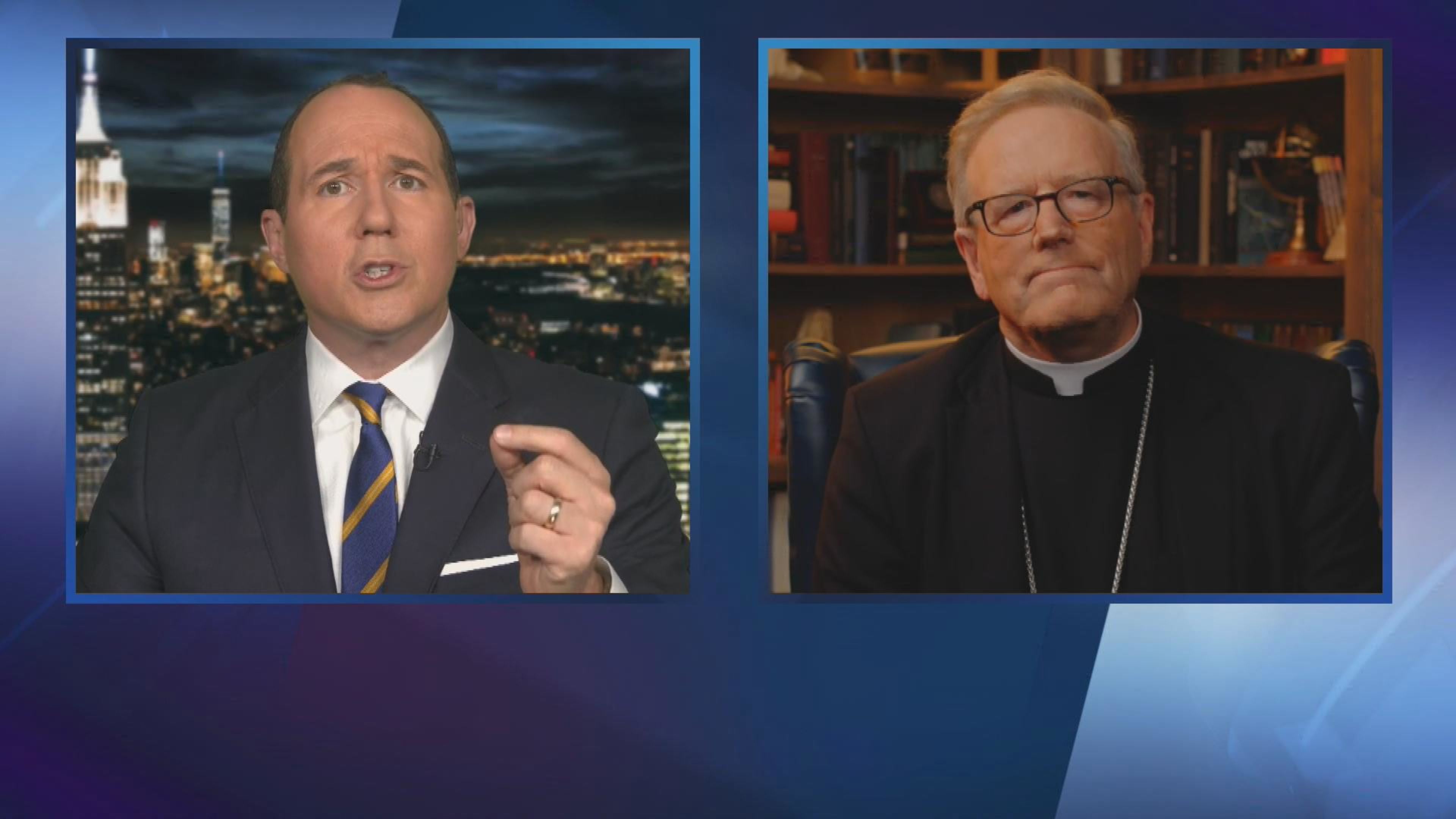
Raymond Arroyo and Bishop Robert Barron discuss several topics in a wide-ranging interview on EWTN’s “The World Over with Raymond Arroyo” on Sept. 17, 2026. | Credit: “The World Over with Raymond Arroyo”/Screenshot
Comparing his role to that of legendary Notre Dame president Father Theodore Hesburgh — who served on numerous presidential commissions across multiple administrations — Barron noted: “If Joe Biden had invited me to be on a commission considering issues of religious liberty, I would have said, ‘Sure!’ … It’s not in any way a compromise or siding with one party.”
Advocating for Jimmy Lai and religious liberty in China
Turning to international affairs, Barron stressed his long-standing advocacy for imprisoned Hong Kong media tycoon and democracy activist Jimmy Lai. While noting he was unsure if his public advocacy influenced his appointment to USCIRF, the bishop made his intentions clear regarding his new watchdog role.
“For years now, I’ve been advocating on behalf of Jimmy Lai. I think it’s outrageous the way he’s been treated,” Barron said. “If Jimmy Lai isn’t brought up in the commission, I would certainly bring him up.”
When asked about the Vatican’s controversial agreement with Beijing regarding the appointment of bishops, Barron hesitated on the specifics of current Vatican diplomacy while pointing to a proven historical model: “I’m a John Paul II man, and the way he dealt with communism, I think, is the right way to deal with it.”
Legacy of Fulton Sheen and resurgence of communism
Looking ahead to the upcoming beatification of Archbishop Fulton Sheen in St. Louis, Barron praised the pioneering Catholic broadcaster as a model for modern evangelists — highlighting both Sheen’s holiness as the “saint of the Holy Hour” and his courage in identifying ideological threats.
Barron noted that Sheen’s bold stance against communism in the mid-20th century carries striking relevance for contemporary culture. “The fact that Sheen took on communism back in the 1940s and ’50s, when he correctly discerned it was threat No. 1 … well, it’s back,” the bishop observed. “It’s back in institutional form in different places around the world, but also in our own country.”
Explaining why Sheen’s critique remains essential today, Barron added: “What he noticed about communism was its deep antipathy toward God, the things of the spirit and the moral order, and he knew this was deeply disruptive to the values of the West. That’s a message that still needs to be heard.”
Modern culture and empathy
Concluding the conversation, Barron reflected on a recent article he penned regarding the limitations of empathy when elevated above all other virtues in public and ecclesial life.
“Empathy is a good thing — to feel with somebody else. … However, there is a hierarchy of values, and empathy is not at the top. At the top of the hierarchy for a Christian has to be love,” Barron explicated, drawing on St. Thomas Aquinas’ definition of love as “willing the good of the other.”
“To love is not to spare the feelings of someone; to love is to will the good of the other. … We don’t say, ‘God is empathy’; we say, ‘God is love.’”
Watch the full interview below:
This story was first published by the National Catholic Register, the sister partner of EWTN News, and has been adapted by EWTN News.
Leave a Reply
You must be logged in to post a comment.