
As Mexico commemorates the 216th anniversary of Mexicoʼs War of Independence, the Mexican Bishops’ Conference (CEM, by its Spanish acronym) acknowledged the nation’s political progress but warned that “open wounds” such as violence, kidnappings, corruption, and inequality persist.
Every year, on the night of Sept. 15, Mexico begins its independence day celebrations by reenacting the “Grito de Dolores” (“Cry of Dolores”). On Sept. 16, 1810, in the town of Dolores, Father Miguel Hidalgo rang the church bells and urged the assembled people to take up arms against the Spanish colonial government.
Mexico’s independence was finally achieved on Sept. 27, 1821, with the entry of Agustín de Iturbide into Mexico City at the head of the Army of the Three Guarantees. The army got its name for its defense of the three “guarantees” of the Plan of Iguala: the Catholic faith as the national religion, independence from Spain, and social and legal equality between between all citizens regardless of ethnic origin.
‘Celebrating independence does not mean turning a blind eye’
In a Sept. 14 statement, the CEM said that in Mexico, “we have made progress in recognizing people’s rights, women’s participation, the strengthening of institutions, solidarity in the face of disasters, and a societal yearning for peace that can no longer be ignored.”
“At the same time, the country continues to bleed from violence, persons inexplicably gone missing, impunity, humiliating inequality, and the forced displacement of entire communities,” the bishops lamented.
For the Catholic Church in Mexico, “celebrating independence does not mean turning a blind eye; it means remembering where we come from so we have the resolve to keep on building.”
In their message, the bishops called on leaders at all levels to ensure “that freedom is not [viewed as] a concession, but is a guarantee; that security and justice cease to be mere promises; and that victims are heard.”
“Furthermore, on the eve of a new election season, we call for public debate to be worthy of the [nation that] sustains it,” they stated, with an eye toward the June 2027 elections, in which the entire federal house of representatives will be elected as well as local officials across Mexico’s 31 states.
The bishops also urged citizens “to love Mexico by acting uprightly every day,” participating politically, fulfilling their personal responsibilities, and “by caring for those who have the least.”
Our Lady of Guadalupe, ‘the heart and soul of our people’
The bishops emphasized that Mexican independence “was born clasping a standard,” noting that “the image of Holy Mary of Guadalupe became the banner of a people realizing that it had become a nation.”
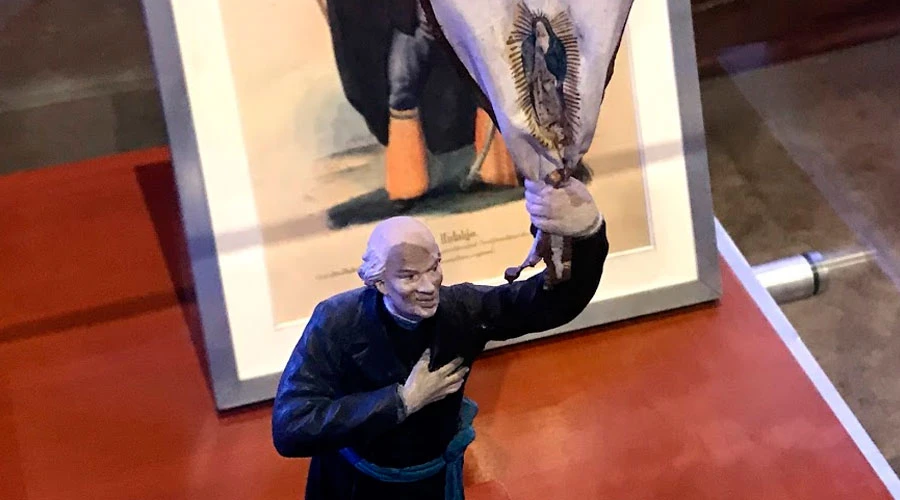
“It was the recognition that this people already had a mother and with her, a common identity capable of uniting the Indigenous person, the person of European descent born in Mexico, and the mestizo in a single home. Even the first president of the republic chose to call himself Guadalupe,” they noted, referring to Guadalupe Victoria, Mexico’s first president.
Originally known as José Miguel Fernández y Félix, the independence fighter adopted that name due to his devotion to Our Lady of Guadalupe and his confidence in the victory of the independence cause, according to the General Archive of the Nation.
“Two centuries later, she continues to be the heart and soul of our people,” the bishops stated, pointing out that Our Lady of Guadalupe “continues to ask for the same thing as she did on Tepeyac: that her sacred little house [chapel] be built in order to show and give all her love, her compassion, her help and her protection to her littlest children, to hear their cries and remedy their sorrows, their miseries, their pain.”
With a view to the upcoming fifth centenary of the apparitions of Our Lady of Guadalupe, which will be celebrated in 2031, the bishops pointed out that “the Intercontinental Guadalupana Novena calls us to make that love an encounter, reconciliation and justice.”
‘Protecting and safeguarding’ freedom of expression and religion
Noting that “independence evokes a decisive word: freedom,” the bishops called for “protecting and safeguarding” two human rights in particular: freedom of expression and religion.
The former, they pointed out, “requires media representing various viewpoints, the personal safety of journalists, and a public debate that does not dismiss those who think differently,” while religious freedom “is not limited to worship within a temple but encompasses the right to believe, to educate in accordance with one’s own convictions, to associate, to serve, and to contribute publicly to the common good.”
“This national anniversary finds us amid the centennial remembrance of the Religious Conflict (the Cristero War). We recall it during these celebrations because it was a fratricidal conflict between brothers who shared the same faith, heart, and culture, and because its lesson is urgent: When freedom of conscience is restricted, the entire nation suffers.”
This remembrance, they affirmed, “calls upon us to always call for religious freedom to be fully recognized and exercised as a fundamental human right — for Catholics and for all religious denominations in our country.”
‘The Church is not a guest in Mexico’
The Mexican Bishops’ Conference further emphasized that “the Church is not a guest in Mexico: It has been part of the country’s fabric since before the state even existed.”
The Church in the country, the bishops noted, established and “sustained the first schools, hospitals, and shelters; it educated many of those who envisioned what the nation would be; and it has never ceased to be present where the suffering is greatest.”
“Today, that presence has concrete names: Caritas and its thousands of volunteers in every emergency; schools, universities, and educational foundations; migrant centers, soup kitchens, clinics, and shelters for women and children; human rights advocacy centers; support for victims and their families; the rebuilding of the social fabric; and constant work for peace,” the CEM stated.
The bishops noted that “the social fabric, freedom, and peace in Mexico are also sustained by the quiet, effective work of believers.”
“As the Church, we offer who we are: open communities, hands ready to serve, a voice to speak out without hatred, and the ability to build bridges where others erect walls,” they affirmed.
This story was first published by ACI Prensa, the Spanish-language sister service of EWTN News. It has been translated and adapted by EWTN News English.