
Paul Tuns:
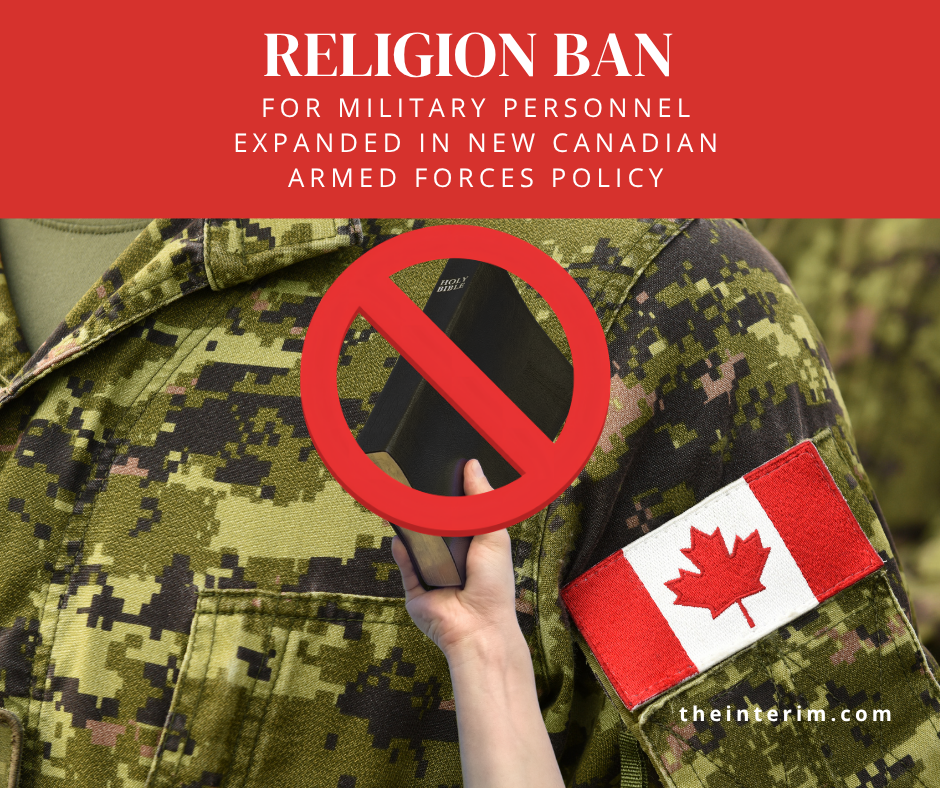
On July 29, Military Personnel Command issued a new directive expanding restrictions on faith-specific language and practices at official military ceremonies. The new rules require all members of the Canadian Armed Forces (CAF) and all employees and contractors of the Department of National Defence (DND) who speak at public events to eschew any talk of God when they offer spiritual reflections.
In 2023, the CAF enacted a policy restricting military chaplains from mentioning God, requiring them to adhere to “a sensitive and inclusive approach” during all public ceremonies. It required chaplains to offer a reflection rather than a prayer and banned the use of terms such as God and Heavenly Father lest they offend non-believers.
The new policy, Instruction 03/26, expands the policy beyond the chaplaincy and clarifies what is and is not permitted during graduation parades, change-of-command ceremonies, honours and awards ceremonies, and all other official military commemorations including Remembrance Day ceremonies.
The new policy states that chaplains and all others taking part in official ceremonies are prohibited from offering prayers but may instead deliver a spiritual reflection, defined as “lessons learned, beliefs, values, and experiences to inspire gratitude, remembrance, hope, and integrity.” No specific faith traditions may be referenced during public comments.
Instruction 03/26 also sets out the exceptions for when overtly religious and spiritual language is permitted, including for military or state funerals or during private interactions with CAF members.
Another exception is for indigenous practices when utilized for “cultural, historical, and educational purposes,” although the directive states that attendees at ceremonies in which indigenous spirituality is allowed should not be forced to take part in any indigenous practice with which they might feel uncomfortable.
The new directive says that the CAF is aiming for neutrality: “The CAF must uphold and respect the Charter rights of our members and members of the public by maintaining religious and spiritual neutrality in the exercise of our public duties.”
DND spokesperson Major Soomin Kim said the new directive is meant “to better respond to the moral and spiritual needs of all members.”
One military chaplain spoke anonymously with the Epoch Times, saying the policy is a “new attack” that seeks to “exhaust us into compliance.” He said the new policy requires chaplains to “adopt secularism as the official religion of the CAF.”
Conservative MP and shadow minister for national defence James Bezan, said the new rules violate CAF members’ Charter rights. “Conservatives are deeply concerned about this Liberal government’s continued interference in the traditions, values, and personal freedoms that have defined the Canadian Armed Forces,” he said in a statement.
The Evangelical Fellowship of Canada (EFC) said it was “deeply concerned” that the policy “forbids military chaplains from not only not praying, but from using words, actions or symbols tied to a specific religious or faith tradition or making any reference to God or the divine in public spiritual reflections.”
Bruce Clemenger, president emeritus of the EFC and a member of the Interfaith Committee for Canadian Military Chaplaincy, said, “This exclusion restricts the spiritual reflection of chaplains to a secularist and characteristically humanist expression.”
The Roman Catholic Military Ordinariate of Canada, Bishop Scott McCaig, who oversees Catholic ministry in the CAF, condemned the new policy. “There is no such thing as reflections on meaning, purpose, and spiritual well-being without philosophical and religious presuppositions. It is not the place of the government to adjudicate between them. That is the opposite of state neutrality,” he said.
Both the EFC and Canadian Catholic Conference of Catholic Bishops have requested that the government reconsider the policy. The EFC asked “for a chaplaincy policy that recognizes and makes room for all in the expression of belief in spiritual reflections, a principled accommodation of the diverse beliefs of Canadians, including those who believe in God.”
Leave a Reply
You must be logged in to post a comment.