
Paul Tuns:
On July 5, Canadian Catholic News (CCN) carried a story by Terry O’Neill exposing an internal report that found thousands of errors in reporting British Columbia Medical Assistance in Dying cases and more than 350 cases of that required education of health care professionals about MAiD’s legal requirements.
Through a freedom of information request, CCN obtained B.C. Ministry of Health’s “Medical Assistance in Dying (MAiD) Oversight 2024 Year End Report,” published by the MAiD Oversight Unit within the ministry.
The Oversight Unit reviews the paperwork on every case of euthanasia requested in B.C., whether or not the patient followed through with being medically killed. All documentation submitted by doctors and nurse practitioners who partake in a euthanasia request and pharmacists who dispense the lethal cocktail of drugs is reviewed for compliance criteria to ensure federal regulations and regulatory college practice standards are adhered to.
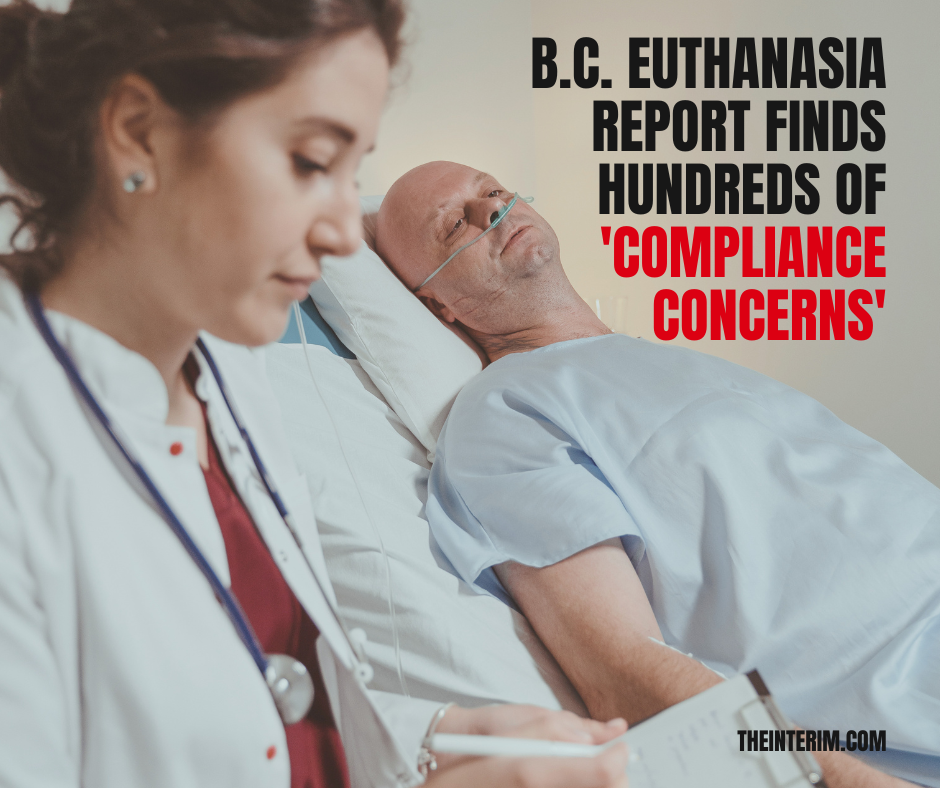
The report revealed that more than half of euthanasia cases in the province (50.9 per cent of 4160 euthanasia requests) were found to have reporting errors requiring government follow-up. Follow-up included obtaining missing information or clarifying existing information. In total there were 2807 errors, meaning some files had multiple errors. According to the National Post most of the missing information was classified as “non-critical” but reportable.
The report stated that among those errors, 353 cases raised compliance concerns that rose to the level of requiring education of physicians, nurses, and pharmacists “to ensure they understand legal requirements and the professional standards associated with MAiD.” The Ministry of Health says that “such education is intended to support practice improvement,” not punish health care professionals that are not complying with the law.
The most common compliance issue was “not reviewing the relationship between the patient and witness on the patient’s written form.” The Unit’s report, which is meant to remain confidential, said “only 0.2 per cent of reported MAiD cases (since 2018) involve serious compliance concerns which may have a significant impact on the integrity of the MAiD process, appropriateness of care, and/or public safety.”
Analyzing the errors listed in the report, Alex Schadenberg, executive director of the Euthanasia Prevention Coalition, found 22.7 per cent of MAiD outcome forms had eligibility criteria errors, 14.9 per cent of prescriber forms had errors in safeguards (assessments), and 10.9 per cent of requests had missing forms, among other errors.
Since 2018, 17,304 people have died by euthanasia in B.C., which means that 0.2 per cent of deaths suggest that 34 patients have possibly been killed in violation of federal safeguards and other restrictions.
When a compliance issue occurs, the Unit determines whether there should be any action taken against medical professionals, including advising educational classes about MAiD, reporting to regulatory and professional bodies, and making referrals to police.
The Ministry of Health does not report whether doctors or other professionals are referred to police or regulatory bodies if they do not comply with federal regulations or professional standards.
B.C. Catholic has reported that there has been no public record of disciplinary action taken by the B.C. College of Nurses and Midwives, the College of Pharmacists of B.C., or College of Physicians and Surgeons against a member related to MAiD. It also reported there have been only two referrals to the police to investigate since euthanasia was legalized in 2016 but there are no records in B.C. of police charging a doctor or other health care practitioner for violating eligibility rules in killing patients by euthanasia.
CCN reported that in Nova Scotia, there have only been three MAiD-related complaints referred to the college of physicians in that province since 2016 and all involved cases in which doctors conscientiously objected to euthanasia. Schadenberg said he only knows of one case in Ontario in which a physician has been reported to the police.
Dr. Ramona Coelho, a family physician, senior follow at the Macdonald-Laurier Institute, and former member of the Ontario Coroner’s MAiD Death Review Committee, responded to the CCN report calling for greater oversight with real teeth of Canada’s euthanasia regime. She said a national oversight body with investigative and disciplinary authority should be established and ideally it should oversee euthanasia requests as they are made and have the power to halt a MAiD death if a family member raises concerns. “There should be an independent review before the death rather than a paperwork review afterward.”
The 2025 B.C. report covering 2024 was not an outlier, with O’Neill reporting “the 2024 findings closely mirror those from 2023,” when there were 2833 errors in 3808 MAiD cases. O’Neill wrote, “These findings suggest that concerns identified in 2023 persisted in 2024.”
Schadenberg said, “It’s all very shocking that you have such a large amount and percentage of errors in British Columbia,” adding, “It’s clear there are huge problems.”
Amanda Achtman, ethics director of Canadian Physicians for Life and founder of the anti-euthanasia Dying to Meet You, said the report’s revelations of “the staggering level of errors surrounding the practice of euthanasia in Canada betrays a level of indifference and callousness toward Canadian patients at end of life.”
Conservative Party of B.C. health critic Dr. Anna Kindy said the report illustrates the need for better and public oversight. “Will B.C. commit to public annual reporting, not just of MAiD volume but of compliance concerns, referrals … [MAiD] trends, and recommendations for system improvement?” Kindy asked the province’s Health Minister, Josie Osborne, in the legislature earlier this year. She told CCN that “this is all about protecting vulnerable British Columbians.”
Irregularities in MAiD occur with some regularity. The Interim reports in this edition about an Ontario woman who was euthanized despite lacking the cognitive ability to consent and expressing her desire to continue living. In April, B.C. Catholic reported that a Catholic priest was asked twice whether he wanted to be euthanized while recovering from hip surgery despite his strong opposition to the practice.
Leave a Reply
You must be logged in to post a comment.