
Pope John Paul II reaffirmed traditional Catholic moral teaching in his 1993 encyclical Veritatis Splendor. In particular, he rejected consequentialism and its close cousin, proportionalism, as incompatible with orthodox Catholic morality. It is worthwhile to consider the consequences of sin, but circumstances and intention can never justify an intrinsically evil act.
In one of the most intellectually seductive comments in the Bible, the High Priest Caiaphas famously said, “Better that one man should die than a whole Jewish nation.” The Roman occupiers were brutal enough. Caiaphas knew the Romans viewed the Judeans as a powder keg. Do the math. Why not eliminate one man for the sake of the entire nation? Caiaphas’s argument exemplifies the consequentialist temptation: sacrificing an innocent person for an anticipated greater good.
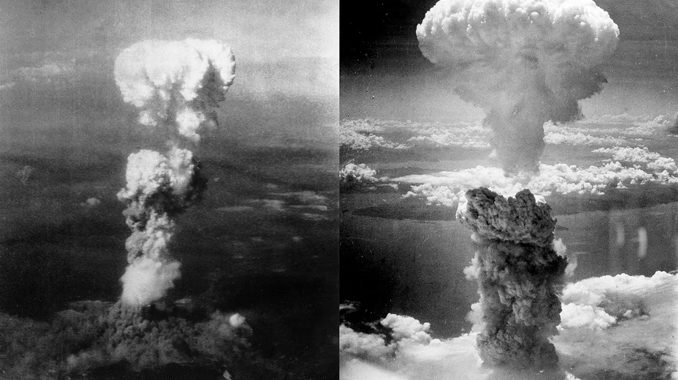
Many defenses of the large-scale bombing of population centers during World War II appeal to consequentialist reasoning: the destruction of civilians, it is often argued, was justified by the greater good of ending the war. Japan announced its surrender on August 15, 1945, the feast of the Assumption. Yet the bombings also produced devastating immediate and long-term human consequences.
Osama bin Laden explicitly invoked Hiroshima and Nagasaki to justify his retaliatory terrorist violence. The late Senator Lindsey Graham appealed to the same history in defending Israel’s conduct in Gaza. In a February 2026 interview with Sky News Arabia’s Hadley Gamble, Graham said, “Just flatten it. We flattened Berlin. We flattened Tokyo,” and defended the atomic bombing of Japan by asking, “Were we wrong to drop an atomic bomb to end the Japanese reign of terror?” He added that, if he were Israel, he “would have probably done it the same way.”
Some Catholics make the same consequentialist argument. Here is a comment from a Catholic website in response to an article that opined that the atomic bombings were intrinsically evil violations of Catholic just war teaching:
You seem to be unaware of the very extensive recent scholarship that has established beyond a reasonable doubt that the Japanese government was NOT ready to surrender before the second bomb was dropped on Nagasaki. The bombs were decisive, not superfluous. And in Japanese-held areas, half a million people, mostly non-white Asians, were dying every month the war went on, from starvation, disease, and brutality. Your moral arithmetic must account for those numbers.
“Moral arithmetic” becomes consequentialist when the calculation of consequences is used to justify an intrinsically evil act. Catholic teaching unequivocally condemns any act of war aimed indiscriminately at the destruction of entire cities or extensive areas together with their populations (cf. Vatican II, Gaudium et Spes, n. 80). The moral question concerning Hiroshima and Nagasaki is whether those attacks should be understood as falling under that prohibition.
No calculation of consequences can render an intrinsically evil act morally acceptable. We may disagree about historical facts or their application, but we should at least be honest about the moral framework we are using. Understanding the principles that guide our judgments is necessary for genuine moral dialogue. A defender of the bombings might object that this is not consequentialism at all.
The question then becomes whether the attacks were directed at legitimate military objectives, whether civilian deaths were proportionate and unintended, and whether the attacks fell within the Church’s condemnation of indiscriminate destruction. If an act is intrinsically evil by reason of its object, however, anticipated favorable consequences cannot make it permissible.
In May 1945, President Truman formed an Interim Committee to advise on the use of nuclear energy and weapons. The Committee’s conclusion: “We can propose no technical demonstration likely to bring an end to the war. We can see no acceptable alternative to direct military use.”
The day after Hiroshima, Senator Richard B. Russell urged Truman to use as many atomic bombs as possible, saying Americans believed Japan should be struck until brought “groveling to their knees.” Truman responded:
I know that Japan is a terribly cruel and uncivilized nation in warfare, but I can’t bring myself to believe that because they are beasts, we should ourselves act in that same manner. For myself, I certainly regret the necessity of wiping out whole populations because of the ‘pigheadedness’ of the leaders of a nation, and, for your information, I am not going to do it unless absolutely necessary.
On August 9, the day Nagasaki was bombed, Truman received a telegram from Samuel McCrea Cavert, a Protestant [not Catholic!] clergyman, pleading that he stop further atomic devastation. Two days later, Truman replied, “When you have to deal with a beast, you have to treat him as a beast.” The two bombs took the lives of more than 200,000 people by the end of 1945, many of them civilians, including women and children.
Beasts?
We cannot settle questions of war and peace merely by adding up the lives saved and the lives lost. Catholic moral reasoning begins with a simple principle: do good and avoid evil. Consequences matter, but they cannot make an intrinsically evil act good. Catholic martyrs are saints because they refused to commit evil even when circumstances and consequences seemed to demand it.
John Henry Newman, in Apologia Pro Vita Sua, defended the Catholic Church’s teaching about sin:
The Catholic Church holds it better for the sun and moon to drop from heaven, for the earth to fail, and for all the many millions on it to die of starvation in extremest agony, as far as temporal affliction goes, than that one soul, I will not say, should be lost, but should commit one single venial sin, should tell one wilful untruth, or should steal one poor farthing without excuse.
Sin—including Original Sin—is ultimately the source of human suffering.
We cannot expect those committed to consequentialist reasoning to abandon the mathematics of their morality. But we should expect honesty as we identify our guiding moral systems.
“For what shall it profit a man, if he gain the whole world, and suffer the loss of his soul?” (Mk 8:36)
If you value the news and views Catholic World Report provides, please consider donating to support our efforts. Your contribution will help us continue to make CWR available to all readers worldwide for free, without a subscription. Thank you for your generosity!
Click here for more information on donating to CWR. Click here to sign up for our newsletter.
Leave a Reply
You must be logged in to post a comment.