
One scandal of the COVID era was the alliance between government and some social media platforms to suppress doubt and dissent about the regime—especially compulsory vaccinations—to control the pandemic.
A casualty has been the erosion of trust in what “experts” declare in the name of “public health.” Lack of trust is one reason behind the current battle in the United States Senate over whether to hold Dr. Anthony Fauci in contempt for invoking the Fifth Amendment and failing to answer a Senate committee’s questions about his COVID decision-making.
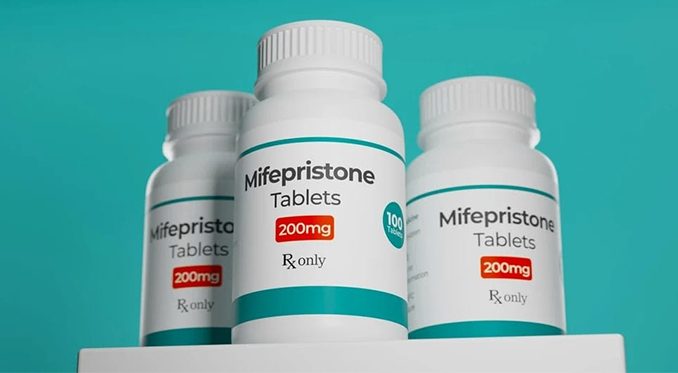
Which makes one ask about the investigation and debate about another public question about public health: the public health impact of widespread use of mifepristone and misoprostol, the “abortion pills.”
Mifepristone and misoprostol essentially act by the manipulation of a woman’s hormonal levels to prevent a fertilized ovum from implanting in his mother’s uterus, being able to acquire nutrition, and developing. One might characterize the “abortion pill” (a misnomer, since there are two) as do-it-yourself miscarriages.
Most chemically induced abortions occur at home. An abortionist prescribes the drugs (sometimes after only having remotely examined his “patient” by an online platform from another state) and sends the woman home. She typically expels the developing embryo (and a lot of blood) into her toilet.
The hormones and other chemical agents in the mifepristone do not dissipate in a woman’s body. They are excreted into the toilet, i.e., eventually into the public sewer system. And that’s where a public health issue arises.
In June, 14 state attorneys general, led by Missouri AG Catherine Hanaway, asked the Food and Drug Administration to study the effect of growing hormonal discharges into public water systems. The attorneys general voiced concern about seepage and the effects of elevated levels of hormones in the ambient environment, especially regarding other pregnant women not intent on aborting their children or the physiological development of young people entering puberty.
Abortionists, who seek to minimize the dangers DIY chemical abortions pose, dismiss these claims as “unproven.” It’s hard to prove something you don’t want to study: vincible ignorance is bliss, if dishonest. They would like to write off such objections as just another “TRAP” (targeted restriction of abortion providers) that lacks a “scientific” basis.
The lessons of COVID should make us skeptical, if not agnostic, about nearly everything claimed in the name of “science.”
Once upon a time, no doubt, smoking was also characterized as a “matter of choice.” Smoke if you want to; do not smoke if you do not. But scientific research began suggesting that no man is an island, immune from another’s smoke pollution. That is why concern about exposure to “secondary smoke” has largely resulted in smoke-free public places where once smoking was tolerated, in restaurants, meeting rooms, and even airplanes. The idea of private “choice” has been tempered by accounting for the communal impact such chosen behavior has.
Pro-life groups have showcased studies suggesting that growing amounts of abortion-related chemicals are being found in urban water systems. The response of media and “public health” gatekeepers has not been to investigate claims but to denounce them. This was the modus operandi a decade ago, when David Daleiden came up against California authorities more interested in protecting Planned Parenthood than investigating whether the abortion giant was profiting from post-abortion sales of body parts.
Attacks also often take the form of criticizing the messenger. Well, assuming that the idea that life begins at fertilization and life should be protected–some basic postulates of biology and ethics—then is the fault the voices crying in the publishing wilderness that bring these stories to the public? Or is it the fault of the “gatekeepers” such as academic presses like California and Rutgers that have maintained a steady drumbeat for “reproductive rights” since Dobbs was handed down?
And, in the name of a robust exchange of views, are we to say it’s just a matter of “academic freedom” when a venerable publisher like Oxford puts out a philosopher’s musings that human extinction would actually be a good thing—if we could only find a way around the pesky ethical issue of how to bring that about?
There are two separate but related issues here: the broader impact on the common good from the proliferation of chemical abortion agents, whose spread is essential to the abortion industry’s circumvention of post-Dobbs state regulation, and the larger question of whether Americans trust the public health “authorities” that increasingly seem to have their own, sanitized through invoking the name of “science.”
Of the former, Americans have a right to know whether a “woman’s private choice” is affecting other pregnant women and sexually developing young people. On the latter, they have a right to know what is being smuggled in under the rubric of “public health.”
I close with a story I wrote about a year ago. Two Michigan bioterrorists “bioethicists,” publishing in a prestigious journal, advocated for intentionally making people sick through bioengineering ticks to carry Alpha-Gal Syndrome. Persons infected with AG Syndrome through tick bites become allergic to eating red meat, which the authors argue has a “public health” benefit by reducing beef demand, resulting in fewer cows heating the planet.
When ideological agendas are infiltrated in the name of what should objectively be “public health,” is it any wonder why so many “experts” might want to take the Fifth?
If you value the news and views Catholic World Report provides, please consider donating to support our efforts. Your contribution will help us continue to make CWR available to all readers worldwide for free, without a subscription. Thank you for your generosity!
Click here for more information on donating to CWR. Click here to sign up for our newsletter.
Leave a Reply
You must be logged in to post a comment.