
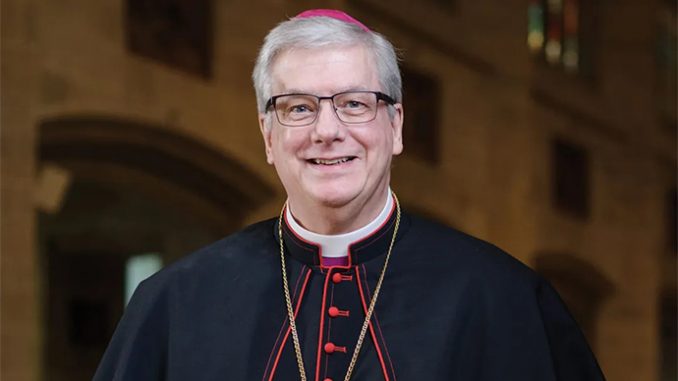
Eleventh Bishop of La Crosse, WI. (Image: Diocese of La Crosse / diolc.org)
Bishop Gerard W. Battersby, 66, has served as bishop of the Diocese of La Crosse, Wisconsin, since 2024. He grew up in Detroit, Michigan.
He and his brother, Chris, are twins and were the youngest of nine children in a devout Catholic family. He entered the seminary for the Archdiocese of Detroit and was ordained a priest in 1998. He served in a variety of parishes as well as assisting with seminarian formation at Sacred Heart Major Seminary in Detroit. He was ordained an auxiliary bishop for Detroit in 2016.
La Crosse consists of 19 counties in west central Wisconsin and has 135,000 Catholics. It has 114 active priests who serve at 183 parish sites.
Bishop Battersby recently spoke with CWR.
CWR: The Catholic Faith was an important part of your life as you were growing up…
Bishop Gerard Battersby: Yes, we were heavily involved in the parish, St. Benedict in Highland Park. It and the parish school were the center of our lives. It had a grade school and high school, and many active sports programs.
CWR: What was your upbringing and childhood like?
Bishop Battersby: My father was a salesman for a cigarette company who started a real estate appraisal business. In addition to nine children, our grandparents lived with us.
The Catholic Faith was very important. We said the Rosary and the seven sorrows of Mary; Catholic devotions were at the center of our lives. My grandparents attended daily Mass. My uncle, Fr. Edmund Battersby, was a priest for the Archdiocese of Detroit and was a frequent visitor to our home.
While I’m reluctant to describe ourselves as “devout” Catholics—President Joe Biden described himself as a devout Catholic, so using that term makes me nervous—but I’d say we were ardent, practicing Catholics.
CWR: Your priest-uncle was a good role model for you.
Bishop Battersby: Yes, in fact, I’d say he was a hero of mine.
CWR: You entered seminary at age 33. What did you do before that?
Bishop Battersby: I took over my father’s appraisal business and appraised residential and commercial real estate. But all the while I was working in the secular world, the Lord was knocking on my door.
I refused to answer for many years, but eventually I couldn’t pretend that he wasn’t asking me the question about entering the seminary. I had to find out. His patience and persistence led me to become a seminarian in 1993.
CWR: You were a pastor and auxiliary bishop in Detroit beginning in 1998. The city has developed a reputation for having much crime. In your neighborhood of Highland Park, for example, two-thirds of the city streetlights were turned off because the city couldn’t afford the cost of the electricity. Many have fled the city. Yet you have spoken fondly about your time in Detroit. Why does Detroit have the negative reputation it has?
Bishop Battersby: What I don’t think people understand is that 864,000 manufacturing jobs were lost there in a single decade. This was devastating to families and the community as a whole.
When I was born in 1960, Detroit was a flourishing city with one of the highest per capita incomes in the U.S. A big part of the decline since then has been the collapsing industrial base. The auto industry declined, and there was not enough diversification of business to take its place. Detroit once had a huge. skilled labor force, but no longer.
Also, the riots of 1967 had a devastating effect on the city. Parts of Highland Park were never rebuilt. And there was a large influx of organized crime and the illegal drug trade into the city. When I was a child, Highland Park was a bedroom community of the city, and some who lived there were upper/middle class. It was safe for me, as a boy, to ride the bus downtown to go to the library. But that changed in the late 1960s into the early 1970s.
Regardless of the city’s difficulties, I like to quote what the Psalmist said of Jerusalem: “I love her very stones.” (Psa 102:15) I love its people, and I love its diversity. I would also note that other major cities have similar problems … but Detroit seems to get the negative reputation. Detroit is a tragic story, but it has the ability to remake itself. I’m optimistic it will turn things around.
CWR: You were involved in seminarian formation. What qualities must a man have to make a good priest?
Bishop Battersby: The fundamental virtues that a good father and family man must have are the same virtues required to make a good priest.
A good father creates a space so that his family can thrive. It begins by being present—I’ve come to believe that merely showing up is 80% of what a man must do to be a good father!—and includes being a protector and teacher to his family. A good father should teach his children to honor and love their mother, and he teaches them how a man should act. I think you can see how these virtues can be adapted to the priest working in a parish.
Also, it is important for a seminarian and future priest to make his faith in Christ central to his life. Our identity as Christians must be in Christ, and as beloved sons and daughters of Our Lord. His mission in life must be to share this identity in Christ with others. It has to be at the heart of what encourages a man to consider a vocation.
We must remember that a vocation isn’t a choice. It is a listening that results in hearing a call. The initiative is with the Lord. If it is with the individual, it won’t sustain him long.
CWR: How is the Diocese of La Crosse doing for vocations to the priesthood and religious life?
Bishop Battersby: We’ve come out of a lull, which I attribute to prayer, a putting of our focus back on Christ, and a re-emphasis that our purpose is to go to heaven and bring as many people with us as we can.
Not long ago, we had eight seminarians; today we have 17. While we certainly like the bigger number, I have stressed to our vocations director the importance of quality over quantity. St. Thomas Aquinas tells us that grace builds on nature. We’re looking for good, healthy, normal human beings looking to commit their lives to Christ in the priesthood. And, I’m delighted to report that after having interviewed all 17, that looks like what we have.
I’m convinced that the Lord is doing something wonderful across the U.S. I think we’re poised for an amazing time in the Church. The Old Age has to pass, like with Detroit, as we head into a bright future. I’m delighted. It gives me hope.
CWR: What are you doing to promote vocations?
Bishop Battersby: Our focus has been on renewal of the priesthood. I tell my priests that if your shadow, like St. Peter’s [Acts 5:15], doesn’t heal, you have to work on your holiness. We must beg the Lord, the Master, to make us holy as He is holy. If Jesus is Lord, then it is madness not to follow Him.
And, following him in a lukewarm manner is not enough. Remember what we read in Revelation: “So, because you are lukewarm, neither hot nor cold, I will spit you out of my mouth.” (Rev. 3:16) So, I focus on our priests; when our young men in discernment see [them] in action, we want them to be inspired to think the priesthood is something worthy to which to devote their lives.
I should also add that we need holy women, too, who want to live their lives for Christ. I’m in the process of starting a new religious order for young women, the Adelines. They are named for Adele Brise (1831-1896) [Note: An immigrant from Belgium to Wisconsin, Adele reported that the Blessed Mother appeared to her in 1859. The site of the apparition is today the National Shrine of Our Lady of Champion, Wisconsin, the first and only approved Marian apparition site in the United States.]
We have a young woman in place who will serve as prioress. She is a well-balanced person, experienced and in love with the Lord. We will beg God for His assistance, and hope to see these young women set La Crosse on fire with His love.
CWR: What is their charism?
Bishop Battersby: They will be engaged in contemplation and aiding families. Some will serve as teachers and will assist in homes in various ways.
CWR: A Chesterton Academy is opening in the diocese in 2027. How is the state of Catholic schools in the diocese?
Bishop Battersby: Eighty percent of the dollars we spend on evangelism in the diocese go to Catholic education. Some is well spent, although in some areas we need to go further in developing our Catholic identity. One of my priorities is to encourage growth in our Catholic schools.
CWR: What major construction projects do you have occurring in the diocese?
Bishop Battersby: One of our biggest projects right now is repairs to our chancery office. We had a water pipe burst about a month ago which caused major damage. It damaged multiple floors; we’re rising from the ashes, though.
CWR: What national issues particularly concern you?
Bishop Battersby: One of my greatest concerns is that we, as a society, seem to have trouble agreeing on what the truth is. When we can’t arrive at a common understanding of truth, we start with a shaky foundation, and that’s hard on which to build a community. So, that’s a general concern.
I also think we have an inadequate immigration policy. Both sides of the aisle have been intentional in their neglect of the immigration system. It has been a political ball, which is hit back and forth. I would add that we’ve seen that unfettered immigration is not good for society at all.
Another tremendous concern I have is the moral collapse of the family. So many of our families are unstable and end in divorce, and the family is the building block of society.
CWR: In 2025, the Wisconsin Supreme Court decided 4-3 that an 1849 anti-abortion law no longer bans abortion in the state. You issued an objection to that ruling.
Bishop Battersby: I’m not trying to be inflammatory when I say this, but we’re killing children. Abortion is not a woman’s right; it is a terrible evil and should be a concern for all of society. That evil has consequences for the life of nations. Countries are not able to maintain their own populations because of the tragedy of abortion.
Do we have the power of life or death? God gives us the opportunity to share in creation, but does he give us the power of life or death? The slaughter of innocents is something with which we all should be concerned.
CWR: Who are some Catholics you particularly admire?
Bishop Battersby: I admire the Catholics who are ordinary people, like my parents and grandparents. My family is originally from Northern Ireland. My ancestors couldn’t walk to school because they were Catholics living in a hostile society. It was a price ordinary people paid, and they exhibited a heroism that goes unheralded.
I also admire the many fine priests and sisters I’ve known. My uncle Ed, the priest I previously mentioned, had a great love of the poor and the underdog. He, for example, fought mightily for the rights of the Amish to educate their children. He received the wrath of Governor George Romney for his advocacy. Two of my grandfather’s cousins were sisters who founded Hotel Dieu, a hospital for the poor, in Windsor, Ontario.
These are the types of Catholics I find inspiring. They are disciples of the Master, and their love for Him motivates what they do.
CWR: What is a basic spiritual program you’d recommend to the average Catholic?
Bishop Battersby: There are many ordinary practices that the Church recommends that can produce extraordinary saints. These include regular celebration of the sacraments and devotion to the Mass and Christ’s presence in the Eucharist.
We must also remember that God gives us many amazing intercessors in the Blessed Virgin Mary, the saints, and the good angels. Seek their help in walking the path of holiness; they once walked the same path in life that we do today. Keep your eyes fixed on Jesus. I ask our Blessed Lady every day: help me love Jesus as you do. I don’t, but I want to.
A normal Catholic life is the path to holiness.
CWR: Any other thoughts?
Bishop Battersby: We need to live out our identity as sons and daughters of our beloved Father. Christ has given us a share in His mission. Know who you are, how you are called to live, and live in hope. Live the joy that comes from being a companion of Christ.
If you value the news and views Catholic World Report provides, please consider donating to support our efforts. Your contribution will help us continue to make CWR available to all readers worldwide for free, without a subscription. Thank you for your generosity!
Click here for more information on donating to CWR. Click here to sign up for our newsletter.
Leave a Reply
You must be logged in to post a comment.