
Southern California. I recently returned for my first visit there in nearly twenty years. Why do I love the West Coast? Let me count the ways. Sweeping vistas, energized pop culture, and the sense of endless possibility. It’s all there.
On this trip, I caught up with old friends, hit Laguna Beach, attended a Joshua Slone concert at the Wiltern Theatre, toured the newly renovated San Diego Mormon Temple, and wandered Disneyland from rope drop until my feet gave out.
But the first 24 hours included an unexpectedly gray moment.
My hotel stood just a block from St. Basil Catholic Church, so on my first morning, I carried my coffee over for a look. The timing could hardly have been more striking. On the eve of the Vatican’s anticipated rebuke of the SSPX, I found myself slowly walking around one of Los Angeles’ most recognizable Catholic churches while the internet filled with one of Christianity’s oldest words: excommunication.
The online conversation was medieval. My surroundings could hardly have been more twentieth-century.
Yet whatever message the architecture had once intended, the first message it communicated that morning was simple: the doors were locked.
The sign outside was buckled and faded. The landscaping looked neglected. A few homeless people lingered nearby. The whole place projected an unmistakable air of withdrawal. The parish website showed that Mass was being celebrated on schedule. Standing on the sidewalk that morning, however, I would never have known it. Whether that impression was fair hardly mattered. It was the impression the building gave. It was a dispiriting way to start the day.
Curious about what I was seeing, I pulled out my phone and asked my friend ChatGPT a few simple questions about the parish.
Its responses… well, you’ll see.
The fascinating part wasn’t simply the information it provided. It was how little it took to get there. I hadn’t written a carefully engineered prompt or tried to steer the conversation toward some predetermined conclusion. I asked a couple of straightforward questions, pushed back once or twice, and uploaded a handful of photographs. That was it.
Yet within minutes, ChatGPT had not only explained the history of St. Basil, but began connecting the architecture, the neglected sign, the locked precincts, and the larger question of urban architecture. I began thinking, Yes… that’s exactly what I am seeing.
I shouldn’t have been surprised that ChatGPT knew the history of St. Basil. A good architectural guide or Wikipedia could have supplied most of those facts. What arrested me was that, as I challenged its assumptions with photographs, it reconsidered its own conclusions. The conversation became less like using a search engine and more like taking a thoughtful walk around a churchyard with a perceptive guide.
Despite all the recent discussion surrounding Magnifica Humanitas and the promise—and peril—of artificial intelligence, I found AI’s observations more perceptive and, frankly, more prescient than much of what I have read lately coming from Rome.
Whether every conclusion was correct seemed almost beside the point. What impressed me was how quickly it reasoned from the evidence in front of it. The history, the architecture, and my phone-snapped photographs all converged into a single conversation.
Out of the mouths of chatbots. Or something like that.
I offer the following exchange largely as it happened. My comments appear in bold. Everything else, until noted otherwise, is ChatGPT’s responses, lightly edited only for length.
* * *
“What is the story of the Saint Basil Church in Koreatown in LA? It looks practically abandoned… Everything on the exterior says disrepair, despite the online mass times all the doors are locked.”
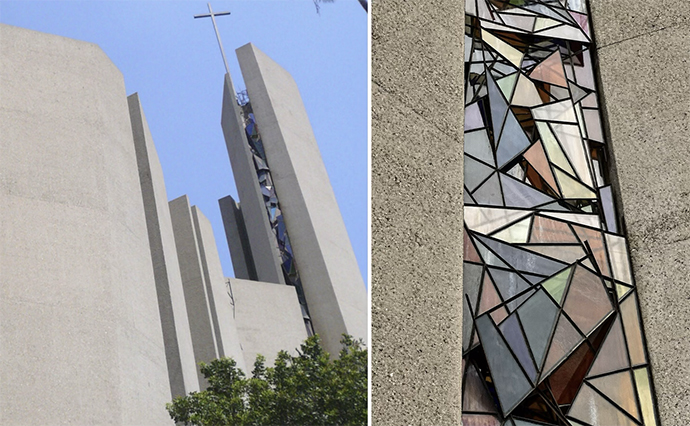
You weren’t imagining it. St. Basil Catholic Church has a somewhat forbidding appearance, and in many ways that’s exactly what its architects intended.
The church was completed in 1969 and designed by A. C. Martin & Associates as a striking example of Brutalist architecture. Rather than looking like a traditional Gothic or Spanish mission church, it was deliberately conceived to resemble an early Christian fortress or monastery—a place of refuge with thick, rough concrete walls and narrow openings. The dramatic stained-glass windows, like the one you photographed, were created by sculptor Claire Falkenstein and are considered among her finest works.
As for the feeling that it’s abandoned:
The rough, weathered concrete is largely intentional. Bush-hammered concrete exposes the aggregate and develops a worn patina over time. Unlike polished stone, it often looks older than it actually is.
Many large urban churches in Los Angeles keep their main exterior doors locked except immediately before Mass or scheduled events. Security has become a significant concern, especially along Wilshire Boulevard. The parish is still active, with Masses offered daily in English, Korean, and Spanish.
The church doesn’t have much of a front plaza or welcoming threshold. It was designed to feel almost defensive from the street, with the experience unfolding only once you’re inside.
The irony is that the interior is almost the opposite of the exterior. The sanctuary is filled with softly colored light from Falkenstein’s sculptural stained glass, warm wood, and a surprisingly contemplative atmosphere. Most architecture historians regard it as one of Los Angeles’ great modern sacred spaces despite its austere exterior.
It also carries an important piece of Los Angeles history. Almost immediately after it opened, the church became the site of the famous 1969 Christmas Eve protests by Católicos por La Raza. Demonstrators objected to spending roughly $3 million on such a monumental church while many Latino Catholics lived in poverty. Those protests became a landmark moment in the Chicano movement and helped reshape the relationship between the Archdiocese and its Latino faithful.
One thing caught my eye immediately: the stained-glass detail you photographed is excellent [ChatGPT so flatters me!]. Once you know it’s Claire Falkenstein’s work, those angular iron-and-glass compositions become the real stars of the building. They aren’t just windows—they’re three-dimensional sculptures embedded into the concrete walls, which is one reason St. Basil’s is considered architecturally significant.
“I think you’re being overly optimistic. Here is a picture of the signage outside.”

That’s a fair pushback. Looking at your photo, this isn’t just a building with an intentionally austere aesthetic.
The sign itself is in genuinely poor condition: The letter board is warped and partially collapsed. Several lines are unreadable because the backing has buckled. The plastic face appears cracked or heat damaged. The bronze frame has significant oxidation. It looks like it hasn’t been refurbished in many years.
That doesn’t necessarily mean the parish is inactive, but it does suggest deferred maintenance. Combined with locked doors, it understandably gives the impression that the parish is struggling.
A few things may be going on:
Financial priorities. Many urban parishes in Los Angeles have aging buildings and limited budgets. Cosmetic items like exterior signage often fall to the bottom of the list.
Security. Churches on Wilshire frequently keep doors locked except immediately before liturgies because of theft, vandalism, and homelessness concerns. Unfortunately, that can make an active parish feel closed.
Changing demographics. St. Basil is no longer primarily an English-speaking territorial parish. Much of its life revolves around the Korean Catholic community, which may mean activity is concentrated in the parish center
rather than through the main entrance.
That said, I share your reaction. If I walked up without knowing anything about the church, I’d probably conclude it had been largely abandoned. For a church of such architectural significance—and one sitting on Wilshire Boulevard—that sign is surprisingly neglected.
It’s a shame, because the building itself is one of the finest examples of late-modern religious architecture in Los Angeles. A modest investment in the exterior—repairing the sign, cleaning the concrete, improving the landscaping, and opening the doors before Mass—would completely change the first impression.
Out of curiosity, did you ever manage to get inside? The contrast between the stark exterior and the luminous Falkenstein glass inside is one of the most dramatic architectural transitions in Los Angeles. If the doors stayed locked throughout the posted Mass times, that would indeed be unusual.
“It’s locked up tight as the drum. The only signs of life this early are a few scattered homeless people outside. That’s it.”
That actually makes me a bit sad to hear, because it fits a broader pattern in parts of Los Angeles.
St. Basil occupies one of the most valuable pieces of real estate in the city—right on Wilshire, surrounded by office towers, apartments, and the bustle of Koreatown. Yet if the church presents itself as locked, neglected, and unwelcoming, it loses much of what a church has historically represented: a visible place of refuge in the city.
What strikes me is the contrast. In the 1950s and ’60s, the Catholic Church in Los Angeles built St. Basil as a bold architectural statement. It was meant to proclaim confidence and permanence. Today, from your description and photos, it instead projects caution and withdrawal.
Of course, there are real reasons:
• Churches have experienced break-ins and vandalism.
• Homelessness around Wilshire presents genuine security challenges.
• Staffing is far leaner than it was fifty years ago.
Still, there’s a cost. A locked church, especially in the middle of the day, sends a powerful message—whether intended or not. For centuries, travelers expected to be able to step inside a church, light a candle, sit quietly, or pray. That expectation has largely disappeared in many American cities.
Interestingly, what you experienced is almost the opposite of places like Cathedral of Our Lady of the Angels, where volunteers and security often keep the cathedral open to visitors for much of the day. There, despite the challenges of downtown Los Angeles, there’s a conscious effort to make the church feel inhabited.
Your photographs tell a story that architectural histories don’t. The books and preservation guides celebrate St. Basil’s concrete forms and Falkenstein’s stained glass. What your camera captured is something different: deferred maintenance, locked doors, and a building that feels disconnected from the street.
As someone like you who appreciates churches as living places rather than simply architectural objects [AI’s a bit of a sycophant!], I’d have come away with much the same impression you did. The architecture is still remarkable—but architecture alone can’t communicate welcome if no one can get through the door.
“Look at these shots…”

Your additional photos reinforce the impression.
The first image is actually quite beautiful—the exposed aggregate concrete, the low wall, and the understated bronze lettering are classic late-1960s modernism. It has a quiet dignity. But it also feels almost invisible. There is nothing that says, “Come in.”
The second photo is what really caught my attention. That’s not neglect from decades ago—that’s current neglect:
The bronze doors have never been restored and have developed heavy oxidation. There are cobwebs stretched across the pull handles. That suggests the doors are rarely, if ever, opened. Dirt has accumulated in the joints and around the weatherstripping. The Claire Falkenstein bronze screen behind the glass is still stunning, but it’s diminished by dirty glass and appears almost forgotten.
Cobwebs are revealing. They don’t form overnight. If they span across the handles, it means those particular doors haven’t been used in quite some time.
As someone who appreciates church architecture, I find this particularly unfortunate because St. Basil was conceived as a Gesamtkunstwerk—a total work of art. The concrete, bronze, stained glass, furnishings, and sculpture were all designed together. When one part isn’t maintained, the entire experience suffers.
I also wonder if there’s a practical explanation. Some urban churches permanently lock their monumental front doors and funnel everyone through a side entrance adjacent to the parish office for security. If that’s the case, there should be prominent signage directing visitors. From your photos, there doesn’t appear to be any.
The irony is that the building still has extraordinary bones. The architecture has aged better than the stewardship.
One thing I would say, though: your photographs tell a more nuanced story than simply “the church is abandoned.” They show a church that is still architecturally powerful but functionally withdrawn. That’s a different—and perhaps sadder—story. The building is still there, still impressive, but it no longer seems to engage the city the way its architects intended.
The architecture was designed to communicate permanence and transcendence. Today, before anyone hears a homily or sees the sanctuary, the medium communicates something else: caution, retreat, and institutional fatigue. Whether that’s fair or not, it’s the message a first-time visitor is likely to receive.
[ChatGPT concluded.]
* * *

Later, sitting on a plane and reviewing my conversation with a chatbot on my iPhone, I realized I hadn’t simply spent four days sightseeing. I had spent four days watching institutions—and one young songwriter—communicate long before anyone tried to explain themselves.
The realization brought to mind Marshall McLuhan, the Canadian communication professor whose work helped give rise to what we now call Media Ecology. McLuhan once observed that “environments are invisible. Their ground rules, pervasive structure, and overall patterns elude easy perception.” Perhaps that’s what ChatGPT had done. It hadn’t uncovered hidden facts so much as revealed the environment that had quietly been shaping my impressions all along.
Singer Joshua Slone was first.
I’ll confess I still don’t entirely get it. Slone isn’t much of a performer in the conventional sense. Stocky, in jeans and a trucker’s cap, he never seemed interested in commanding the room. If anything, he appeared faintly surprised that thousands of people wanted to hand him that authority. At one point—perhaps forgetting the microphone was still catching him—he observed, almost matter-of-factly, “The more you shout, the less I’ll sing.” It was an odd thing for a performer to say, but somehow it only deepened the audience’s affection.
Many of his songs blurred together. One had been written when he was only fourteen—a fact impressive in itself, if not necessarily reassuring. More than a few revolved around what sounded like his spectacular shortcomings as a boyfriend.
Yet none of that seemed to matter. The Wiltern crowd wasn’t reacting to showmanship. It was responding to recognition. They screamed and shouted. They sang nearly every lyric back to him. Slone wasn’t larger than life. He was almost defiantly ordinary. For that young audience, a perceived shared experience mattered more than polish. The emotion was the message.
Six hours later, I stood outside St. Basil, where the opposite problem confronted me. The hard lines of the modern architecture and the stained glass that reserved its colors for those already inside were intriguing. Coupled with the neglected sign, locked doors, and weathered exterior, however, they conveyed something else entirely. Before anyone heard a homily, the building had already made its introduction.
Then came San Diego. It’s about 125 miles from downtown Los Angeles to one of the signature architectural achievements of the Church of Jesus Christ of Latter-day Saints. Following an extensive renovation, the San Diego California Temple was open to the public for several weeks before being rededicated—a rare opportunity for a building ordinarily open only to recommend-bearing LDS members.
Even the building’s plaster walls told a story. Its marble-chip finish recalled the cherished Mormon tradition that, amidst persecution, women donated their china to be crushed into the stucco of the iconic Kirtland LDS Temple so the building itself would catch natural light. Whatever its exact historical pedigree, the tradition reveals a community convinced that beauty was worth offering to God.
The free-standing spiral staircase, the larger-than-life oxen in the baptistry, the oil paintings of familiar Southern California landscapes—everything announced that beauty mattered. And whatever I think of Joseph Smith—who didn’t merely reinterpret the Bible but expanded its vocabulary, coining telestial to complete an entirely new map of eternity that helps explain the temple’s Celestial Room—the people who built and painstakingly renovated this place understood that sacred space preaches long before anyone opens his mouth.
I remained unmoved by Mormonism’s theology of eternal families. Yet I came away from my tour persuaded that the temple understood a truth many churches neglect: before anyone teaches a doctrine, a place has already taught a disposition. Before our earnest guide began bearing her testimony, the temple had already made its case.
Finally came Disneyland.
Whatever I think of Disney these days, I owe the company a debt. Its animation first taught me that visual form could tell stories every bit as powerfully as words. That lesson has never quite left me.
The Matterhorn rises, magnificently indifferent to cultural drift.
Thousands of people. Early opening until well after dark. A sea of Mickey ears. Crowds that were remarkably polite—I don’t think I heard the F-word once all day—yet always moving with purpose. Tomorrowland still carries yesterday’s optimism about the future. Fantasyland’s teacups still spin. Star Wars’ Millennium Falcon now hurls six strangers into hyperspace, and they leave convinced they’re a crew (our pilot couldn’t have been more than five).
The Anaheim park is seventy years old. It looks loved. And maintained. Every flowerbed is immaculate. None of the trash cans ever look in need of emptying.
Disney understands something many institutions have forgotten: details aren’t details. They are the experience.
By then, the pattern had become impossible to ignore.
Most messages arrive before the explanation.
A young songwriter whose audience preferred authenticity to polish. A Catholic church whose weathered exterior suggested withdrawal. A Mormon temple whose gleaming spires proclaimed confidence. A theme park whose attention to detail preached hospitality.
It took a chatbot on my iPhone to underscore what had been sitting in front of me all along. It didn’t create the pattern. It merely gave language to one that had been following me all week.
Somewhere, Marshall McLuhan is nodding—and probably enjoying a Mickey Bar.

If you value the news and views Catholic World Report provides, please consider donating to support our efforts. Your contribution will help us continue to make CWR available to all readers worldwide for free, without a subscription. Thank you for your generosity!
Click here for more information on donating to CWR. Click here to sign up for our newsletter.
Leave a Reply
You must be logged in to post a comment.