
As the United States commemorates the 251st anniversary of the military chaplaincy, established on July 29, 1775, at George Washingtonʼs request, the story of Catholic priests in uniform reveals a long tradition of faith, courage, and sacrifice.
From the battlefields of the Civil War to the prison camps of Korea, generations of Catholic chaplains risked their lives to celebrate the sacraments, comfort the wounded, and strengthen the faith of those serving far from home.
Early Catholic chaplains in the Revolutionary era
Catholic priests were serving American troops long before the Civil War. During the Revolutionary War, Jesuit priest Father John Carroll — later the first Catholic bishop in the United States — accompanied American forces on the failed 1775 expedition to Canada, ministering to Catholic soldiers and seeking support from French Canadians.
In the decades that followed, as the nation’s Catholic population steadily grew, priests increasingly served military communities, laying the foundation for the larger and more organized Catholic chaplaincy that emerged during the Civil War.
Shepherds amid the carnage of the Civil War
The role of Catholic chaplains took a significant turn during the Civil War.
As Irish and German Catholic immigration dramatically increased the nation’s Catholic population, thousands of Catholic soldiers filled the ranks of both Union and Confederate armies. They needed priests who could celebrate Mass, hear confessions, administer the anointing of the sick, and offer hope in the midst of unimaginable suffering.
More than 100 Catholic priests served officially as military chaplains during the conflict, while many others ministered informally in hospitals and camps.
Among the best known was Father William Corby of the Congregation of Holy Cross, chaplain of the famed Irish Brigade.
Just before the Battle of Gettysburg on July 2, 1863, Corby climbed onto a large boulder overlooking the brigade and offered general absolution to thousands of Catholic soldiers preparing for battle. Knowing many would soon die, he urged them to entrust themselves to God’s mercy before raising his hand in blessing.
The Battle of Gettysburg was the bloodiest battle of the Civil War, with casualties exceeding 57,000. Corby’s absolution of the troops stayed deeply in the minds and hearts of the survivors, becoming one of the most enduring images of Catholic military history.
Col. St. Clair Mulholland later recalled the extraordinary silence that fell over the brigade.
“While there was profound silence in the ranks,” Mulholland wrote, “over to the left, the roar of the battle rose and swelled and reechoed through the woods … I do not think there was a man in the brigade who did not offer up a heartfelt prayer. For some it was their last; they knelt there in their grave-clothes.”
The witness of Corby established a model of Catholic chaplaincy that would be repeated in Americaʼs wars for generations.
Bringing Christ into the trenches of World War I
When the United States entered World War I in 1917, hundreds of Catholic priests once again offered their services. One Catholic chaplain, serving in New York’s famed 69th Infantry Regiment, came to embody the courage and compassion of those who ministered on the front lines: Father Francis P. Duffy.
Not long after the war began, Duffy’s regiment was redesignated as the 165th Infantry and sent to fight in France. It was there on the front lines that he gained his reputation as the “fighting chaplain.”
The trenches of France were places of constant shellfire, mud, disease, and uncertainty. Amid those harsh conditions, Duffy celebrated Mass wherever he could. He heard confessions from soldiers who faced certain death. He encouraged weary soldiers by reminding them that God does not abandon his children, even in the darkest moments of war.
Rather than remaining behind the lines, Duffy was regularly seen bringing the sacraments to the wounded and comforting the dying on the battlefield.
Over time, Duffy earned such widespread respect as a leader that he was considered a potential candidate for regimental commander. Because chaplains typically do not hold command authority, even being considered for such a position was unheard of.
By warʼs end, Duffy was widely respected by soldiers and civilians alike. He received numerous military decorations for his service and is remembered as one of the most decorated chaplains in U.S. Army history.
After the war, Duffy continued serving faithfully at Holy Cross Church until his passing in 1932. He was so beloved that his funeral Mass at St. Patrick’s Cathedral was attended by approximately 25,000 people.
Courage under fire in World War II
Millions of Americans served overseas during World War II, requiring the largest military chaplaincy in the nationʼs history.
Among the heroic men was Father Joseph T. O’Callahan, a Jesuit priest and Navy chaplain aboard the aircraft carrier USS Franklin.
On March 19, 1945, after the ship was devastated by Japanese air attacks, O’Callahan ignored exploding ammunition and raging fires to administer the sacraments, rescue wounded sailors, and encourage exhausted crew members.
For hours, OʼCallahan continued to organize firefighting and rescue efforts that ultimately saved the crippled carrier. Because of OʼCallahanʼs courage, leadership, and compassion, he became the first U.S. Navy chaplain to be awarded the Medal of Honor.
Another heroic chaplain of WWII was Father John P. Washington. Washington was an Army chaplain and one of the legendary Four Chaplains.
When the troop transport ship USS Dorchester was torpedoed and sank in the North Atlantic on Feb. 3, 1943, Washington and three other chaplains (representing Jewish, Methodist, and Reformed faiths) worked to calm the frightened, tend the wounded, and guide the disoriented toward safety.
When there were no lifejackets left, the chaplains removed theirs and gave them to four frightened young men. “It was the finest thing I have seen or hope to see this side of heaven,” said John Ladd, a survivor who saw the chaplains’ selfless act.
As the ship went down, survivors in nearby rafts could see the four chaplains — arms linked and braced against the slanting deck. Their voices could also be heard offering prayers.
Faith in captivity: Father Emil Kapaun
Another enduring witness came from Father Emil Kapaun, an Army chaplain who served during the Korean War.
Although ordained before World War II, Kapaun’s greatest witness came after volunteering for service in Korea. During fierce fighting, he repeatedly ran onto battlefields to rescue wounded soldiers, anointing the dying, carrying them to safety under enemy fire, and remaining behind to care for those unable to retreat.
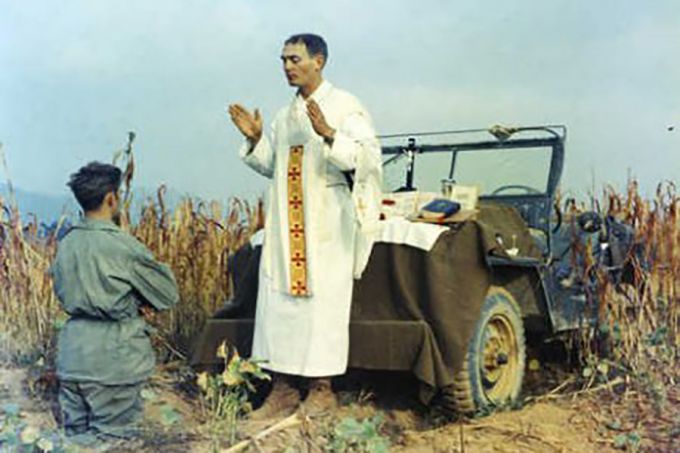
After the Battle of Unsan in November 1950, Kapaun was captured by Communist forces. Forced to march 60 to 100 miles to a prison camp at Pyoktong, he tirelessly encouraged fellow prisoners to carry the weak and wounded.
Once inside the dismal prison camp, Kapaun risked his life by sneaking through the camp after dark. He foraged for food, cared for the sick, and encouraged his fellow soldiers to hold fast to their faith and their humanity.
When the Chinese instituted a mandatory reeducation program, Kapaun patiently and politely rejected every theory put forth. One officer, Lt. Walter Mayo, later recalled the Communists taunting Kapaun. They argued that God must not exist since he was doing nothing to save them. Kapaun’s calm response: “God is as real as the air you breathe but cannot see; as the sounds you hear but cannot see; as the thoughts and ideas you have but cannot see or feel.”
Later, Kapaun openly flouted his captors by conducting a sunrise service on Easter morning, 1951.
Shortly after the service, Kapaun fell fatally ill. As he was being carried to the hospital, he asked Godʼs forgiveness for his captors, and to his fellow men he said, “I’m going where I always wanted to go, and when I get there, I’ll say a prayer for all of you.” He died in captivity on May 23, 1951, at the age of 35.
In 2013, Kapaun was posthumously awarded the Medal of Honor. He is also being considered for sainthood; in early 2025, Pope Francis officially declared him venerable.
Still serving those who serve
The work of Catholic military chaplains continues today. Priests celebrate Mass aboard ships, in hangars, at remote outposts, and in combat zones. They baptize children, prepare couples for marriage, hear confessions before deployments, and comfort grieving families when loved ones do not return home. Their mission remains what it has been since the Revolution: to bring Christʼs presence to those who serve.
Leave a Reply
You must be logged in to post a comment.