
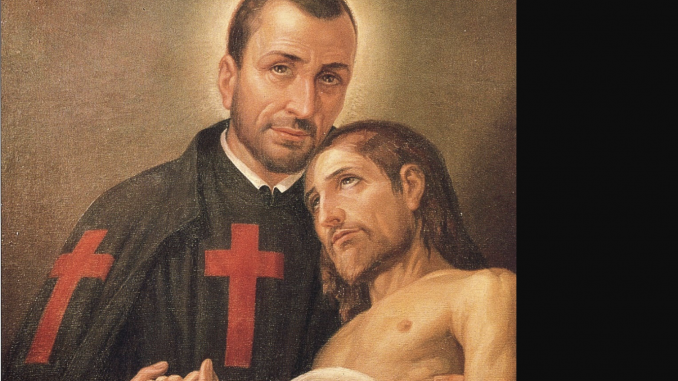
The phenomenon of angry, young men turning to violence, developing addictions, and wandering aimlessly through life is not new. That’s what the life of Saint Camillus de Lellis (1550-1614) looked like when he was twenty-five years old.
Camillus’ father, Giovanni, came from an Italian family that claimed to trace its lineage back to sixth-century Romans, and his mother, Camilla, also came from a noble family. After the birth of one son, who died soon afterward, decades of childlessness followed. It’s not clear whether that was because Camilla married somewhat later in life or because her husband was often away on military campaigns. Everyone was surprised when sixty-year-old Camilla discovered she was pregnant again.
Yet Camillus was born a strong, healthy boy. He was just like his father, full of energy and fascinated by battles and war, not at all like his gentle, devout mother. He was clever, outgoing, and completely unmanageable. His mother died when he was only thirteen years old, probably praying until the very end and wondering what would become of her son.
Camillus spent four years at home, mostly ignoring his tutor, before his father would allow him to become a soldier. Then father and son went off to fight the Ottoman Turks together. When it was all over, Giovanni was an old man, in poor health, and penniless. He had gambled away everything he had.
When Giovanni died, he had nothing to leave his son except a dagger, a sword, and the de Lellis name. After Camillus recovered from malaria, he developed an infection in his right foot and ankle. Since the infection was serious and made it difficult for him to walk, he decided to go to Rome and seek admittance at the San Giacomo hospital for incurables.
To imagine a hospital in the sixteenth century, subtract the modern understanding of germ theory and the notion of dedicated, paid nursing staff. Granted, these servants received payment at the time, but many poor men like Camillus came to the hospital to care for sick people solely so that they could afford to pay for their own treatment. Such servants were notoriously greedy, unreliable, and anything but compassionate.
Camillus was like his father in one more way: he was obsessed with gambling. While he was supposed to be caring for the sick, he ignored his patients, got into quarrels and fights, and gambled whenever he could. Finally, the hospital administrator told him he had to leave.
To earn a living, Camillus took up arms as a soldier again. But after the battles were over, he had lost everything he had earned through his gambling addiction. Even his father’s sword and dagger were gone. When a Capuchin Franciscan offered him a position performing manual labor at a friary, Camillus accepted.
At one point, Camillus had privately promised himself to become a Franciscan friar. (Doesn’t every addict make promises like that?) As he worked for the Capuchins, he desperately wanted to become a good man and a friar. But he just as desperately tried to keep away from the influence of the friars and continue gambling. Saint Paul’s description of being caught in the grip of sin (see Romans 7:18-20) described him perfectly.
The Capuchins, of course, could see a battle was waging in his soul, so one day, the Guardian of the friary sat him down. He talked about God. He talked about sin. He told Camillus that when he was filled with evil thoughts, he must “spit in the face of the devil.” Camillus felt like he was waking up from a dream, and the next day, while he was working, he broke down in tears. It was February 2, 1575, a feast day of the Blessed Mother.
Camillus considered that the date of his conversion. But conversion is a process. He tried to become a friar, but the Franciscan habit aggravated his wounded leg, making him unable to work. The Capuchins sadly had to send him away. Camillus then returned to San Giacomo, resolving that he would “give himself in all and through all to the service of Jesus Christ crucified in His most living image, the Sick.”
It was a different man who returned to that hospital, a man who truly cared about his patients. He was cheerful, amusing, and compassionate. He sought out the most disagreeable and foulest-smelling patients, gave up his sleep to care for the sick at all hours of the day and night, cooked special meals for those who had lost their appetite (he was an excellent cook), and, in his spare time, scrounged for donations to make them more comfortable. He befriended those few other servants who genuinely wanted to help the sick, and they became his disciples.
Unfortunately, many of the servants at the hospital were lazy, and they complained about Camillus and his friends, who, of course, made them look bad. Camillus was forced to leave San Giacomo.
Saint Philip Neri, who was an insightful confessor and spiritual director, was living in Rome during this period. He befriended Camillus and helped him develop a life of prayer and virtue. While Camillus did not always follow Philip’s advice, he did agree to be ordained a priest. Over time, Camillus formed a plan of life for his disciples, and this group eventually became the Clerics Regular, Ministers of the Sick, a religious order devoted to the care of the sick. (Camillus humbly preferred the title Servants of the Sick, and he would hate it that his followers are still often called Camillians after him.) He and his men wore a distinctive black cassock with a red cross on the chest, laid down their lives for the sick during times of plague, and cared for the wounded in battle.
Many people claimed that Camillus’ prayers worked miracles during his lifetime. Those miracles included physical healings, but it’s often difficult to distinguish between a supernatural healing and a healing that could result from the attentive care of a trained, compassionate nurse like Camillus.
When a hospital building under construction collapsed on the workers inside, Camillus merely pointed to a spot to start digging, and all the men were found safe under the rubble. Other reported miracles involved money. The order was constantly in need of funds, and donations often appeared when everyone except Camillus had given up hope. For example, a gentleman sent a donation to the order, but the amount was so large (300 gold scudi) that Camillus sent it back, certain that it was a mistake. The startled man immediately sent the money back to Camillus because he knew that he had not sent that much money and certainly not in gold. It must have been a miracle, and the benefactor did not want to steal money from God.
What changed a hot-headed, selfish gambler into a saint? God’s grace, of course. Camillus was motivated by a love for Jesus Christ, who had saved him from a dark, hopeless life and the prospect of eternity in Hell. But can we recognize any patterns in Camillus’ life that might be applicable to convert angry, young men today?
Camillus was 6 feet, 6 inches tall, broad-shouldered, and physically tough, except for his ongoing leg wound. He was the kind of man who reveled in hard, demanding work, not sitting around reading books. It was probably harder for him to learn Latin, study theology, and daily recite his breviary as a priest than it had been for him to enter combat. Many of the exhausting tasks he set for himself—constantly lifting and moving patients, rising in the middle of the night to check on the sick, and crawling through abandoned buildings looking for those who had been abandoned during plagues—were not unlike the work he had done as a soldier. Camillus proved that the corporal works of mercy could be heroic and manly acts of charity.
One of Camillus’ greatest challenges as a leader was his inability to imagine that others would not want to work as hard as he did. After all, he was certain that they were better men than he, for they had never fallen into the sins that had consumed his soul in the past. This led to painful conflicts between Camillus and his followers, who simply couldn’t keep up with him. Camillus’ humility—his willingness to acknowledge his own faults and assume goodwill in everyone else—astonished, converted, and inspired many people.
After governing his order for sixteen years, seeing it increase to 242 religious brothers—although many of his early followers had already died while caring for the sick—with eight hospitals and fifteen religious houses, Camillus decided to resign. He thought he was about to die, and it was certainly a miracle that the painful infection in his leg had not already killed him. Although they tried to dissuade him, it is not easy to change the mind of a saint.
Therefore, for his remaining eight years of life, one of his earliest companions, the prudent Fr. Biagio Opertis, served as General of the order. Camillus, considering himself now a mere member of the order and under obedience to his superiors, was basically ordered to do the sorts of things he wanted to do.
He did not take it easy. He performed visitations at all the order’s houses, traveling mostly on foot although he could barely walk. He also spent as much time as possible in hospitals, particularly caring for children “as if they had been the Baby Jesus.” Camillus’ version of “retirement” was to spend himself even more completely for those who were sick, whom he considered to be Jesus Christ on earth.
Few people mention one of Camillus’ most remarkable gifts. Although he freely admitted his addiction to gambling, a terrible temper, gluttony toward food, and pride over his family name and honor, he never lost his chastity. Camillus somehow managed to remain chaste even while on battlefields, in taverns, and in dire poverty. Some have suggested that his purity is what ultimately saved him, the one virtue which he always retained, keeping the door of his heart open just wide enough for the grace of God to penetrate when he was at his lowest moments.
Or perhaps there is one more lesson from the story of Camillus’ dramatic conversion and holy life. He had a devout mother who never stopped praying for him, an encouraging sign for mothers of angry, young men in every time and place.
If you value the news and views Catholic World Report provides, please consider donating to support our efforts. Your contribution will help us continue to make CWR available to all readers worldwide for free, without a subscription. Thank you for your generosity!
Click here for more information on donating to CWR. Click here to sign up for our newsletter.
Leave a Reply
You must be logged in to post a comment.