
In Playa Grande, a neighborhood in the city of La Guaira, Venezuela, Kamar Galíndez was on the top floor of Chipi’s Beach Hotel, preparing to start his daily workout in the gym, unaware that his life was about to change forever.
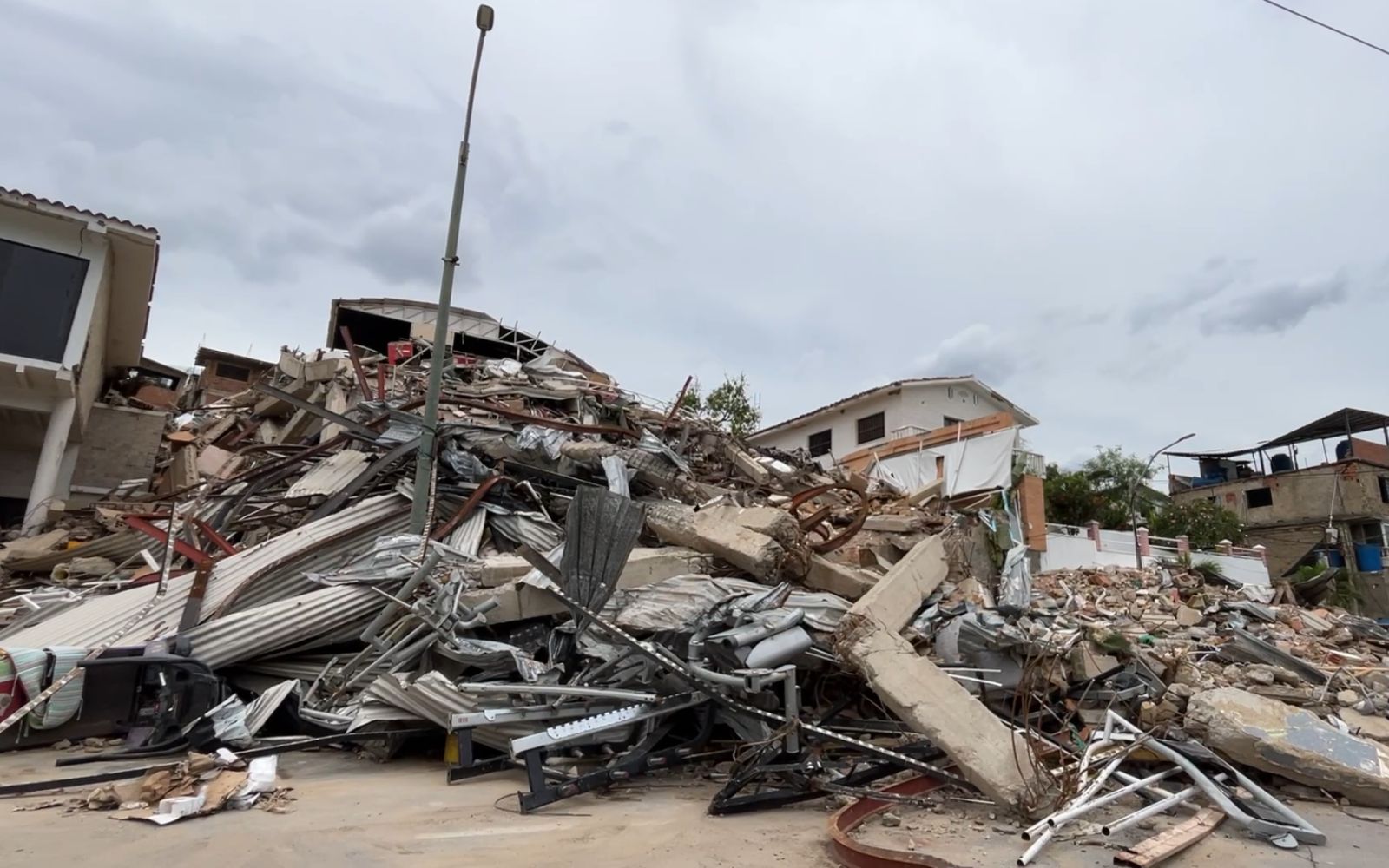
It was Wednesday, June 24, the feast day of St. John the Baptist and a national holiday commemorating the anniversary of the decisive Battle of Carabobo. At 6:05 p.m., the peaceful atmosphere created by the stunning ocean view from the top of the hotel was shattered by the thunderous violence of two consecutive earthquakes that took everyone by surprise, sowing anguish and confusion.
Speaking with ACI Prensa, the Spanish-language sister service of EWTN News, Galíndez, a 53-year-old lawyer, recalled how the heavy gym machines began moving from one side to the other, much like an air hockey puck. Disaster struck within seconds.
“The floor split, and immediately I saw half the building tilting forward while the section I was in collapsed straight down; I felt my feet were no longer standing on anything, and the next thing [I knew], I was trapped in the rubble,” he recounted.
Faced with imminent death: ‘Lord, have mercy!’
Galíndez recounted that the only thing he managed to do was to seek protection beside a nearby wall. As he felt the building collapsing, what came to his mind was the image of the Lord Jesus as he first appeared to St. Faustina Kowalska on Feb. 22, 1931.
“I remember thinking of the merciful Christ and praying, ‘Lord, have mercy,’” he said, on the verge of tears. “The next thing was feeling the building collapse because with that violent shaking, I kept saying, ‘It’s going to fall,’ and of course, it did.”
Galíndez never lost consciousness. He said he felt every blow but that “amid the shock and fear, physical sensations become secondary.” Once the confusion of the collapse subsided, he realized he was alive, though his body was completely buried in the rubble and pinned by a massive beam crushing his chest.
He couldn’t breathe properly. His head had not been buried, and through that immense mountain of twisted metal, bricks, and earth, he could see the sky, still lit by the last rays of the evening sun. All around, the desperate screams of other people trapped in the rubble could be heard.
Galíndez wiped his face and tried to move to free himself. Then he realized his left arm was broken: “A lot of desperation, a lot of fear” is what he recalled feeling, yet amid the suffering, he didn’t hesitate to entrust himself to God’s protection.
“Then I prayed to stay calm. What I did was to pray a lot: ‘OK, Father God, help me get out of here. Keep me calm’ was the first thing I prayed. ‘Keep me calm and tell me what I need to do,’” he recounted.
He signaled for help as best he could. He said he has no idea how long he was underneath the rubble, but he knows it “felt like an eternity.” Finally, a man who had climbed the mountain of debris helped him break free.
‘The Miraculous Medal saved me’
Galíndez made his way down the remains of the collapsed building on his own. Upon realizing the magnitude of the tragedy, which claimed thousands of lives in a split second, he is positive that emerging virtually unharmed was a miracle, one he attributes to Our Lady of the Miraculous Medal, to whom he has always been devoted.
“I was wearing a small chain with a crucifix and a tiny medal of the Miraculous Virgin. Among the things I lost track of, the chain broke, though, of course, I hadnʼt noticed it at the time,” he recalled.
On his way to his home, which was also completely destroyed, a couple of young people helped Galíndez with first aid. While they were tending to him, he became aware of one of those small miracles that holds profound meaning for someone with sincere faith.
He asked the young people to help him put his watch into one of the pockets of his shorts, as he needed to remove it to hold his fractured arm still. And then, the inexplicable happened.
“I was wearing shorts with a small zippered pocket, and when I looked — don’t ask me where from, don’t ask me how — a piece of the chain and the Miraculous Medal were caught inside.”
“Of course, I told the boy: ‘Please, put that little medal away for me too, because that was what saved me,’” he said. “I havenʼt the slightest doubt.”
“Absolutely, absolutely,” he replied when asked if he truly believes his life is a miracle obtained through the intercession of the Blessed Virgin.

Many people didn’t make it out of what was left of the hotel. For Galíndez, having survived is the work of the mercy of God, who listened to his pleas in every instant and granted him his request for a reason he still does not know.
“In the greatest adversity, you begin to see it in terms of what is most basic, because the most basic thing becomes impossible. When the most basic thing is impossible and you manage to do it anyway, you say: ‘Only God can do that,’” he reflected.
“There is a God who looks after you in that moment, attending to what you are asking of him and what you need. From freeing up an arm or reminding you of his presence by leaving a small medal hanging from your [shorts],” he said.
He then emphasized what he considers most important following his harrowing experience: “I have the greatest gift God [my dear] Father gave me, which is life.”
Galíndez said he feels deeply grateful to be alive. For him, what happened serves as a humbling reminder that what we have comes from the will and mercy of God, who does not abandon his people; who does not abandon Venezuelans, especially during times of greatest suffering.
At the time of publication, the official death toll in Venezuela from the double earthquake has risen to 3,535, while the number of injured has reached 16,740. Estimates by independent organizations indicate that tens of thousands of people are still missing.
This story was first published by ACI Prensa, the Spanish-language sister service of EWTN News. It has been translated and adapted by EWTN News English.