
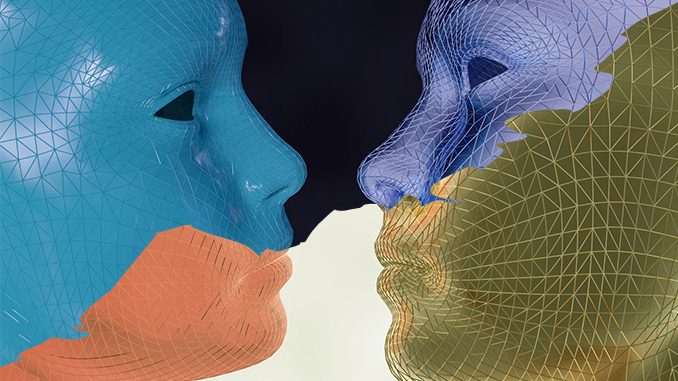
From the inception of the Internet, we’ve known that there is a distance between who we are as embodied souls struggling through a fallen world and who we present to be on the Internet, even if we try our best to be authentic and “real.” As social media created new opportunities to monetize a curated digital version of ourselves, that default (if not inescapable) tendency became all the more acute (“Be sure to click ‘subscribe’!”).
With artificial intelligence now progressively integrated into the very fabric of our daily existence, what actually constitutes human flourishing risks becoming even more obscure. That is especially true when it comes to human friendship and sex.
Of the various alarming predictions in Ridley Scott’s 1982 dystopian sci-fi film Blade Runner, surely one of the most troubling is the humanoid robots designed to be “basic pleasure models,” to offer companionship and sex (a theme repeated in its sequel, Blade Runner 2049). The most intimate of human activities, and the one which creates new human life, is shorn not only of human intimacy, but of any connection to its procreative function. Our ever-widening AI boom makes that fever-dream all that much closer to a reality.
The growth of AI-generated pornography
I’m talking in particular of the worryingly rapid expansion of AI-generated pornography. Though reliable estimates of its share of the broader pornography market remain unavailable, at least four peer-reviewed studies within the last year document the emergence of specialized AI pornography platforms, an increase in downloadable deep fake models, and the rise of marketplaces devoted to AI-generated explicit content.
One 2025 study noted the emergence of all manner of AI tools specially tailored to create explicit images, videos, chatbots, and stories. Another from earlier this year observed that Not Safe for Work (NSFW) AI-generated content is steadily rising. And NSFW requests are now a majority of all bounty requests, which are posted challenges in which one user offers a reward for another to create some specific AI-generated content. The Internet Watch Foundation in 2025 discovered a 400% increase in webpages containing AI-generated child sex abuse material compared with the previous year. Yet another describes “deep nude” applications in which users can generate realistic pornographic images from ordinary photographs.
Pornography, of course, has always been a simulacrum of intimacy, though the Internet not only dramatically multiplied its availability but also what, exactly, people could see. No longer would its consumers leaf through a magazine or rent a video from some seedy establishment. Instead, they could, in the privacy and anonymity of their home, watch endless hours of all manner of categories and sub-categories of material, tailored to their peculiar peccadilloes and sexual fantasies.
Immoral and inimical to God’s intended design for sexual intimacy, absolutely, but at least the “actors” performing such deeds were real, a sad experience (even if they are willing participants), but also one that might persuade porn consumers to realize those on the screen are real people who perhaps should not be objectified and have their bodies commodified like pieces of meat, as Matt Fradd argues in his excellent book Porn Myth.
The proliferation of AI pornography means that those who consume it will be even more disconnected from real intimacy. It also likely means they will have fewer qualms with what they allow themselves to be exposed to—it’s just computer-generated images and videos, not real people, right? What’s the harm in such degrading or violent content, if it’s all fake? Pornography is already disastrously disconnected from the realities of actual sexual intimacy, given that (well-adjusted) people don’t like being treated like an object that exists for the pleasure of another whenever that person wants sex, or participating in bizarre, dehumanizing role-playing.
But if conventional pornography is an addictive drug, AI-generated porn is that same drug engineered to be more powerful and infinitely customizable, creating an infinite number of imagined fantasy worlds (talk about dystopic!).
Fake friendships that harm real intimacy
Of course, the intimacy problem isn’t just about porn. Younger cohorts are treating AI as if it were a real friend. Per one study from last year, more than 70 percent of teens have used an AI companion at least once; more than half use them at least a few times per month. A third use them for friendship, emotional support, role-playing, or romance, and almost a third say conversations with AI are as satisfying, if not more satisfying than conversations with actual humans.
One can easily imagine how this could be the case: humans are flawed and fallible; we get bored, distracted, or angry; we ask things of people, and when we do things for them, we expect something in return. Sometimes our emotions (or sinful tendencies) hurt others.
“So-called artificial intelligences do not undergo experiences, do not possess a body, do not feel joy or pain, do not mature through relationships, and do not know from within what love, work, friendship, or responsibility mean,” writes Pope Leo XIV in his recent encyclical letter Magnifica Humanitas. “Nor do they have a moral conscience, since they do not judge good and evil, grasp the ultimate meaning of situations, or bear responsibility for consequences.”
Even though in many respects they imitate various human functions, “they lack the affective, relational and spiritual perspective through which human beings grow in wisdom.” Thus, to have a “friendship” or imagined sexual experience through AI is to elide the kinds of experiences that make us most human: being faithful, being vulnerable, making mistakes that we can learn from, forgiving those who’ve wronged us, and being forgiven by those we’ve wronged.
Pope Leo’s encyclical perceptively sees the character of the problem: “Here, the danger is not so much that a person may believe they are communicating with another person, but rather that they may gradually lose the very desire to form genuine human connections.” The porn addict gradually loses interest in or the ability to have an authentic sexual relationship. The person who relies on AI for friendship likewise progressively forfeits what we might call the danger and opportunity of friendship. Yes, another person may fail to understand you or hurt you; he or she may also come to appreciate or accept you in a way you’ve never experienced before.
Suffering, too, far from being something to avoid as antithetical to happiness, is actually part of what makes us human, opening us up to God. “We see this at many moments when our limits become tangible: when we face rejection, when we suffer the illness or loss of a loved one, when we encounter our own weakness or failure.” It is through those experiences that we learn new things about ourselves, and avail ourselves of prayer that draws us into the transcendent. AI sex and AI friendship, in contrast, draw us away from others and even our own selves. “For an algorithm, an error is a flaw to be corrected; for a person, however, an error can be a catalyst for profound change. A person’s future is not calculable, but depends on one’s freedom — elevated by the inexhaustible grace of God — and on the relationships cultivated.”
Reality and idolatry
AI, Pope Leo aptly observes, is not morally neutral, which is all the more reason not only to be discerning regarding how we use AI, but even which version we use. (I can recommend one app, Acutis AI—named after recently canonized St. Carlo Acutis—which is designed by two Catholics and intends to give families and students a safer way to use AI, and is designed for everyday questions and tasks, but with stronger guardrails and a moral framework based on the teachings of the Church). Digital platforms, whether we are talking about social media or AI, “have a considerable ability to affect the collective imagination and to present a particular vision of reality as desirable.”
This manifests across a host of issues, including body image, hustle culture, the influencer luxury lifestyle, and romantic relationships (“swipe left”). And the ongoing debates of realistic and unrealistic expectations related to fulfilled womanhood.
Discussion of pornography, “hypersexualized material,” and “addiction linked to the ‘digital attention economy’” all make an (albeit brief) appearance in Magnifica Humanitas, the pope noting that digital platforms are specifically focused on “exploiting [people’s] vulnerabilities and weakening their inner freedom.” But I think the trends related to AI porn are perhaps the canary in the coal mine of what awaits our civilization if we do not take more drastic measures to curb its destructive dissemination.
“The quality of a civilization is measured not by the power of its means, but by the care it is able to offer, by its ability to recognize the other as a face not merely as a function,” writes Pope Leo.
It is not too much to worry that the more man stares into the contrived “face” of AI sexual content, the more humanity will itself seem a great, anonymous mass ripe for objectification and exploitation, and the more he, too, will suffer that subjugation himself. “The idols of the nations are silver and gold, the work of men’s hands,” wrote the Psalmist. “They have mouths, but they speak not; they have eyes, but they see not; they have ears, but they hear not, nor is there any breath in their mouths. Those who make them are like them; so are all who trust in them” (Psalm 135:15–18).
If you value the news and views Catholic World Report provides, please consider donating to support our efforts. Your contribution will help us continue to make CWR available to all readers worldwide for free, without a subscription. Thank you for your generosity!
Click here for more information on donating to CWR. Click here to sign up for our newsletter.
Leave a Reply
You must be logged in to post a comment.