
The pope met with authors to mark the 100th anniversary of the Vatican Publishing House.
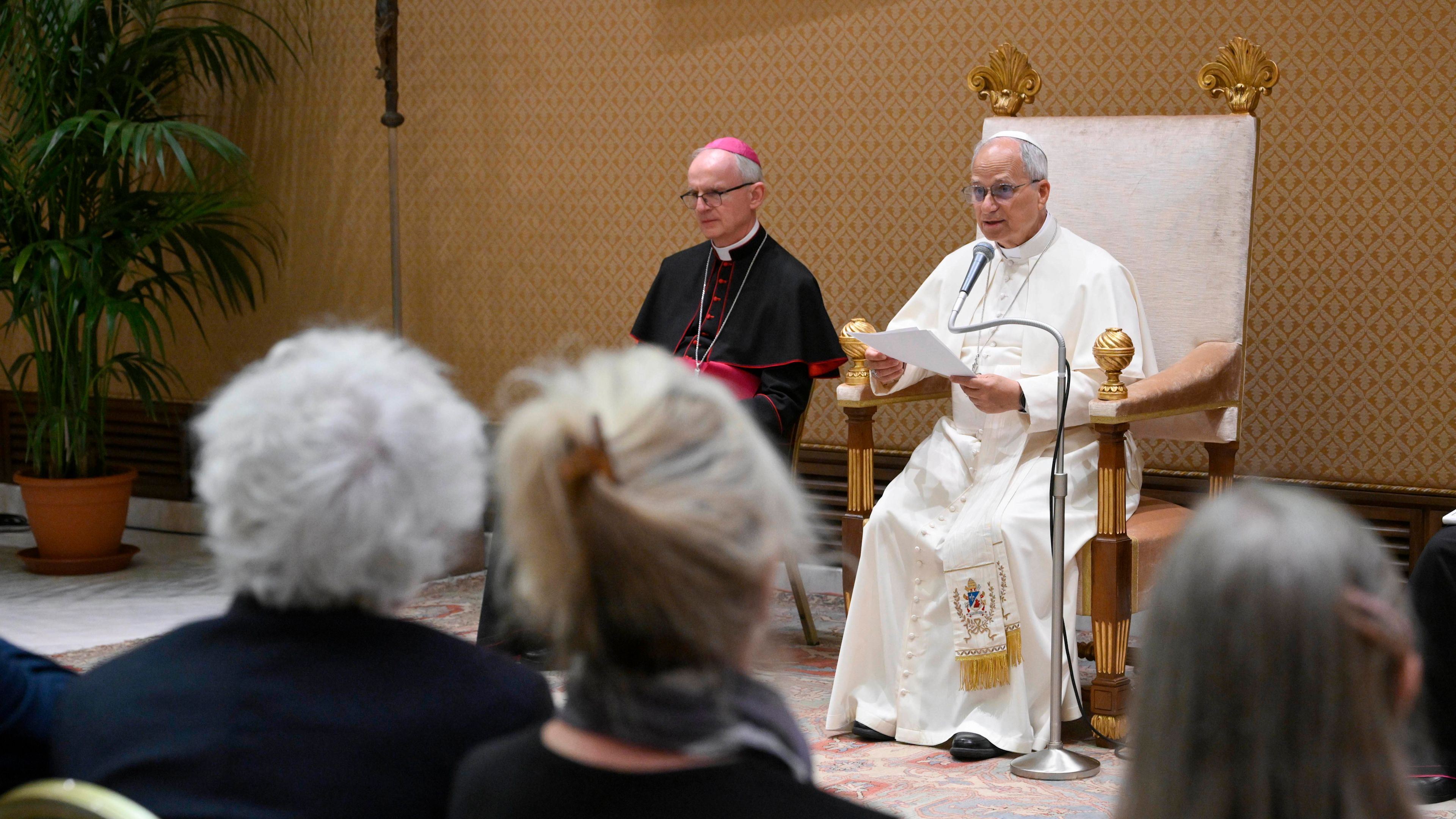
Pope Leo XIV this week emphasized the importance of writing, describing it as a human expression of truth that ultimately leads to God.
In an audience with a group of authors on June 24, Leo discussed the enduring value of literature amid rapid digitalization. In his remarks, he urged authors to inspire readers to seek truth through their work.
The encounter between the pope and writers marked the 100th anniversary of the Vatican Publishing House, also known as Libreria Editrice Vaticana, shortened to LEV, in Italian.
“Writing, as you know, is an act of truth, of revelation, for it reveals who we are, what we believe and hope for, the world we strive toward and the future of which we dream,” Leo said. “We are never masters of the truth; if anything, it is the truth that ‘conquers’ us. That is why I hope you will inspire others to be drawn to the truth, because you yourselves are drawn to it.”

Leo also explained that writing, as a human exercise, ultimately leads to God.
“When we delve into the very depths of our humanity, we are not far from God; for there, in the midst of very human stories, God reveals himself,” Leo said.
His speech to writers follows a similar address delivered to the Vatican Publishing House employees on May 7, also held to mark its 100th anniversary.
The Vatican Publishing House was founded in 1926 as the official publisher of all texts by the pope and the Holy See.
Encounter through literature in the age of AI
Several of the authors reflected on the pope’s speech in comments to journalists following their audience.
Jonathan Safran Foer, a critically acclaimed Jewish-American author, described the encounter as revealing the power of writing to foster empathy for others’ suffering.
“Writing is good at opening us up empathically and being aware of the suffering in the world,” Foer told EWTN News. “It is very easy to ignore somebody you don’t see. It’s very hard to ignore somebody who is in front of you. And at its best, art brings the other in front of you. It creates those encounters.”

Other authors discussed the challenges faced by writers in the era of artificial intelligence (AI). Paul Elie, an American author and a senior fellow at Georgetown University, praised Pope Leo for highlighting the need for writers in today’s world.
“Artificial intelligence — thereʼs no question itʼs a threat to literature and writing, and the pope addressed that today. ‘We need you,’ he said. One reason the world needs writers is that we still write as a free act, not as something created by an algorithm,” Elie told EWTN News.
Colum McCann, an Irish writer of literary fiction, added: “The Holy Father has been talking about stories and storytelling, language, disarming language, and how AI has penetrated the world of storytelling. If you get to the heart of the human mystery, you get to the heart of proper storytelling and engagement. We would then hope, somehow, to bring [humanity] back together in these divided times.”
If you value the news and views Catholic World Report provides, please consider donating to support our efforts. Your contribution will help us continue to make CWR available to all readers worldwide for free, without a subscription. Thank you for your generosity!
Click here for more information on donating to CWR. Click here to sign up for our newsletter.
Leave a Reply
You must be logged in to post a comment.