
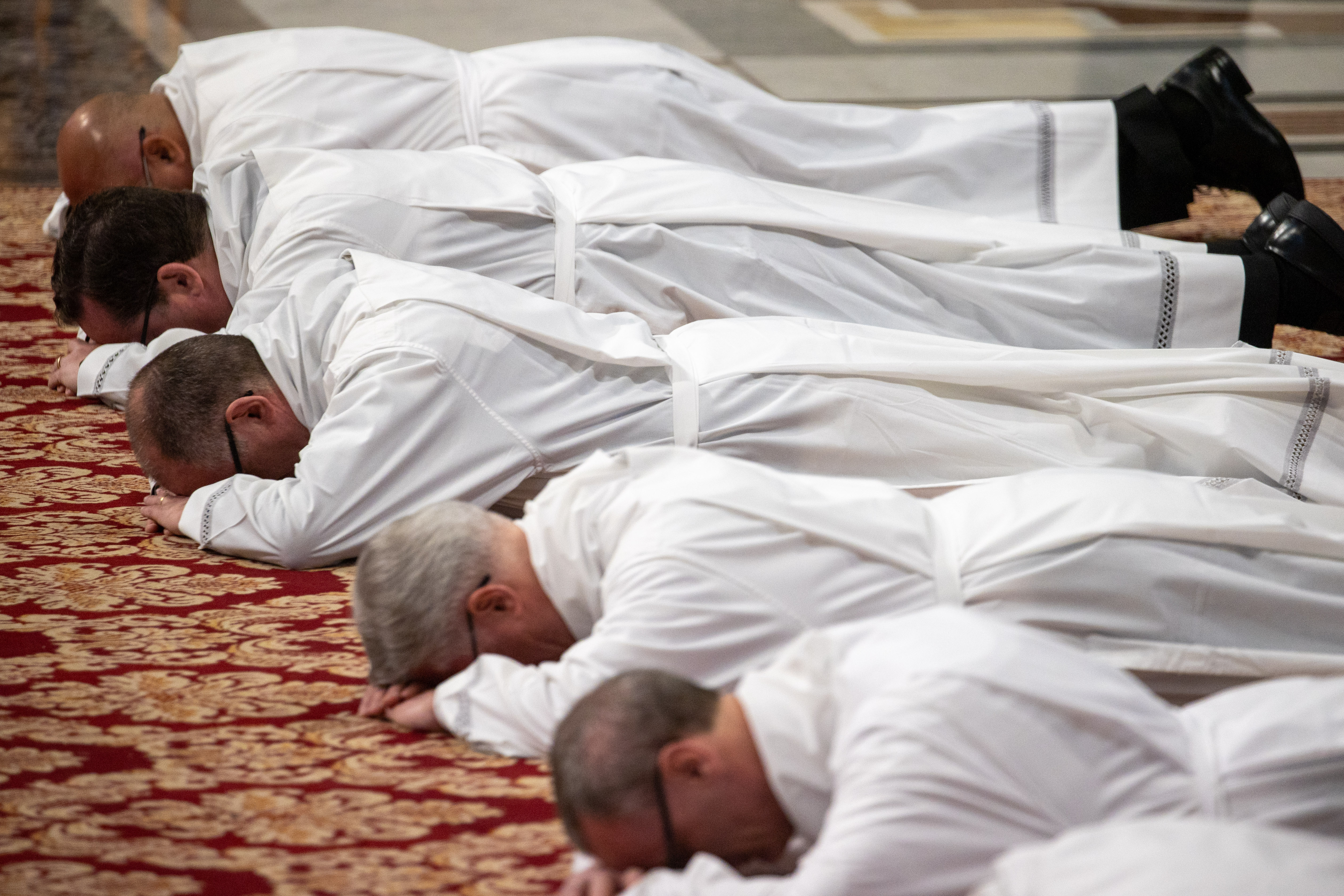
WASHINGTON — The Catholic Church’s permanent diaconate in the United States reached a record size in 2025. Still, a national survey suggested the ministry may be approaching a demographic crossroads as aging membership, retirements, and deaths increasingly offset ordinations.
The findings come from the “A Portrait of the Permanent Diaconate in 2025,” an annual survey conducted by the Center for Applied Research in the Apostolate (CARA) at Georgetown University on behalf of the U.S. Conference of Catholic Bishops’ (USCCB) Committee on Clergy, Consecrated Life, and Vocations.
The survey was administered between February and May, asking about the previous year. CARA received responses from 143 of the 185 archdioceses, dioceses, archeparchies, and eparchies whose bishops and eparchs belong to the USCCB and have an active Office of Deacons, for a 77% overall response rate.
Researchers estimated that 21,562 permanent deacons serve in the United States, a record high. The previous year’s report showed 20,212 U.S. deacons.
Yet beneath the 2025 record figure, the report revealed signs of stagnation that could shape the future of the ministry carried out by married or unmarried men ordained as permanent deacons to preach, teach, baptize, witness marriages, and lead charitable service.
“The 2025 diaconate portrait shows a remarkable rebound, estimating 570 ordinations compared to 494 retirements and 390 deaths,” Sister Thu Do, LHC, the report’s primary researcher, told EWTN News. “While we are moving toward a healthier replacement rate than in previous years, the workload for active deacons remains intense.”
Growth slows despite record numbers
The report estimated that 13,864 deacons are active in ministry, while thousands of others are retired or no longer serving in active assignments.
Although the overall number of deacons increased slightly from the previous year, growth has slowed considerably. The survey found that losses from retirement and death are nearly matching the number of men entering the ministry.
During the 2025 calendar year, 466 permanent deacons were ordained, the study showed. Extrapolating to include those who did not respond to the survey, it can be estimated that there were 570 deacons ordained in the United States in 2025, according to the report. At the same time, 494 deacons retired from active ministry, and another 390 deacons died, the report said.
The data suggest that growth will depend heavily on whether dioceses can attract and form enough candidates to replace those leaving ministry.
An aging ministry
The report’s findings highlight that the permanent diaconate is aging rapidly, and its pipeline isn’t keeping up.
The median age of active deacons is 69, while the median age of all permanent deacons, including retirees, is 70. Only a small percentage of active deacons are younger than 50.
The report indicates that the permanent diaconate remains one of the oldest groups of ordained ministers in the Church in the United States.
The aging trend is also reflected in the number of deacons who retire each year. In many dioceses, retirements outpace growth, contributing to concerns that the ministry could begin declining in size if ordination rates do not increase, the report said.
Demographic profile
The survey found that the vast majority of permanent deacons are married, with only a small percentage being widowed or never married.
Racial and ethnic diversity within the diaconate continues to increase, though most deacons are non-Hispanic white, the report said. Hispanic and Latino Catholics represent a growing share of both active deacons and men in formation, the report said.
“I want to highlight how beautifully the diaconate reflects the growing cultural diversity of the U.S. Catholic Church,” Sister Thu said. “This dynamic adaptation equips men to serve communities in their heart languages, serving as a wonderful testament to the universal and living nature of the Church.”
Questions about the future
The report does not forecast an imminent decline in the permanent diaconate. However, its findings point to growing demographic pressures that could limit future expansion.
While the total number of deacons has reached a historic high, the ministry’s growth increasingly depends on replacing aging members rather than expanding into new territory as retirements and deaths consume much of the annual increase generated by ordinations.
“This signals a crucial transition,” Sister Thu said. “To maintain vibrant parish ministries and avoid a pastoral vacuum as our senior deacons rightfully retire, we must actively encourage the next generation of men to discern and hear this call.”
Leave a Reply
You must be logged in to post a comment.