
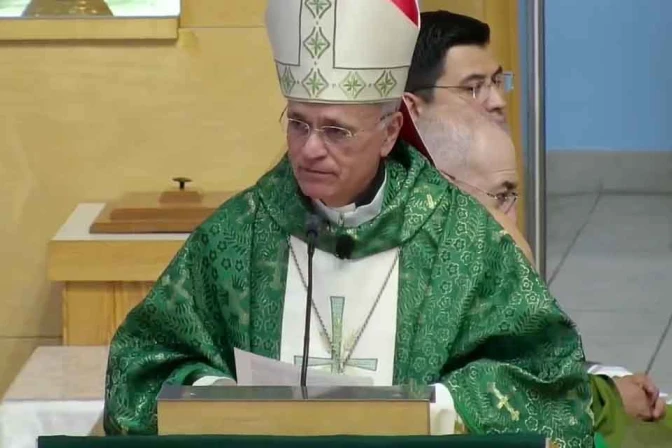
In a homily over the weekend, Auxiliary Bishop Silvio Báez of Managua, Nicaragua, compared “casting out demons” to denouncing the cruelty and irrationality of dictatorships that violate human dignity.
“Casting out demons means committing ourselves to processes of personal and social liberation, and helping those trapped by idols, fear, or hopelessness to regain their freedom,” the bishop noted during a Mass he celebrated at St. Agatha Parish in Miami on June 14.
“It also means denouncing the irrationality and cruelty of regimes that violate human dignity and multiply peopleʼs misery, often even invoking the name of God,” he emphasized.
Báez, who was forced to leave Nicaragua in 2019, now lives in exile and serves at the Miami parish where his compatriots gather. Like many others, Báez was a victim of persecution by the Nicaraguan dictatorship, which intensified its ruthless campaign against the Catholic Church in 2018, a campaign that continues to this day.
The Nicaraguan prelate reflected on a passage from the Gospel of Matthew, stating that Jesus saw the crowd and “had compassion for them, because they were weary and dejected, like sheep without a shepherd.”
This image, he noted, “has lost none of its relevance. Today, too, there are many people living like sheep without a shepherd: individuals who are sad, lonely, disoriented, and disillusioned by deceptive idols; families torn apart by poverty, forced migration, or violence; entire peoples deprived of freedom and a future due to war or dominated by dictatorial regimes that impose themselves through fear and repression.”
In this situation, the bishop explained, “prayer is the first and most urgent response,” not because it “replaces action but because it is the root and foundation of action, making it fruitful and strong.”
Through prayer, one can be in tune with the Lord and move toward effective action, he noted. “From this compassion and this prayer came forth the choice of the Twelve [Apostles],” the prelate emphasized.
“The power Jesus grants is a power at the service of life and human dignity. It is exactly the opposite of the power that seduces the world — the power that crushes, controls, intimidates, and subjugates. This power, received to serve rather than to subjugate, did not end with the Twelve; it continues today through us,” he said.
In addition to casting out demons, he said every member of the Church is called to perform various actions, such as “healing the sick, raising the dead, and cleansing lepers.”
The bishop explained that resurrecting the dead “is restoring hope to those who no longer expect anything, helping them discover glimmers of Godʼs light in the middle of the nights of life. It’s announcing, without tiring, the God of life.”
“And it is also to oppose the oppressive powers that subjugate people, with the conviction that God accompanies and blesses the efforts made for the freedom and dignity of people,” he noted.
The Nicaraguan prelate also emphasized that “cleansing the lepers means striving to restore dignity to those marginalized by society or religion, through gestures of inclusion, solidarity, and respectful dialogue.”
He remarked that “the laborers remain few. The Lord continues to seek those today who are willing to extend his compassionate gaze into the world. May that gaze be ours.”
This story was first published by ACI Prensa, the Spanish-language sister service of EWTN News. It has been translated and adapted by EWTN News English.
Leave a Reply
You must be logged in to post a comment.