
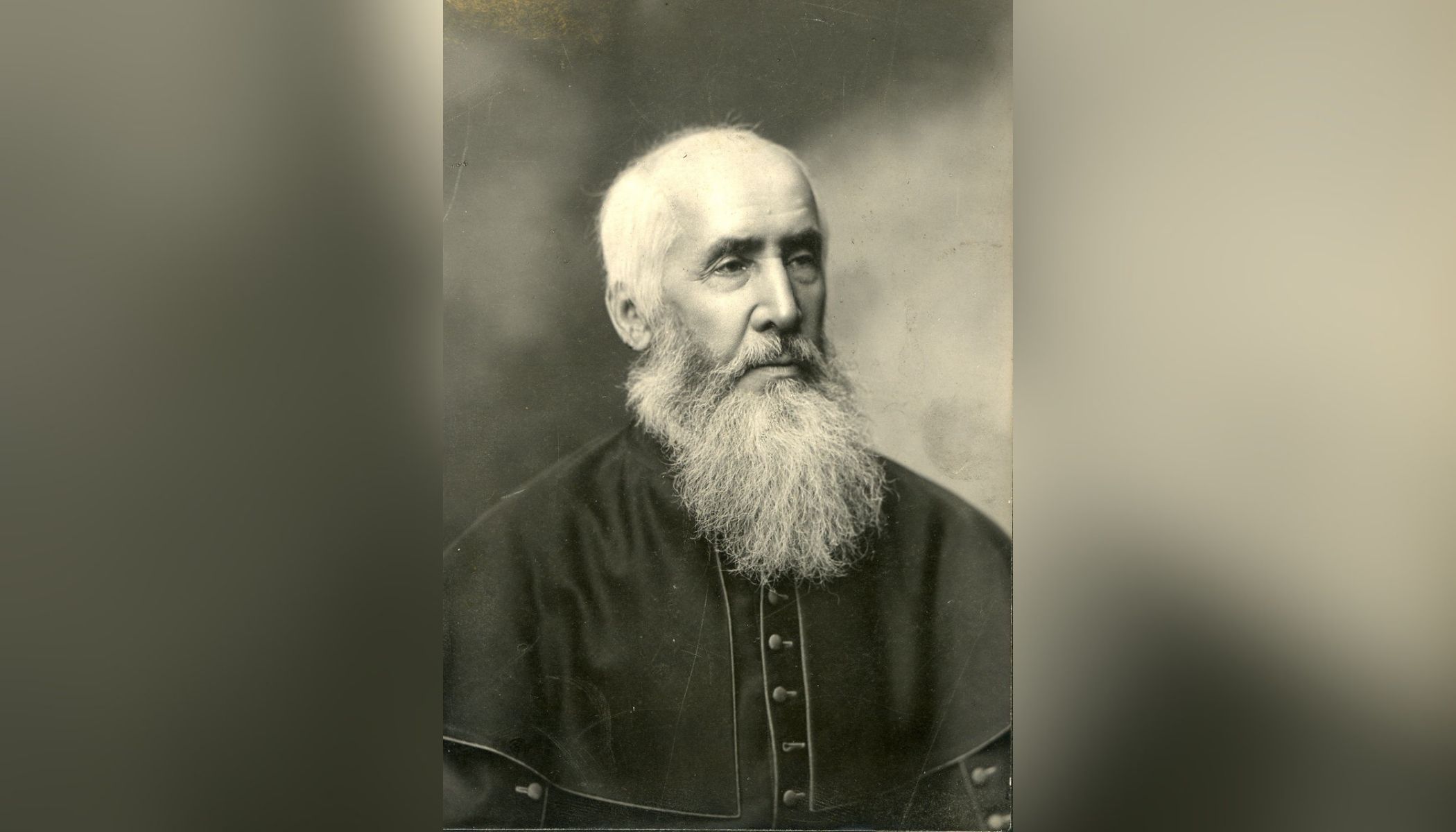
ORLANDO, Florida — The U.S. Conference of Catholic Bishops (USCCB) voted June 10 to support advancing the cause of beatification and canonization for Monsignor Joseph Buh, a Slovenian-born missionary priest who spent more than half a century ministering in northern Minnesota.
The vote took place during the bishops’ plenary assembly in Orlando, Florida, after Duluth Bishop Daniel J. Felton asked members to consider whether it was advisable to advance the cause on the local level.
The bishops also approved advancing the cause of sainthood for John Rick Miller, a layman and international missionary known as the “ambassador of the Virgin Mary.”
Presenting the request to his fellow bishops, Felton described Buh as “a remarkable example of missionary discipleship” whose “love for Christ and the Church led him to leave his homeland of Slovenia and dedicate his life to the people of northeastern Minnesota.”
“His story remains profoundly relevant for the Church today,” Felton said. “For we live in a missionary age.”
The action marks another step in a process that has been developing in the Diocese of Duluth for several years. In 2024, the diocese began formally exploring whether Buh’s cause should move forward, consulting clergy and the faithful about devotion to the priest and his reputation for holiness.
Buh was born in 1833 in what is now Slovenia and was ordained in 1858. After emigrating to the United States, he became one of the most influential Catholic missionaries in northern Minnesota during a period of rapid immigration and settlement.
Known for extensive travels across the region — often by horseback over long distances and difficult terrain — Buh ministered to immigrant mining communities and Native American settlements at a time when priests could spend weeks or months covering a single mission circuit. He helped establish more than 50 parishes and missions and later served as vicar general of the Diocese of Duluth.
Felton said Buh anticipated key elements of modern Catholic teaching on evangelization.
“He immersed himself in the communities that he served. He learned their languages, understood their customs and struggles and, most importantly, learned the language of their hearts,” Felton said.
Buh spoke six languages, including Ojibwe, an Algonquian language, which Felton said he learned so that he could “faithfully serve and evangelize the Indigenous communities.”
He added that Buh’s pastoral method was rooted in presence and listening.
“He began by listening after learning their language, their story, and their needs,” Felton said. “His example reminds us that evangelization begins with presence, listening, and genuine love for the people entrusted to our care.”
The proposal brought before the bishops follows several years of preparatory work in the Diocese of Duluth. In October 2023, Felton appointed Father Richard Kunst to help evaluate whether sufficient devotion to Buh existed among the faithful to warrant moving forward with a cause.
‘A true spiritual father’
Although Buh died in 1922, interest in his life has persisted within the Diocese of Duluth. Advocates of the cause point to both his missionary work and the reputation for sanctity that followed him during his lifetime and after his death.
Felton said the faithful of northeastern Minnesota have long regarded Buh as “a true spiritual father,” reflected in the title by which he became known, the “patriarch of the Diocese of Duluth.”
His ministry coincided with demographic changes in northern Minnesota as mining and railroad expansion drew new immigrant communities to the region. His fluency in multiple languages allowed him to minister across cultural lines, particularly among European immigrant groups who often lacked stable parish structures in their early years in the United States.
At his funeral, Church leaders praised his decades of missionary service across remote communities in northern Minnesota. In the years since, his memory has remained particularly strong in the region.
“Stories of his life continue to be shared throughout our region, even to this day,” Felton told the bishops. “There are accounts of his sacrifices while traveling through severe winters, his tireless efforts to provide both spiritual and material assistance, and the deep trust people placed in his prayers.”
“For generations, devotion to Monsignor Buh has endured,” he added.
Interest in Buh’s cause has increased in recent years. His remains were exhumed in 2024 and transferred to the Cathedral of Our Lady of the Rosary in Duluth, where they were formally entombed in 2025.
As supporters have examined Buh’s life and writings, Felton said he is remembered as “a beloved, gentle, humble, and generous priest” whose life was ordered toward helping others draw closer to God.
“He did not come to Minnesota in search of adventure or personal gain,” Felton said, “but out of a desire to serve Jesus Christ and to lead others.”
The bishops’ vote does not open the cause nor declare Buh a saint. Rather, it represents one of several preliminary steps in the canonization process.
If the process continues, the Vatican’s Dicastery for the Causes of Saints would need to grant a “nihil obstat” (“nothing stands in the way”), allowing the cause to be formally opened. At that point, Buh would receive the title “servant of God.”
Felton told the bishops that Buh’s witness speaks to the Church’s present missionary context.
“I truly do believe the Holy Spirit is lifting him up in this time,” he said. “I think the Holy Spirit has lifted him up for our times to be our inspiration, to be our guide.”
Leave a Reply
You must be logged in to post a comment.