
CHICAGO — What does a 17th-century anatomist-turned-bishop have to do with the future of Catholic science? Quite a lot, according to Nuno Castel-Branco of All Souls College, Oxford, who was one of the presenters at the ninth annual Society of Catholic Scientists conference held June 5–7 at Mundelein Seminary in Illinois.
About 130 scientists gathered for this yearʼs conference for talks that touched on the deeply Catholic history of science, the moral dilemma of identical twins, how science and faith are one in their pursuit of truth, how AI fits into the grand scheme of things, and how key mathematical discoveries reveal God’s beauty and infinity.
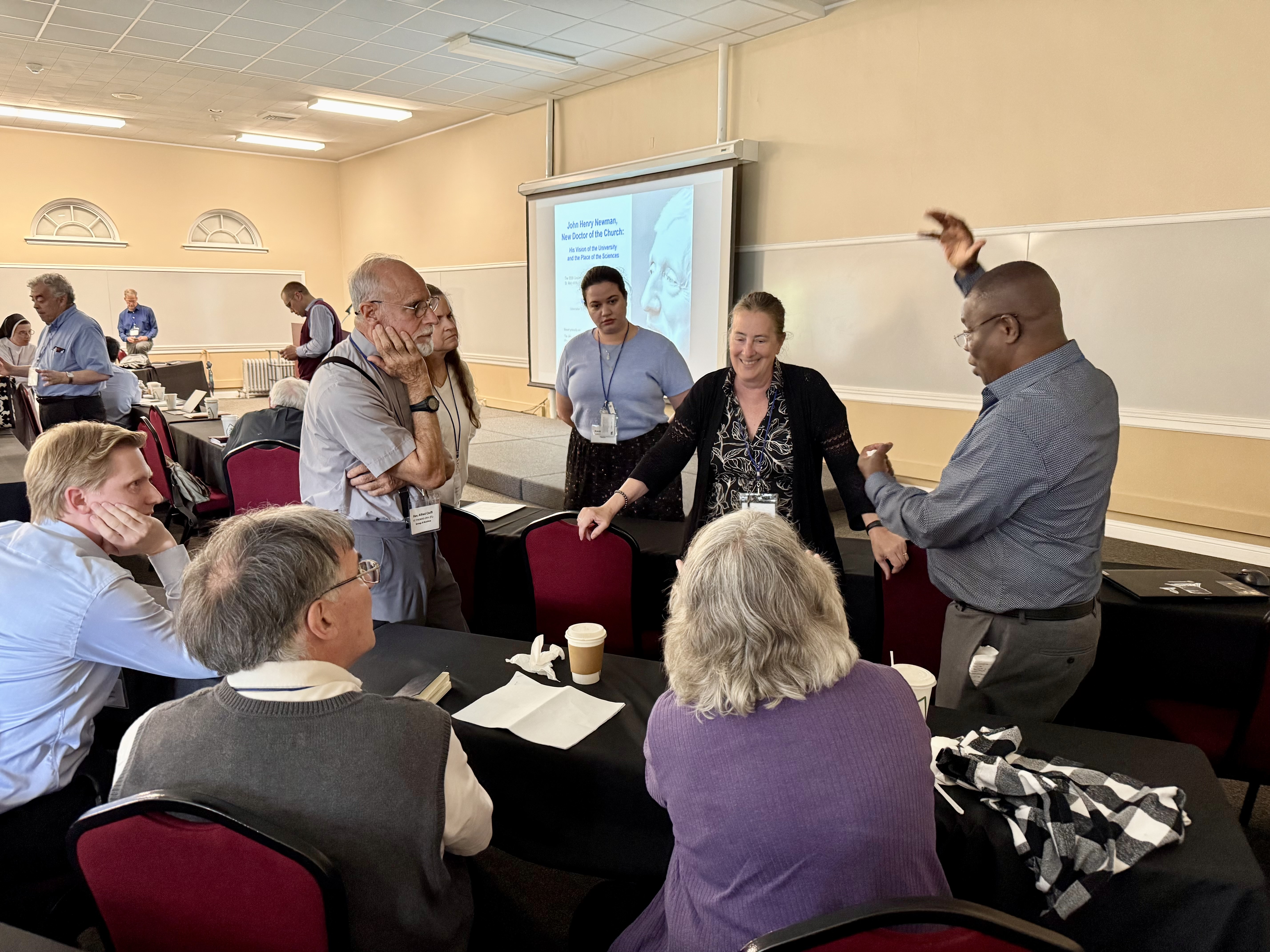
The Society of Catholic Scientists (SCS) exists to correct the false characterization of faith and science as opposed, and how to combat this myth was a constant topic in both formal presentations and informal conversations. All presentations can be seen on the recorded livestream.
Castel-Branco told the story in his Saturday morning talk of St. Nicolas Steno, a revolutionary scientist who is considered the father of geology and comparative anatomy. This brilliant researcher converted to Catholicism after witnessing a Corpus Christi procession in Italy, going on to become a bishop and then a saint.
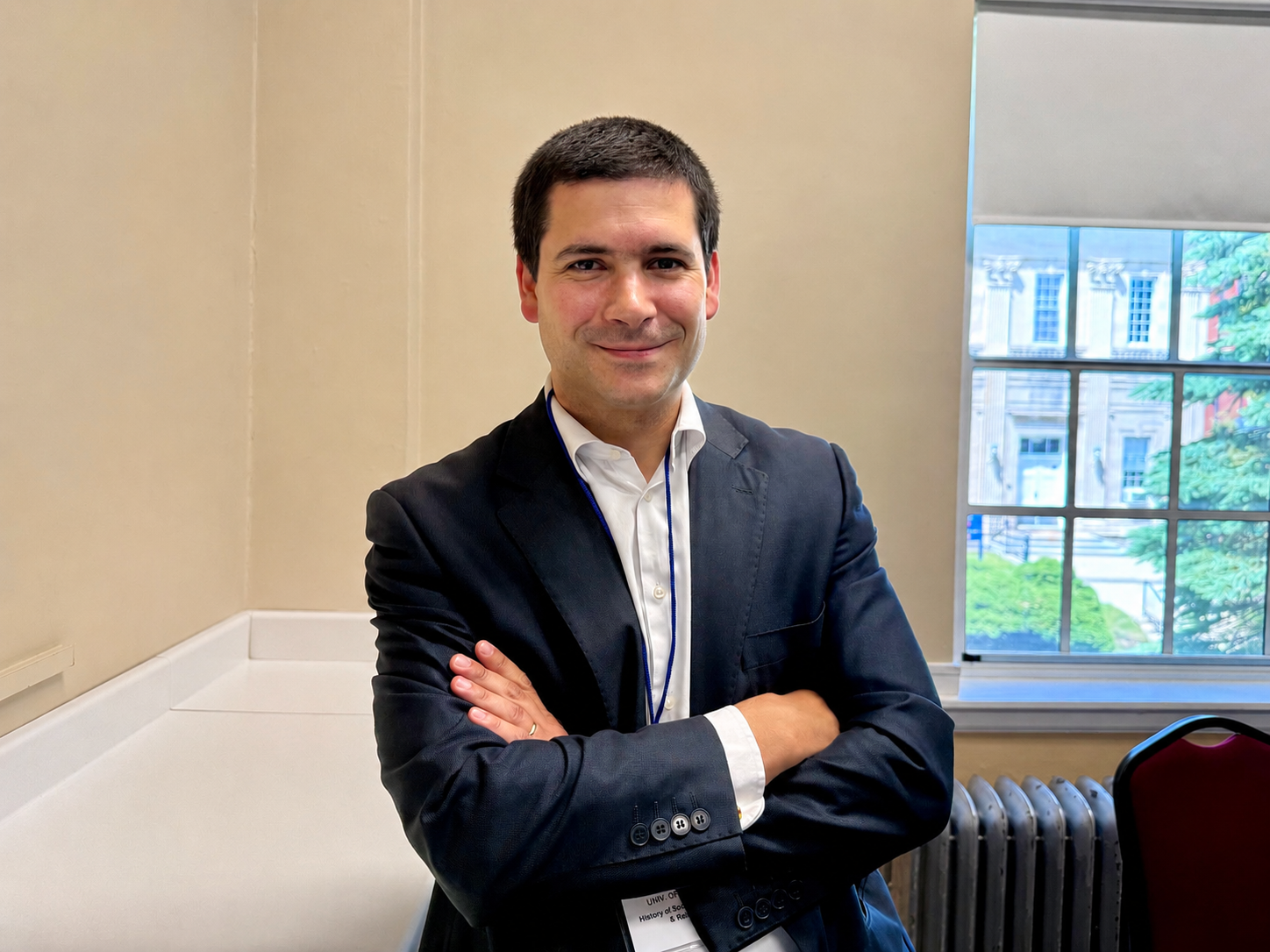
The same research skills Steno used to understand the natural world, Castel-Branco said, became his path to heaven as he turned his intellect toward studying the Church fathers and theology.
Later on Saturday afternoon, Maureen Condic, neurobiology professor and bioethicist at The Catholic University of America, presented her solution to the “twin problem.” Identical twins pose a moral dilemma: If one embryo can divide into two distinct persons, how does that square with the belief that personhood begins at conception?

Condic pulled from the newest research in molecular developmental biology and the ancient wisdom of Aristotelian-Thomistic metaphysics to present a sophisticated answer that affirms the dignity of human life at all stages, arguing that the splitting of an embryo to become identical twins is an act of biological regeneration, comparable to asexual reproduction. Thus an embryo becoming identical twins is not the division of one human person but the spawning of a second individual from a first.
Ignasi Rosell, a particle physicist and one of several visitors from the society’s Spain chapter, explained how scientists can understand their work in light of St. John Henry Newman’s vision of the university, saying: “Truth is one. Newman was not defending theology against science: He was defending the unity of knowledge. The university remains the privileged place where that unity is sought.”

Two talks addressed artificial intelligence, one addressing trustworthy scientific inference given the scope of AI and the other attempting to place machine intelligence on Aristotle’s “Great Chain of Being” that classified all living and nonliving things into a hierarchical scale based on the complexity of their souls.
The conference also turned to the philosophy of mathematics in a presentation that revealed how religious faith brings new understanding to every field of scientific inquiry. Gregory F. Johnson, principal software engineer at Zap Surgical Systems, a spin-off of the Stanford Medical School, discussed “The Mathematical and Philosophical Revolution Launched by Gödelʼs Incompleteness Theorem,” a theorem published in 1931 that fundamentally altered the philosophy of mathematics.
“The key thing Gödel showed was that mathematics has sort of infinite realms where weʼre being asked to explore more and more deeply,” Johnson told EWTN News. “Gödel thought — he was a man of faith, a man of religious belief — that, in a way, God created an abstract realm to go with the material physical realm, where he was just opening doors for us to explore more and more deeply into his truth and his presence.”
Participants called the conference “joyful,” “refreshing,” and “genuinely interdisciplinary.”
“Itʼs just a joyful sharing of the intersection of faith and science,” Alexander Webber, a research fellow at the Food and Drug Administration, told EWTN News. It was Webber’s fifth year attending the conference, and he said he frequently encourages friends and colleagues to come too.

“Itʼs just an incredible experience every year, gathering with highly qualified scientists who are also believers,” he said. “We always have wonderful conversations — not only on how our faith informs our work but also how our work reveals more about our faith. I always leave feeling edified. It’s very much unlike other conferences. Nobody here is really putting on any pretenses.”
Other attendees said they enjoy being with other serious scientists who are devout Catholics and who share their understanding that faith and science go hand in hand.

Robert Scherrer, a physics professor at Vanderbilt University, said: “Thereʼs this myth that science and religion are opposed to each other. A lot of atheists have a very simplistic view of religion: The religion they donʼt believe in is not the religion I do believe in. But young people see this myth and think, ‘I have to pick which team Iʼm going to be on.’”
Chris Clemens, an astrophysicist and former provost of the University of North Carolina-Chapel Hill, was one of the first members of the SCS. He said it was hard to find other Catholic scientists at first, but now it has grown and draws more members every year.

The organization has seen enormous development in its international chapters. The president of the Spain chapter, the second-largest chapter after the U.S., gave a presentation about its growth and success at the conference.
Scherrer, another founding member of the SCS, said he greatly enjoys the event’s interdisciplinary nature. “All the other conferences I go to are in my specialty, and itʼs fun, but it’s the same topics every time,” he said. “Whereas here, Iʼve heard talks about bees, and the Great Lakes, and lobster brains, and all sorts of things that you just donʼt get in your normal run of your life, so itʼs much more interesting. It reminds me of when I was a kid and was interested in science. I didnʼt just do physics; I was interested in all science. It feels like a chance to get back to that.”
SCS members have initiated a number of projects to share more broadly the compatibility of faith and science, from a “Faith, Science, and Reason” high-school textbook written by Chris Baglow, who directs the Science & Religion Initiative of the McGrath Institute for Church Life at the University of Notre Dame, to a new training this year that prepares scientists to give lectures on the unity of faith and science.
Leave a Reply
You must be logged in to post a comment.