
A White House official in President Donald Trump’s administration expressed a desire to work more closely with churches and faith-based leaders in efforts to confront both drug and human trafficking and assist in recovery.
Victor Avila, assistant director of the Office of National Drug Control Policy (ONDCP), made the comments during a panel discussion on border security and immigration enforcement hosted by the America First Policy Institute’s (AFPI) Hispanic Leadership Coalition in Washington, D.C., on May 14.
“We need to get the church involved,” he said, referencing a ONDCP report that emphasizes the importance of faith-based partners.
The report, issued this month, details the administration’s drug control strategy and states the office will ensure access to evidence-based prevention and recovery programs that are faith-based. It lists faith leaders as important partners and advocates and encourages them to use their role to promote a social norm that is opposed to using drugs and supportive of treatment for addicts.
Avila told EWTN News after the panel that he hopes churches can also assist in the realm of human trafficking, noting that much of it “happens in plain sight.”
Both the Vatican and the U.S. Conference of Catholic Bishops have been outspoken on the issue of human trafficking in recent years, with the Vatican hosting an international conference last year on the issue and the U.S. bishops running programs and promoting policies to combat human trafficking.
Illicit drugs, human trafficking, and border policies
The discussion of drug control and human trafficking was part of a broader conversation about border security and immigration enforcement in the country.
While the U.S. bishops support border security, they have been at odds with the administration over various immigration enforcement policies.
During the panel, Avila indicated that the work to secure the border has been essential to the “drop in drugs coming in” and noted “the illegal alien rate [is] almost at zero.” He specifically noted significant drops in poisonings related to fentanyl, which he also credited to dramatically improved border security during the current administration.
Alfonso Aguilar, AFPI director of Hispanic engagement, similarly noted humanitarian concerns that overlap with border security, noting people making journeys to cross the border unlawfully often face “violence, exploitation, and even death along the way” with many women and girls being victimized through “rape and sexual assault.”
“That’s not a humane system,” he said, emphasizing that migration should be “effective, lawful, and humane.”
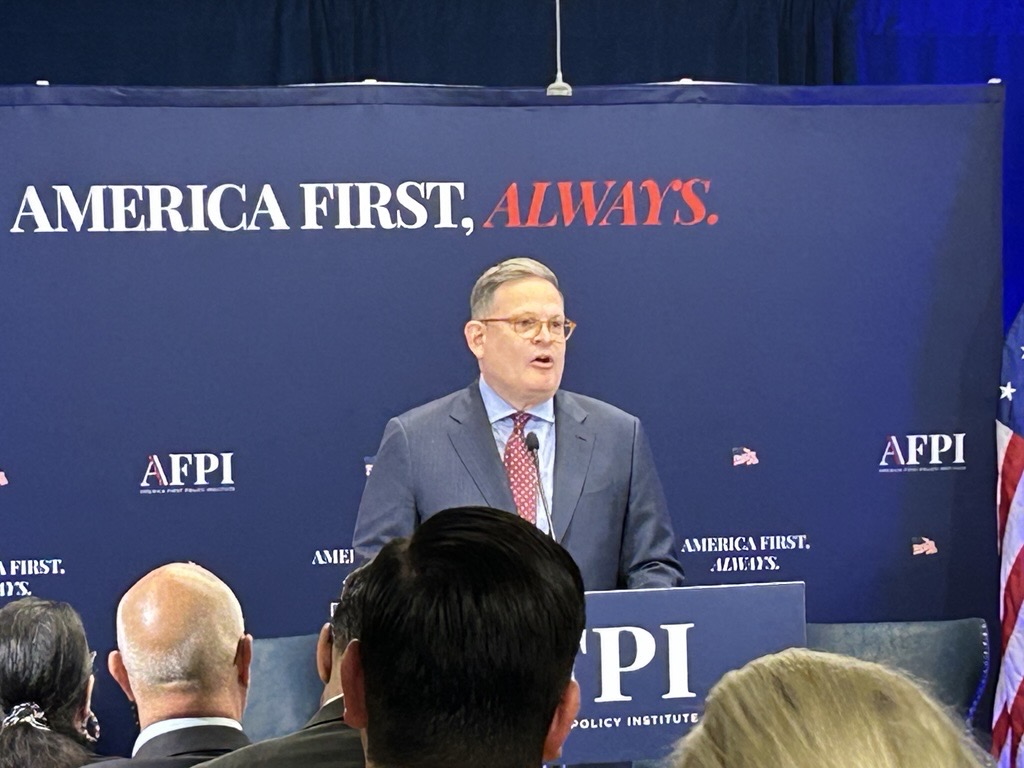
Panelists, including Avila and Aguilar, defended the administration’s mass deportation agenda, arguing that those policies are required for safety. Although a low percentage of migrants facing deportation have committed violent crimes, panelists claimed that a majority have some form of criminal history.
Aguilar said that number is 70% — the same number reported by the Department of Homeland Security (DHS). This number includes people convicted of crimes and those who face charges but have no convictions. It includes both felonies and misdemeanors.
Speaking to EWTN News, Aguilar said some nonviolent crimes are serious: “Child pornography is not a violent crime. It is a serious crime. Those are being detained as well.” During the panel, he noted other nonviolent crimes that put people at risk, such as driving while intoxicated.
“There is a 30% who are collateral arrests, but they are arrested when thereʼs an enforcement operation going after a criminal,” he told EWTN News.
Michael Garcia, a former Republican congressman from California, said during the panel that it’s important to “hold the criminals accountable first,” calling enforcement “common sense.”
During the panel, Emilio González, former director of U.S. Citizenship and Immigration Services, also noted that he is an immigrant, but he considers illegal immigration to be the greatest threat to legal immigration.
“It should be legal, it should be safe, it should be orderly,” he said.
Family separation, mass deportations
Before the panel began, Aguilar, a Catholic, quoted the concerns Cardinal Robert Sarah has expressed about large-scale migration, in which the cardinal noted that people come to Europe “penniless, without work, without dignity.”
“The Church cannot cooperate with this new form of slavery that has become mass migration,” Sarah said.
At the same time, Pope Leo XIV has encouraged support for migrants. In addition, the USCCB overwhelmingly backed a November 2025 joint statement to oppose “the indiscriminate mass deportation of people” and unnecessary separation of families.
A Brookings Institute report this week estimated that more than 100,000 children have been separated from their families as part of deportation proceedings.
A DHS spokesperson said in a statement to EWTN News that immigration enforcement “does not separate families,” adding: “Parents are asked if they want to be removed with their children or ICE will place the children with a safe person the parent designates. This is consistent with past administrations’ immigration enforcement.”
Avila, who had a career in federal law enforcement before joining the Trump administration, told EWTN News it’s “not a good feeling for us as police officers” to separate families, but that if someone in the country unlawfully has children who are citizens, then they have an option for the children to remain in the country or leave with the parent.
“They think that if my kid is a U.S. citizen that I get to somehow stay here,” he said, adding that this situation does not justify remaining in the country unlawfully.
“I arrested countless people in my career,” Avila said of his law enforcement experience. “One hundred percent of the time, I separated families.”
He said immigration enforcement has “separated families all the time” including when Avila worked for DHS under former President Barack Obama. He alleged a “double standard” in rhetoric from “the [political] left.”
DHS reported more than 675,000 deportations in Trump’s first year in office and has estimated more than 2.2 million self-deportations in that time period. Some organizations, including the Center for Migration Studies, have questioned the asserted self-deportation numbers.
Leave a Reply
You must be logged in to post a comment.