
SUNAMGANJ, Bangladesh — As Catholics around the world mark Laudato Si‘ Week, a Caritas Bangladesh project in the countryʼs remote northeastern wetlands is offering a quiet, concrete example of what the late Pope Francis’ encyclical on care for creation looks like in practice.
In the Jamalganj area of Sunamganj district, about 4,000 families — roughly 20,000 people — are learning to grow food year-round on previously unused land in their backyards, raise poultry without chemical pesticides, and produce organic fertilizer from earthworms and cow dung.
The project, formally known as the Livelihood Diversification and Climate Resilience Project for the Haor Region, is run by Caritas Bangladesh, the charitable arm of the Catholic Bishops’ Conference of Bangladesh. It began in July 2023 and is scheduled to run through January 2027.
‘The taste of the food is better now’
Rubina Begum, 30, is one of the beneficiaries. On a small patch of uncultivated land beside her home, she grows gourds, eggplant, beans, and leafy greens — all without chemical pesticides or fertilizers.
“Caritas gave me earthworms and I am preparing fertilizer by releasing them into the cow dung. I am applying that fertilizer to the vegetable garden. I am using a kind of trap to kill the insects; I am using stove ash to kill insects. I am not using any kind of chemical pesticides or fertilizers,” Begum told EWTN News.
Before joining the program a year and a half ago, she used conventional farming methods. The difference, she said, is tangible.
“When we used to farm earlier, the yield was low and the taste of the food is also better now than before. We are also selling vegetables in the market to meet the needs of our family. With this, we can do other household purchases,” Begum, a mother of three, said. “At the same time, I am farming ducks and chickens at home, but earlier, due to the use of pesticides, I could not farm ducks and chickens at home; they would die.”
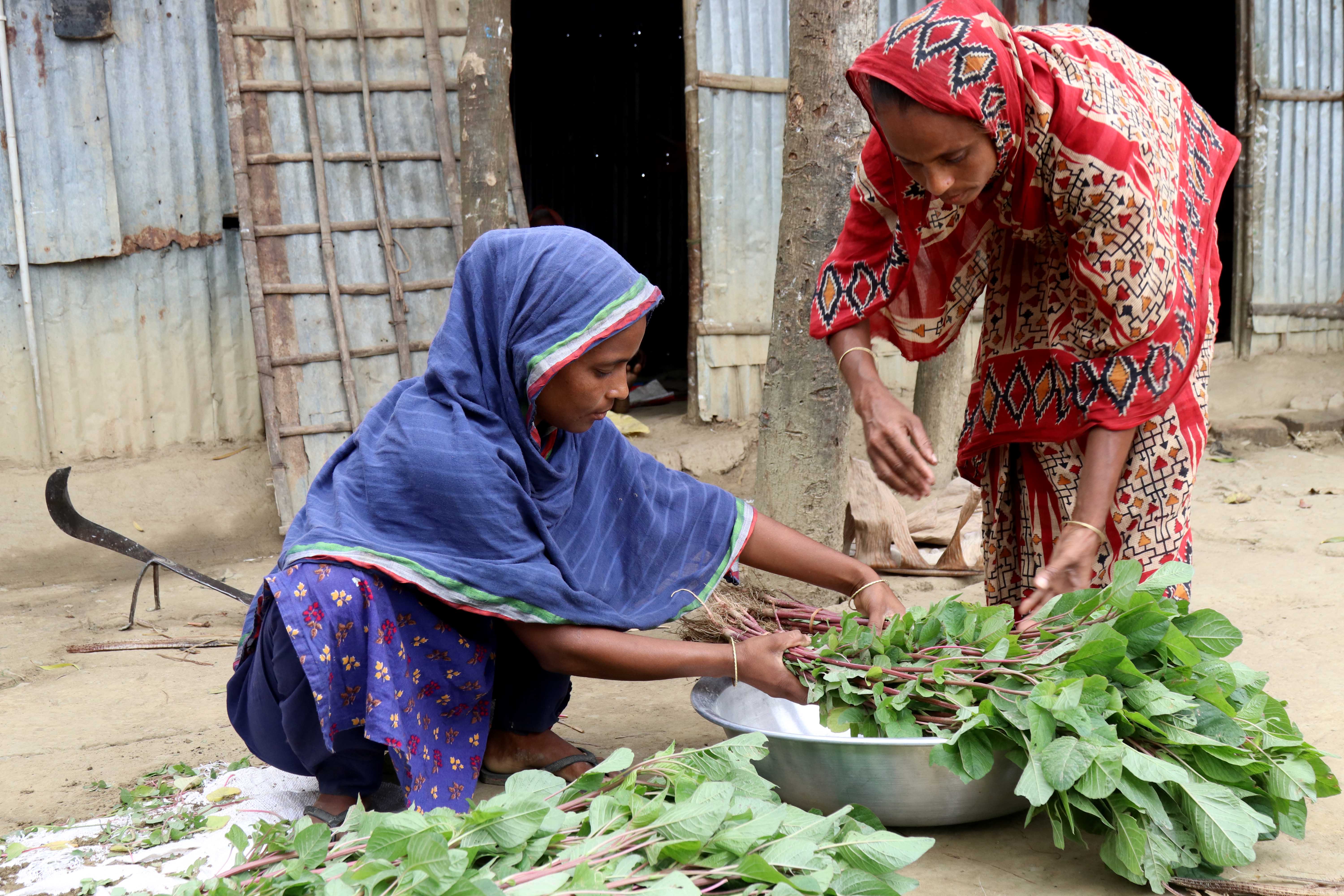
Her husband, Samraj Miah, 40, is a day laborer. The Jamalganj area sits in Bangladeshʼs haor region — a basin of tectonic wetlands that floods for roughly four months each year, leaving families like theirs without work or income for extended stretches.
“I am grateful to Caritas. Because we are now able to live fairly comfortably by using the methods Caritas have taught us about vegetable cultivation and poultry farming,” Miah told EWTN News.
He added that a cow or two would allow them to produce their own dung for fertilizer rather than sourcing it from neighbors, while also supplying milk for the familyʼs nutritional needs.
A region where 90% live in poverty
According to the 2022 national census, the population of Jamalganj subdistrict is about 185,866 across an area of roughly 309 square kilometers. About 90% of the population lives below the poverty line, according to local government estimates.
Agriculture is the areaʼs primary livelihood, but climate change has made it increasingly precarious. Seasonal flooding eliminates crop production for four months each year, with an additional two months of knock-on disruption — meaning families can face six months without reliable income.
Caritas Bangladeshʼs response extends beyond kitchen gardening. The project also provides sewing machines and training, seed funding for small businesses, support for traditional handicraft workers, and tree-planting initiatives.
Aruna Debnath, 72, and his wife received about 5,500 taka (about $45) in startup assistance from Caritas. With the money, they buy bamboo and other materials and now earn about 2,500 taka (about $20) per week making baskets, pots, and chicken nets from home.
“We used to work as daily wage laborers, but as we get older, it becomes very difficult to work as day laborers, and many times they donʼt even want to hire us. But after receiving financial assistance from Caritas, we are working from home,” Debnath told EWTN News.
“I work at home on my own terms, take a break when itʼs hard, and then work again. With the income we earn, our family is living well,” he said.
The couple acknowledged, however, that the rise of cheap plastic alternatives has undercut the market for their biodegradable bamboo products.
‘A part of Laudato Si’ and environmental conservation’
Swapan Nayek, the project supervisor, told EWTN News that Caritas Bangladesh is incorporating the teachings of Laudato Si’, the late Pope Francis’ 2015 encyclical on the environment and human development, into every project.
“Among our various activities, we focus more on kitchen gardening so that they can produce something throughout the year on the fallow land in their backyards to meet their familyʼs needs and earn some income,” Nayek said.
Tree planting and greening are central to the haor project, he added, calling vegetable cultivation and annual tree planting “a part of Laudato Si’ and environmental conservation.”
But Nayek was candid about the scale of the challenges. Beyond food insecurity, the haor region faces acute problems with sanitation, healthcare, and access to clean drinking water.
“In the haor, there is not only a problem of food but also problems of sanitation, healthcare, drinking water, and these places are big challenges for us. We are providing services on a small scale, which is insufficient,” Nayek told EWTN News. He said more funding and vocational training are needed to expand the projectʼs reach.

The project also partners with the Bangladesh governmentʼs Department of Agriculture. Suman Kumar Saha, the agriculture officer for Jamalganj, praised the collaboration.
“Caritas‘ field-level farmer selection and the technology and resources they have are, in a word, extraordinary. Since Caritas is working for the socio-economic development of women here, this is also very commendable,” Saha told EWTN News. “The people of the haor are in great distress, and Caritas’ training and education are working very well to help them overcome that distress.”
For Begum, the aspirations are simpler and closer to home.
“I hope to make my children if not doctors, engineers or anything else, at least ideal farmers,” she said.