
The president of the Mexican Bishops’ Conference issued a powerful call to the Church and society not to turn away from those suffering because of the violence that is the result of organized crime, declaring that “our God hears the cries of the victims, walks with them, and calls upon us, too, not to look the other way.”
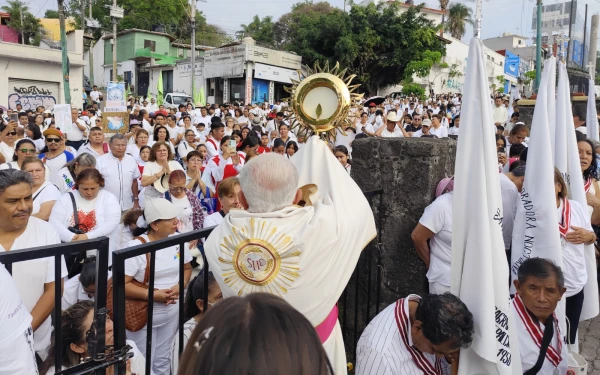
Bishop Ramón Castro Castro of Cuernavaca delivered the message during the 12th annual Walk for Peace in his diocese on Saturday, May 16, as thousands gathered to reject resignation in the face of ongoing violence.
This march, he said, demonstrates that the people of Morelos are “a people who keep moving forward, who don’t give up, and who continue to believe that peace is possible.”
According to the most recent report by the Citizens’ Council for Public Security and Criminal Justice, 17 Mexican localities appear on the list of the 50 most violent cities in the world. Cuernavaca ranks 23rd.
Guarding the ‘flame’ of peace
After recalling the message of Pope Leo XIV for the 2026 World Day of Peace observed on Jan. 1, in which the Holy Father described peace as “a small flame threatened by the storm,” Castro affirmed: “That is what we have come here to do today: to guard that flame so that it’s not extinguished by the storm. And we do so together, for if we stand alone, it goes out. But together, we can keep it lit.”
The Mexican prelate emphasized that his message is not “that of a politician, nor of a social analyst, nor of someone who seeks to point out the suffering of others from a distance. I speak as a shepherd, as a brother who walks alongside his people.”
“I speak as a disciple of Jesus Christ who has seen too many tears on the faces of [the people of] Morelos and of Mexico, of our homeland, so deeply wounded by the violence afflicting our families,” he noted.
“I have heard the mothers who break their silence, searching [for their disappeared children],” he continued. “I have seen the fear of young people who feel their future slipping away; the weariness of entire families living amid uncertainty, violence, and abandonment; the exhaustion of transport workers unable to earn an honest living because organized crime holds them in subjugation; and the fed-up frustration of so many who can no longer put up with the corruption we endure.”
In the face of this suffering, he said, “the Church cannot remain indifferent, nor take refuge in the comforting atmosphere of its churches; for the God in whom we believe is not a God who observes from afar, he is the God of the burning bush, the God who said to Moses: ‘I have seen the oppression of my people, I have heard their outcry, and I have come down to deliver them.’ Our God hears the cries of the victims, walks with them, and calls upon us, too, not to look the other way.”
“The Church is not here to divide or to sow confusion out of ambition or to gain power; the Church is here to build based on the truth, for only the truth can open the way to authentic reconciliation,” the prelate said.
“In the face of the person mourning a child, of the one who has been forcibly disappeared, of the one being extorted, or of the one who has lost hope — there is Christ, crying out once again from the cross,” he lamented.
A priest forced to leave his parish due to death threats
The prelate subsequently referred to the “particular wound” afflicting the small town of Huautla, in southern Morelos — one of the “poorest and most forgotten corners of our state,” a “land of simple, hardworking people; a land hard hit for years by poverty and migration; a land that has watched its children depart in search of the daily bread they can’t get there.”
There, he denounced, “organized crime has reached a level of cruelty that defies description,” exacting extortion payments, also known as protection money, “simply for living there, simply for owning a home.”
“When the pastor of St. Francis of Assisi Parish in Huautla became the last bastion of hope for the community, as the priest so often is in Mexico’s most vulnerable villages, and when his presence and his words were the only support the people had left to keep from sinking into despair, organized crime threatened to take his life.”
“Those threats were so serious, so real, and so concrete that he was forced to leave his community for his own physical protection; and today, Huautla is left without a shepherd,” he lamented.
Governing means not abandoning the people
Castro emphasized in his message that “governing means not abandoning the people. Governing means not refusing to take up the responsibility of guaranteeing the security and well-being of every person within the territory entrusted to them.”
“Our heartfelt plea without mincing words is that Huautla not be left all alone; that the government do its job to help the mothers searching [for their disappeared children] an effort which they rightly deserve; that transport workers be afforded security; that thousands upon thousands of merchants — micro, small, and medium-sized alike — be able to work without having to pay protection money; and that our young people be provided with real alternatives: quality education, decent jobs, and personal safety, so that organized crime is not the only door open to them.”
“We ask you, government officials, not to sell us false narratives. The people aren’t buying them anymore then you declare peace, while 90% of the people of Morelos are afraid to step out onto the street. That’s not governing; that’s an insult to the intelligence of the people,” he stated.
At the same time, he assured the authorities of help from the Church and its priests, religious, and communities: “We’re not here to criticize for the sake of criticism; we are here to contribute, to offer accompaniment, to put forward proposals, and to walk together toward peace.”
This story was first published by ACI Prensa, the Spanish-language sister service of EWTN News. It has been translated and adapted by EWTN News English.
Leave a Reply
You must be logged in to post a comment.