
Editor’s note: Part One of this essay can be read here.
——————
Wait, we’re not home yet, though. The journey’s not over.
Less than a week later, I was back in a car. A rental because I’d not yet roused the particular type of energy required for purchasing a car in these United States. I was driving this horrible little Chevy that could barely get up my driveway and taking it, to the wild west this time, but to the deep south, to a conference on Catholic arts at a Louisiana monastery. My friend who lives in Houston wanted to come, but couldn’t, so I decided that after the weekend, I’d just shoot over to Texas for a day to visit her, and then return to Alabama. Hopefully, staying still for a good long while after that.
I considered the route. I tracked it, traced it. It would be mostly along I-10, the interstate that runs along the Gulf Coast and the Florida panhandle. You know where this is going, don’t you? Baton Rouge, Lafayette, Lake Charles, Beaumont, Houston. Right off the interstate, every one of them.
Let’s see, just to see.
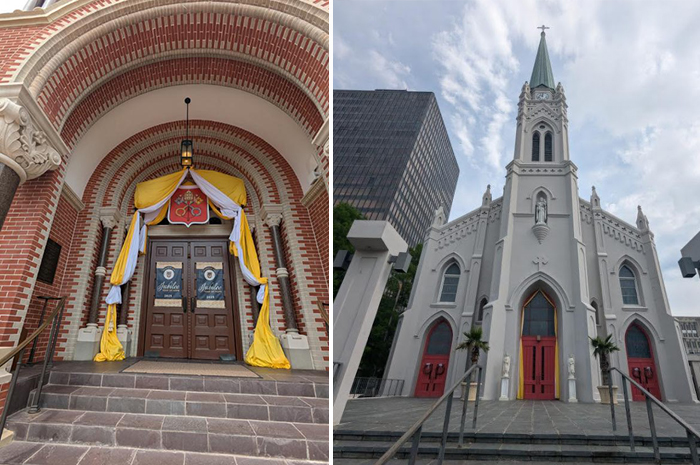
In two weeks, the Catholic vibe had dramatically shifted, and the cathedrals along I-10 showed me how.
The black, of course, was gone, packed away until next time. Since, as the saying goes, there’s nothing deader than a dead Pope, the Francis photos were gone, too, probably packed away until never.
Instead of black, goldish yellow and white ruled the day. The astonishing brick Romanesque and Byzantine-styled St. John the Evangelist in Lafayette won the prize with a landscape of papal-colored flags and banners whipping in the wind in the front plaza, an elaborate bunting over the front door. And they’d even obtained an official Leo photo for the narthex wall.
No one else came close, with the enormous, pristine, newish co-Cathedral in Houston coming in dead last of all of them, with ribbons that could have wrapped a package dripping over the door. But they all tried, all marked themselves with that gold and white, a plaque of Peter’s keys if they couldn’t swing the photo, all saying in some way to the world Habemus papam, and you don’t.
Along I-10, back up in Wyoming, in Birmingham, anywhere, the Catholics were happy. Even though we still didn’t know anything much about this Leo.
——————
Leo will probably be my last pope, but of course, he’s not my first. I remember nothing about John XXIII and Paul VI (except when Paul died). I was a college freshman plugged into the Catholic student ministry in the fall of 1978. We were momentarily charmed by John Paul I, shocked at his death, puzzled by this new pope from Poland.
Years of John Paul II, then Benedict XVI reigning and resigning, and then Francis.
What did I think of them? Well, the theme of this piece is the puzzle of a Pope’s meaning, so does it matter? I would like it not to matter, for that very issue–the particular way that the pope has come to matter in the lives of Catholics–bothers me.
When did it start, this interest in the person of the pope, this association of one’s Catholic temperature with how one felt about what this pope said yesterday, or how friendly he seems, how he sits on the world stage, or how he meets the cameras?
As soon as the cameras started rolling, I suppose, and as soon as those images started speeding around the world. It’s a potent mix that’s been created: the modern and post-modern evacuation of the transcendent, of inherent meaning, leaves us with little but our response to experience as a gauge of authority and authenticity. Faith decisions based less on our assessment of truth than on how the particular community, the music, the vibe makes us feel.
Which is all about people, isn’t it? About how their personalities and actions call to us, how appealing they are?
And whose stage is bigger than the pope’s?

This took a particular, even nasty, turn over the past few pontificates. JPII priests, B16 converts, Francisphiliacs, Francisphobiacs. The evacuation of much of the solid core of Catholic faith and practice in the wake of the Second Vatican Council. That sense, which I lived through as a young Catholic in the Seventies, that much of the Faith is up for grabs. That the Faith is dependent on the movement of the Spirit in the moment and your response to that moment—that left us, so very free in the Spirit, but not shockingly at all, adrift.
Untethered from immutability, supposedly for our own sake, we float, unsatisfied as it turns out, with little more than our own experiences and insights, than the bitter feelings that are left when the community that was supposed to be the vibrant Body of Christ in our Time just…turns.
So what remains? Well, not much more, for a Catholic, than where the culture, the landscape, the atmosphere of this post-modern life points us toward as the most substantial expression of faith still standing in our emotionally-responsive, celebrity-focused age: a pope.
Do you love this pope and everything he says, all those words we normie Catholics would never have read fifty years ago, but now have delivered to our inboxes every morning? Do you respond to this pope and his gestures that appear on the news or on your feed in the appropriate, filial way?

Check yes for Good Catholic, no for Bad Catholic. Final evaluation: depends on who’s checking.
This hyperpapalism is the fruit of aspects of our social, cultural, and even theological age, but it’s not the way it should be. It reached an intense, unrelenting peak with Francis and his supporters and critics, and I think by the time he died, many were exhausted with it all, because we know. Even the most loyal pope-lover knows. It shouldn’t be this way. Can we just love the Pope – in his proper place? And can he just stay there?
In Paolo Sorrentino’s lush, fabulous but flawed The Young Pope, Jude Law plays another American elevated to the papacy, one Lenny Bernardo.
There’s a lot to say about the show–and I have, in other places, but the element to focus on here is simply this: A primary theme of The Young Pope is not “conservatism” or “liberalism,” as it may seem from the outside, but something more intriguing: Lenny’s determination to remain hidden.
For months after his election, he doesn’t celebrate Mass in public, he doesn’t speak, and he has no time for the Vatican marketing department, which wants to profit from slapping his image on anything from lighters to calendars. He agrees to make a journey to Africa, indicating that yes, here is the moment he’ll initiate his public presence. But–no, he doesn’t. In the end, all he’ll give them is his voice over a loudspeaker. It’s not out of coyness, though. He’s seen that his presence is going to be used by corrupt powers, both civil and religious, and he will not have it.
There’s more, of course, and some of it is smart, and some of it is stupid (and the sequel, The New Pope, is quite stupid), but what an interesting, salient point, a response, really, to everything I’ve seen, not just on this trip but in sixty years as a Catholic. It’s not that, unlike some voices call for, we want the pope to just shut up and stay in his lane. It’s that in the wake of a papalism that seems to have become a divisive, rather than unifying force, a reset might be called for.
We’ve got an instinct to rejoice in our pope. We trust that his existence is a sign of God’s continuing presence. I will never leave you orphaned.
But energized by his agenda, by elements of his personality, by likes and, yes, by dislikes, he can be too much. Incited by emotionally-centered, insubstantial faith formed in a personality-focused culture, we can want too much.
——————
After seeing this very real, and not-at-all pope-fixation grow and divide over most of my adult Catholic life, I confess a sense of, if not despair, at least great frustration. Could we ever get over it? Will we ever be—not JPII, B16, Francis, or Leo Catholics—just…Catholics again? One faith, one baptism, and all that?
Well, as I saw along I-65, I-80, I-90, and I-10, down the Mississippi River and along the Gulf Coast, the answer just might be yes.
And maybe, despite the shrieking of us online types, the answer has been yes all along.
For I didn’t just hit cathedrals on these trips. Of course not. I poked around everywhere. I studied the great evangelist Fulton Sheen’s typewriter and his notes and prayed at his tomb in Peoria. Up in another part of Illinois, I walked around the hard work of another not-so-famous priest, who’d spent years, probably decades, painstakingly constructing, out of another sort of evangelistic spirit, a quirky, beautiful grotto of biblical scenes from stone and found objects.

I stumbled into a First Communion practice full of excited children in the wildest, most intensely, exuberantly decorated basilica in Iowa, I think, and then drove a few miles down the road to the silence of a chapel—the simplest, lead-adorned Trappist monastery. In Spillville, Iowa, I opened the door to a quiet old church, walked right up to the organ loft, studied the sign that told me this was the organ where Antonín Dvořák played for Mass during the summer of 1893, and I took a photo of it for my own organist son.
I found Flannery O’Connor’s dorm and her plaque on the streets of Iowa City, but I couldn’t go into the church she attended there—because it’s a church, not a museum—and there was a funeral that morning. In the Stations of the Cross in a reservation chapel in Wyoming, a native Jesus was crucified, and his mother, with strong features and straight black hair, mourned.
In Lake Charles, Louisiana, worshippers were settling in for the Latin Mass. In Covington, Walker Percy, who foresaw the crackup of American church and society in absurd, yet uncomfortably true ways, lay buried in a monastery cemetery while yards away, his hopeful heirs in American Catholic arts and letters talked, once again, as we always do, about what Catholic art exactly is and who is the Catholic artist in Church and society exactly and…
…all of that, yes, as we always do.
All of that life, that variety, all of that dying and rising, as the popes came and went, there we were all along, here we remain, considering these mysteries that leave us, if we can cling to hope, in the end, as Paul says, “…perplexed, but not in despair” (2 Cor 4:8).
——————
On a weekday in late April, I went to look at Grant Wood paintings in Cedar Rapids and saw that there was Mass at a parish nearby, around noon. I parked and noted the surprising number of cars in the lot. Another funeral? In a way, I suppose.
Inside, the reason for the large number was clear–it was a Mass for the repose of the soul of Pope Francis. The church was full for him.
And as I listened to the priest’s homily and considered the diversity of the congregation–young, old, all ethnicities—an older woman, severe in demeanor behind me, a young woman in torn jeans talking on her phone outside as she walked behind me saying, “Oh for sure, I’ll pray for you; I’m going to Mass right now”–and what we were all praying for, I was, again, moved.
Where else do you find this on earth? Or find it in human history? Nowhere. For good or for ill, nowhere. And I can’t help but believe it’s overwhelmingly for good.
So what did the priest say at this lunchtime Mass, in the middle of Iowa?
He began by explaining why he was wearing red. That for a Mass for the deceased Pope, the celebrant wears red in recognition of the way in which a pope is called to pour himself out completely for Christ and for his people.
He said other things, but he ended simply. That, in essence, what we pray for is not anything more specific than the gift of a “good and holy Pope.” All over the world, at Masses like this, in homes, in our hearts, that’s it, making our way, trusting, that was the prayer, no more, no less: for a “good and holy pope.”
Oremus.

If you value the news and views Catholic World Report provides, please consider donating to support our efforts. Your contribution will help us continue to make CWR available to all readers worldwide for free, without a subscription. Thank you for your generosity!
Click here for more information on donating to CWR. Click here to sign up for our newsletter.
Leave a Reply
You must be logged in to post a comment.