
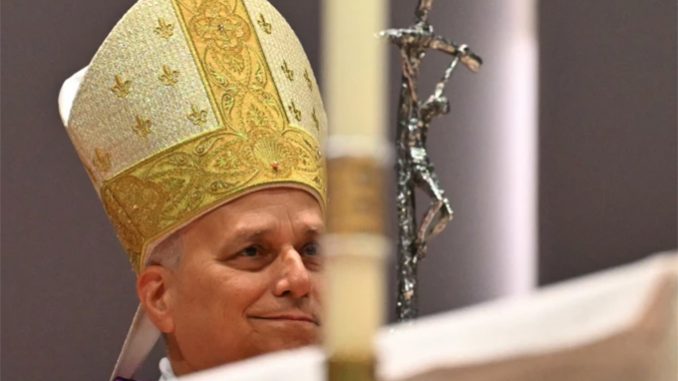
On the anniversary of his election, and with a year of the papacy under his belt, it is fair to say that Pope Leo would make, as a friend of mine has stated, a “good poker player”. He holds his cards close to his vest and is careful to avoid giving away “tells” as to his deepest theological convictions.
I, however, will put my cards on the table: I like Pope Leo, and I think he is cautious to a fault precisely because he senses that the greatest need right now is for the turbulent ecclesial waters to be calmed.
Testing on two fronts
But that desire for a calming of the waters is about to be tested on two fronts with the emergence of two ecclesial headaches—from each end of the spectrum—that are going to force Leo to make some stark decisions.
First, Cardinal Reinhard Marx in Germany stated recently that the German bishops are going to issue a formal blessing for homosexual “unions”, precisely as an official liturgical blessing of those unions per se as unions. Unfortunately for the Germans, this violates Fiducia Supplicans in at least two ways (which I will discuss below). The German disregard for Fiducia is a serious matter, regardless of what one thinks of Fiducia, because the German move signals a kind of “end game” escalation of the German “synodal way” with the German hierarchy testing the new pope’s resolve to thwart much of the agenda of that “way”.
Fiducia asserts that the blessings of couples in “irregular unions” must be “spontaneous” and never formalized as an actual liturgical blessing published in an official liturgical text from the diocese. The current German proposal directly contradicts this rule and creates a situation where parishes will be advertising such “liturgical” events and hosting marriage-simulating celebrations for all manner of unions no matter their moral standing within the Church. Anyone who thinks that this is not where this is headed is naïve or in denial.
The Germans are attempting an end-run around Church teaching by stating that these are blessings of unions, but not in any way a form of “gay marriage” in the Church. But this is such a transparently empty distinction, given what the average German Catholic thinks about sex and gender issues, that nobody really believes that this is anything other than an attempted normalization of homosexuality in the Church.
Finally, and most obviously, Fiducia forbids the use of these blessings as a blessing on the union as such, and what is being blessed are merely two individuals who have asked for a blessing in order to lead a better and more Christian life. I think this is a slippery distinction, as I have written before, since it is open to the very abuses the Germans are now pushing.
Needless to say, just as with the SSPX’s recent announcement that they will defy Rome and ordain new bishops in July, here too is a “crisis” that has been deliberately engineered. There was nothing in the German situation that “demanded” this action be taken now. There is no real “emergency”—the Germans have decided, for reasons known only to them, that now is the time to throw down the gauntlet.
Differing motivations
The two situations, it seems to me, differ in their motivations.
The SSPX decision seems grounded in an exasperated impatience with Rome’s “stubborn” belief that an ecumenical council and the six papacies that followed it still carry binding and normative magisterial weight. The SSPX leadership knows that Pope Leo will not change this reality, and therefore their overtures to Rome for dialogue ring hollow. They know the situation is hopeless in terms of “regularization” and so their motives for making the move now are clear. We have a young pope who is not a “traditionalist”. Time to move on.
The Germans, by contrast, seem to be merely kicking the tires on this young papacy and deliberately engineering this confrontation to gauge just where Leo stands on all of this, and, by extension, how much else of the Teutonic “synodal way” will survive under his leadership.
It did not take long for the Germans to get their answer. In an airplane interview on April 23rd, Leo made it clear that the Vatican does not agree with the German plan and that this has been communicated to the German hierarchy. He did not say if there was any response from the Germans, nor did he give any clues about what he might do if the Germans defy the Vatican and move ahead with the blessings. The only clue he may have given, however obliquely, was to say that he did not think matters of sexual morality should divide the Church.
Was that a warning to the Germans that the Pope considers their proposal as potentially a sin against ecclesial unity and thus they should not insist upon it, or was he signaling that the Vatican would not insist upon its views on the matter, sacrificing doctrinal truth for the sake of ecclesial peace? My money is on the former and not the latter since Leo must surely understand that if the Vatican just turns a blind eye to the Germans, should they go ahead with this, the silence from Rome would in effect be a tacit approval for the new blessings, or at least that the matter is not important enough to warrant discipline.
And this would give a green light for many other liberal leaning episcopal conferences to do the same. At which point it would be too late for Rome to stop the popular tsunami of “gay blessings” that would sweep across vast sectors of the Church.
Pope Leo’s remarks on sexual morality
In that same interview, Pope Leo went on to reorient the relative importance of sexual morality in the hierarchy of moral concerns, which I think was expressed somewhat clumsily. I in no way think he meant to communicate via his statement that sexual issues are trivial. Furthermore, he was correct to point out that a singular fixation on sexual matters as the main focus of Catholic morality is a false characterization. And this is not a bogeyman or a straw man he is attacking, since there are many Catholics who, either consciously or subconsciously, so emphasize sexual purity as the bell cow of a “virtuous life”, that it has the net effect of trivializing other sins that are truly toxic to the soul in deeper ways.
By way of support for the pope’s views, I offer here what C. S. Lewis had to say on this topic:
If anyone thinks that Christians regard unchastity as the supreme vice, he is quite wrong. The sins of the flesh are bad, but they are the least bad of all sins. All the worst pleasures are purely spiritual … For there are two things inside me, competing with the human self which I must try to become. They are the Animal self, and the Diabolical self. The Diabolical self is the worse of the two. That is why a cold self-righteous prig who regularly goes to church may be far nearer to hell than a prostitute. But of course, it is better to be neither. (Mere Christianity, Christian Behavior, chapter five)
However, despite the obvious truth of the pope’s casual observation, some have claimed that the comment was at the very least “infelicitous” and in need of a better and more nuanced treatment. Especially in light of the interconnectedness of the Church’s moral teachings, which, although admitting of a hierarchy of truths, never pits the higher against the lower.
But was the pope “pitting the higher against the lower”? I think not. There is another way to read the pope’s comments that goes beyond a lament over yet another papal controversy generated by an off-the-cuff airplane interview. And that approach is to read his comments about the hierarchy of moral concerns as indicative of why he thinks both the SSPX and the Germans are wrong; to wit, that they both represent a skewed understanding of the exact nature of the crisis we face in the world today and, therefore, are engaging in a truly false reading of the “signs of the times”.
In other words, what they prioritize as of ultimate importance–even to the point of stressing ecclesial unity to the breaking point–is not of ultimate importance at all. It is not even of penultimate importance.
Herein, we begin to see the emerging theological priorities of Leo’s pontificate. And those priorities have no time for the bourgeois sexual obsessions of the left or the rage nostalgia of the Catholic right, as it seeks a romanticized restoration of a Church that never actually was.
We see this in his response to the SSPX. And so far, that response is silence; a “talk to the palm” dismissal of the SSPX’s myth of origin, which is that it is the sole hope for a Church in the death throes of a wide and deep apostasy. His silence represents a thorough rejection of the SSPX claim that this apostasy stretches from the pope in Rome down to the lowest regions of the Church, as seen in such “blasphemous” outrages as communion in the hand and the horrific “Masonic” Novus Ordo.
The restorationist emotivism of the SSPX betrays an intellectual immaturity incapable of dealing with the nettle of the sociocultural crisis that confronts us. In short, I think that, for Pope Leo, the Church does indeed face a crisis. But it is not the crisis the SSPX imagines it is. Furthermore, the SSPX’s misdiagnosis of the crisis at hand leads them to make positive prescriptive proposals that will not only not heal the crisis, but will make the patient far sicker.
Pope Leo, in my view, and without minimizing the need for intra-ecclesial reforms, understands that the real crisis we are facing is a sociocultural one with far-reaching implications for all of humanity, including, of course, those in the Church. What we see is the coming together of a perfect storm of cultural factors that threaten to strengthen into a monster typhoon of revolutionary change.
The current crisis and Leo’s thinking
This perfect storm began with the emergence of the reductive materialistic naturalism that is the default worldview of modernity, going back two or three centuries now. This reduction, which is ultimately corrosive of the human, is then combined with the modern digital technological revolution and further combined with the rise of predatory surveillance capitalism. All of this is larded with a de facto atheism that insinuates into this digital erasure of the human a subtle nihilism, which brings in its wake the false anthropology of a neutralist understanding of freedom as autonomy, all of which is finally now culminating in the rise of a truly post-Christian situation on both the political right and the left.
In other words, I think Leo sees clearly that the crisis that confronts us is a crisis of the loss of humanity as such, with the attenuation of our souls becoming so severe that it is a thinning out into a wispy, gossamer nothingness–both fragile and fungible–that only a return to Christ can solve. The moment we face is a radical one insofar as it is taking us back to the very roots of everything, all of which demands a powerful doubling down on the pursuit of holiness. As C.S. Lewis observed, what we face is the loss of the contours of the human in the “Abolition of Man”.
I think this is Leo’s concern as well.
Leo’s response to the Germans is equally dismissive. His comments could be rephrased as, “stop your obsession with sex and come out of your adolescent arrested development, since we have much larger concerns on our doorstep than baptizing and promoting the exhausted categories of bourgeois sexual mores.” That may be reading a lot into the pope’s comments. But based on many other things he has said, I think it is an accurate reading.
There are three keys to the mind of Leo here that are hidden in plain sight.
First, that Pope Leo is an Augustinian and therefore it is safe to assume that he has a largely Augustinian understanding of history as the theodramatic confrontation between the “city of man” and its fundamental orientation to the libido dominandi, and the “city of God” with its fundamental orientation to the love of God, and all that relates to God, which includes the charity and justice owed to our neighbors. Therefore, it is highly doubtful he is in that school of thought that believes that the Holy Spirit is “doing a new thing” via the unregenerated desires of pop culture, now baptized as the very voice of God.
The second key is his choice of the name “Leo”. I think he did so after very careful consideration. Many of the names he could have chosen carried with them the baggage of ecclesial politics. Had he chosen the name Francis or Benedict or Paul or John or John Paul or Pius, instant polarizations would have emerged and a narrative of who he “must be” concocted within hours of his election. Therefore, he reached back to a name not easily given to such political freighting, but also one that expressed his own concern that the Church’s “social teaching” (a term I am not fond of, actually) should be marshalled once again to confront what is perhaps the gravest set of crises ever to beset humanity.
The third key is the fact that he spent twenty years as a missionary in Peru. You do not come away from that experience unchanged. I spent time as a seminarian in Latin America. In the rural, poorer regions, what you encounter are elemental realities and truths that lead to a painful purgation of idolatries as the dross of what del Noce calls the modern “cult of bourgeois well-being” is burned away. Such a man as Pope Leo will have little time for our decadent obsessions with sex or for the epicene foppishness of our new class of liturgical savants.
It is clear that Pope Leo instead wants to tap into the Church’s deep reservoir of Christ-centered wisdom to meet these new threats—threats almost apocalyptic in their implications—via a deep and prophetic critique of the libido dominandi, which has morphed of late and undergone a very real apotheosis into the strong gods of Blut und Erde. To borrow a phrase from Paul Claudel, the Church must recover its Christological “mystique” to combat the counterfeit mystique of the murderous Moloch, the disordered eroticism of Dionysius, and the unvarnished and out-of-control rage of Ares.
Looking ahead
Therefore, both the SSPX and the Germans emerge as obtuse distractions, insofar as their concerns and obsessions are simply non-starters. I therefore make the bold prediction that, under Leo, we are not going to get women priests/deacons, “gay marriages/blessings”, contraception, a democratized Church, or any of the other Germanic fever dream fantasies.
Nor are we going to repudiate Vatican II and the entire modern magisterium of the Church and reject religious freedom, liturgy in the vernacular, and interreligious and ecumenical dialogue. Those also are fever-dream fantasies of a restorationist sort.
Along these lines, there are strong rumors that Leo will publish his first encyclical on May 15th, the anniversary of Rerum Novarum. The rumors are that it will be called “Magnifica Humanitas” (Magnificent Humanity) and will attempt to apply the fundamental social teaching principles of Rerum Novarum in an updated way in order to address topics including artificial intelligence, the ever-escalating threats of war, and the loss of respect for human dignity and moral agency in an age of reductive techno-nihilism.
It reminds me of another first encyclical by a previous pope. John Paul II’s “Redemptor Hominis”. It also was a response to the sociocultural anthropological crisis of our time.
May Leo’s first encyclical be as successful. I think it will be, and it will give us a clear indication of his profound concern for the ongoing desolation of the human landscape.
If you value the news and views Catholic World Report provides, please consider donating to support our efforts. Your contribution will help us continue to make CWR available to all readers worldwide for free, without a subscription. Thank you for your generosity!
Click here for more information on donating to CWR. Click here to sign up for our newsletter.
Leave a Reply
You must be logged in to post a comment.