
In recognizing the work of the Italian Association for Amyotrophic Lateral Sclerosis (AISLA, by its Italian acronym), Pope Leo affirmed that “in the various situations of life — especially the difficult ones — no one should be left alone.”
His words were delivered during an audience with members of the association, which took place Saturday at the Apostolic Palace in the Vatican.
The Holy Father stated that the work of AISLA “unites people experiencing an illness—along with their family members and caregivers—in a therapeutic alliance of great closeness and proximity that faithfully reflects the manner in which Jesus himself approached those who suffer.”
ALS, also known as Lou Gehrig’s disease, affects nerve cells in the brain, brainstem, and spinal cord that control the movement of voluntary muscles. The disease causes motor nerve cells to deteriorate or die, rendering them unable to send messages to the muscles.
Over time, this leads to muscle weakness, spasms, and an inability to move the arms, legs, and body. The condition continues to worsen, and when the muscles in the chest area cease to function, breathing becomes difficult or impossible.
The Pope expressed that patients — with commitment, faith, and courage — “bear witness that the goodness and value of life are greater than illness,” and that the challenges it presents “can be faced together, transforming them into special and privileged opportunities to give and receive love.”
“Thank you for this! As prophets, you teach everyone the true value of life — and our world desperately needs this message!” Pope Leo said.
He strongly emphasized the closeness of the association’s members to the sick — something he considers “very important,” as healthcare requires presence “for the well-being of the person in their various dimensions: biological, psychological, and spiritual.”
“The Church deeply senses the value of this ‘closeness’: standing alongside people — wherever they are, in their homes — to offer support, not only in terms of care but also in terms of spirituality, paying special attention to the questions regarding the meaning of suffering — questions that cannot be left unanswered,” he underscored.
“In the various situations of life — especially the difficult ones — no one should be left alone; and volunteering, which unites people through generosity, powerfully embodies this value by fostering solidarity and respect, and by responding with gestures of care to the culture of waste and death,” he added.
Finally, he invited them to reflect upon the Passion of Jesus, who chose to experience it “as a time of trial, of physical pain and spiritual suffering,” standing in solidarity with humanity to the very end and demonstrating to them “that pain and suffering cannot halt love nor nullify the power of God.”
Augustiner Brewery delivers beer
On May 9, Pope Leo also received pilgrims from the Edith Haberland-Wagner Foundation and the Augustiner Brewery, who presented him with beer as a gift. This gesture allowed the Pontiff to offer two points for reflection.
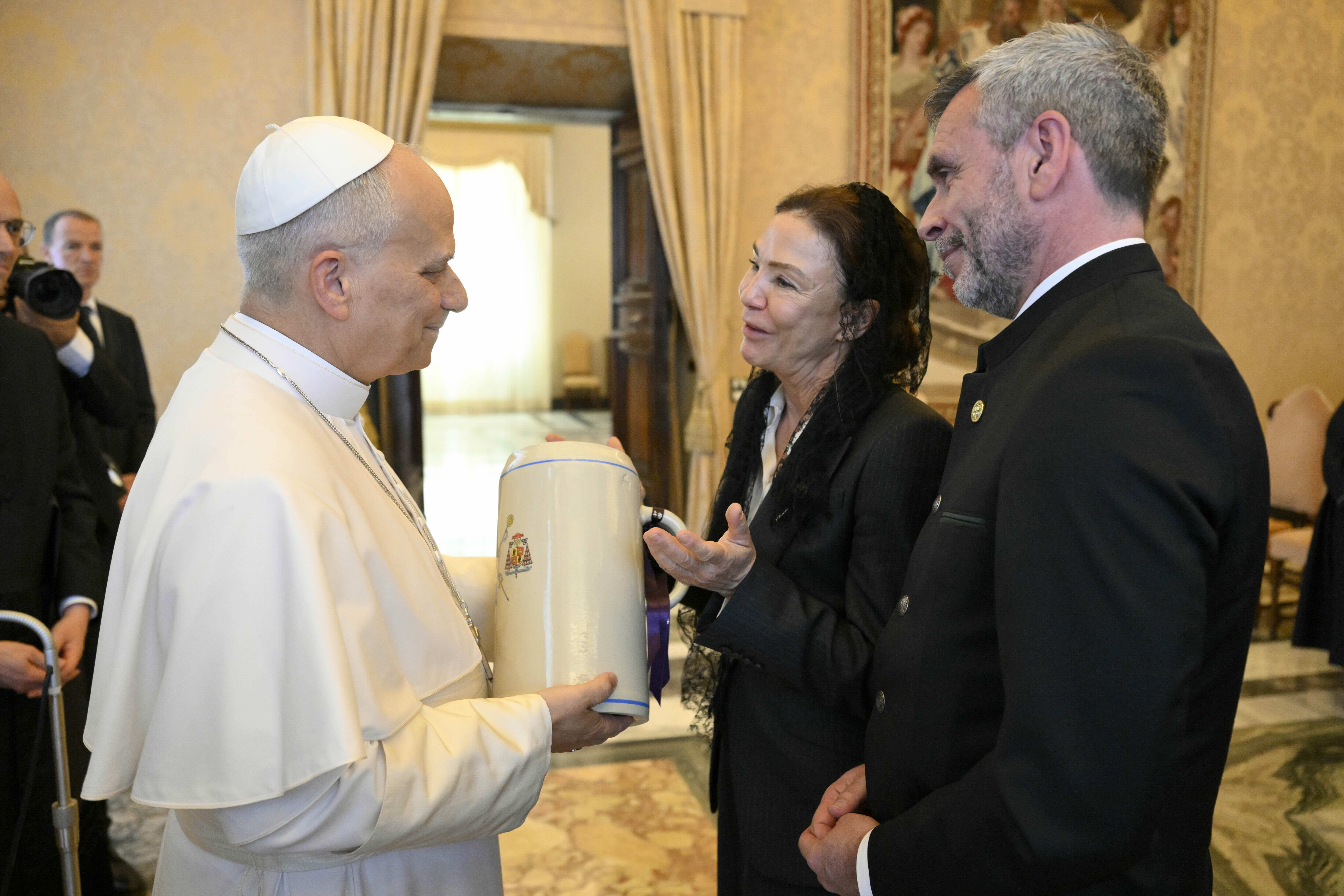
First, he highlighted the pilgrims’ connection to the Augustinian Order, to which he himself belongs. In this regard, he recalled the impact of Saint Augustine on his own life — a figure who “reminds us that we all possess gifts and talents bestowed upon us by God, and that our purpose, fulfillment, and joy derive from offering them in loving service to God and to our neighbor.”
The Augustiner Brewery is the oldest brewery in Munich and the last to remain privately owned. Its history dates back to 1328.
“I hope, therefore, that your pilgrimage not only strengthens you in faith but also inspires you to continue serving your brothers and sisters, especially those most in need,” he affirmed.
Then, recalling Pope Francis’s encyclical Laudato Si’, the Holy Father stated that man is called not only to care for creation, but also to “ensure that its resources are always used with wisdom and with a view to justice — an indispensable prerequisite for peace.”
“Therefore, upon returning home, I encourage you to continue contributing to the promotion of a just and effective approach to the care of creation, both in the professional and personal spheres, for the common good,” he concluded, imparting his blessing upon all present.
Leave a Reply
You must be logged in to post a comment.