
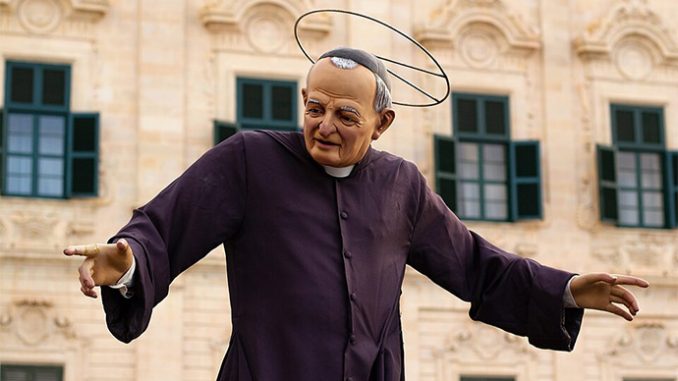
Outside of his native country of Malta, St George Preca (1880-1962) is primarily known (if he is known at all) as the originator of what we now call the Luminous Mysteries of the Rosary. Yet the man whom Pope St John Paul II called the “second apostle of Malta” is a gift not only to his beloved nation but to the whole Church.
The future priest and saint was born in Malta’s capital city of Valletta in 1880. The small island nation south of Sicily, in the heart of the Mediterranean Sea, has a connection to Christianity that goes back almost to its very beginnings. On his way to trial in Rome, the Apostle Paul (with Luke and other companions) was shipwrecked on Malta. Malta was the stage for the striking story of Paul being bitten by a venomous snake resting in the wood for a fire, yet surviving unharmed, contrary to the expectations of the natives. Paul remained on Malta for several months waiting for the new ship that would take him on to Rome (see Acts 28). Paul converted the chief of the island to Christianity before leaving, and St. Publius is considered the first bishop of Malta. Several churches in Valletta commemorate St Paul’s time there.
In the Middle Ages, Malta became a place of conflict during the wars between Islam and Christianity, with the islands sacked and depopulated by Muslim forces in 870, colonized by settlers from Muslim North Africa in the early 11th century, retaken by the Norman Kingdom of Sicily at the end of the 11th century, and coming into the possession of the Military Order of St John in 1530. In 1565, five hundred knights of the order and six thousand foot soldiers withstood the almost four-month efforts of the Ottoman Empire with forces at least 35,000 strong to conquer the nation in what is now known as the Siege of Malta. French Republican forces invaded the islands in 1798, only to be expelled by the British shortly after. When George Preca was growing up, Malta had been a de facto British colony for almost a hundred years.
Malta was around 99 percent Catholic at the turn of the twentieth century, but for many inhabitants, religion was only cultural; their faith did not seem to touch their souls. Young George was an exception. His family had moved to a town not far from Valletta while he was still young. He enrolled in the Brown Scapular of Our Lady of Mount Carmel as a teenager, and with the help of a priest who taught at his high school, he discerned a vocation to the priesthood. In seminary, George had another holy priest as a confessor who, however, died in 1905, before George was ordained. Several times throughout his life, George told the story that this priest in fact appeared to him after his death, bearing the message, “God has chosen you to teach his people.”
That message proved the inspiration for his life’s work.
Inspired by what he took to be a message from heaven, George began working with a group of young people in town, instructing them in the truths of the Faith and teaching them to have a closer relationship with God through prayer. He was ordained in late 1906, and by early 1907, the small group of laymen he taught had grown enough that they started renting a building in which to have their meetings. This building was so run down that the young adults called it the “museum”, and the nickname soon became a way of referring to the group itself. Fr George (rather reluctantly at first, the accounts make it sound) adopted the name but chose to spiritualize it: he turned it into an acronym, MUSEUM, which stood for the Latin phrase Magister Utinam Sequatur Evangelium Universus Mundus! (“Teacher, would that the whole world follow the Gospel!”)
The phrase became marching orders for the fledgling group. Members of MUSEUM were (and still are) laymen who pledge themselves to live lives of Gospel simplicity, to teach the young and the working class their catechism every day, to follow a daily rule of prayer, and to meet regularly to deepen their own relationship with God. Decades before the Second Vatican Council made the call for a lay apostolate universal, Fr. George had established a system of lay discipleship, where those handing on the Faith dedicated themselves to live the Faith with more commitment.
The goal is not to create teachers so much as it is to make witnesses for the Faith. After a long process—which included a period of over a year where the groups were shut down completely during part of the investigation—the diocesan authorities gave the group formal approval in 1932 under the name the Society of Christian Doctrine. There are now over a hundred centers of formation and education in the islands of Malta and Gozo (roughly evenly divided between centers for men and centers for women), with other groups throughout the world.
As he guided MUSEUM, Fr. George continued to grow in his own spiritual journey. He was much in demand as a preacher and confessor. He became a Third Order Carmelite in 1918; thus, with Ven. Fulton Sheen, he was another example of a strong Third Order Carmelite evangelist. In addition to his work guiding and forming the MUSEUM group, Fr. George engaged in the apostolate of the written word. Writing in the Maltese language, he composed Bible studies and wrote dozens of tracts and brief books. His goal in his writing was always to make the Scriptures and the great spiritual traditions of the Church more accessible to the average reader. They are not works to be read so much as works that are meant to become the foundation of one’s prayer. They are less about information and more about formation, intending to inspire the reader to become a closer disciple of Christ.
Jesus the Incarnate Word was central to everything that Fr George said and did: Verbum Dei caro factum est. He taught his listeners to love the Incarnation, inspiring in parishes throughout Malta to have processions in honor of the Christ Child that continue to this day. He taught members of MUSEUM to love the Bible, which he often called “the Voice of the Beloved.” The Scriptures were to be memorized, meditated upon, and internalized until they transformed the soul. It was this focus on meditating upon and internalizing the Gospel that led him in 1957 to propose a new set of mysteries for private recitation of the rosary that focused on the public ministry of Jesus. Very slightly adapted, these mysteries were to become the Luminous Mysteries of Pope St. John Paul II’s 2002 Apostolic Letter, Rosarium Virginis Mariae.
His life was not without struggles. In addition to the period when even Church authorities seemed to oppose his community, he was plagued with health issues his entire life, especially facing difficulties breathing. He considered himself (perhaps modeling himself after the first apostle of Malta, St Paul) a great sinner, and took as one of his patron saints the medieval Carmelite Franco Lippi, who had led a very dissolute life as a soldier before a radical conversion. All his life, those who met him commented on Fr. George’s humility, meekness, and generous spirit. Though made a monsignor in the 1950s, most people who knew him addressed him affectionately as DunĠorġ.
He died in 1962 at the age of 82, after an illness that confined him to bed for the last six months of his life.
John Paul II beatified George Preca (with two other Beati with Maltese connections) during an apostolic visit to Malta on May 9, 2001. In his homily on the occasion, the Pope stressed in a special way Preca’s evangelical meekness and apostolic zeal. The date of his beatification has become his feast day. Pope Benedict XVI canonized him six years later (with three other Beati) on June 3, 2007, which was Trinity Sunday that year. Thousands of pilgrims from Malta were in attendance as the Holy Father reminded us all that in the saints we see reflected the glory of the Trinity.
And that, I think, is St George Preca’s greatest lesson for us today. St. George was a man so totally in love with Jesus Christ and so thankful for everything God had given him that he couldn’t help but share what he had been given with others. The Faith was not something cultural or habitual for him. It was alive and life-giving. Life-giving precisely because it brings one into communion with Jesus Christ, the Way, the Truth, and the Life. He saw the Gospel call to holiness as simultaneously a call to give freely of what he had received, to bear witness to Jesus, and to make disciples of all.
May St George Preca pray for all of us striving to follow Christ and make disciples wherever we may be.
If you value the news and views Catholic World Report provides, please consider donating to support our efforts. Your contribution will help us continue to make CWR available to all readers worldwide for free, without a subscription. Thank you for your generosity!
Click here for more information on donating to CWR. Click here to sign up for our newsletter.
Leave a Reply
You must be logged in to post a comment.