
Paul Tuns:
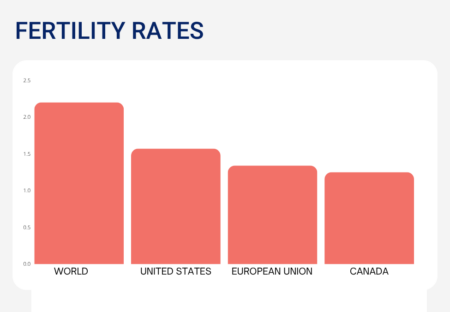 In April, the U.S. Centers for Disease Control and Prevention released statistics that show the United States had its lowest ever recorded fertility rate, with just 1.57 births per woman of child-bearing age. Demographers say that a birth rate of 2.1 is necessary to maintain a stable population over time without immigration or emigration.
There was a total of 3.6 million births in 2025, about 20,000 fewer than the year before.
The Wall Street Journal reported that the declining fertility rate and number of births seems to be driven by women delaying marriage and parenthood. For the first time, the number of women in their late 30s giving birth exceeded the number of births to women in their early 20s. “People are waiting longer to enter parenthood and probably want to make sure that things are set in their lives before they do so,” Wendy Manning, co-director of Bowling Green State University’s National Center for Family and Marriage Research, told the Journal.
University of North Carolina-Chapel Hill Carolina Population Center director Karen Benjamin Guzzo told the paper, “We spent decades and lots of money trying to discourage early childbearing, saying, ‘This will ruin your life. This will ruin your kid’s life. Don’t do it’.”
Child- and parents-rights activist Katy Faust of Them Before Us tweeted in response to the CDC report, “We have a fertility crisis because we have a marriage crisis,” and “We have a marriage crisis because we have a dating crisis.” Faust argued that, “We have a dating crisis because young people are forming few in-person relationships.”
Another driver of plummeting birth numbers is the rapidly declining incidence of teen births, a trend that began a quarter century ago. Last year, the teen birthrate fell another seven per cent.
Live Action said that abortion also figures in the declining number of births as both the number of abortions and pro-abortion sentiment as evidenced in public opinion polls have been ticking upward.
Yet in comparison to many western and east Asian countries, the U.S. fertility rate of 1.57 looks relatively robust. In January, Statistics Canada reported in its “2024 Survey on Family Transitions” that Canada’s fertility rate hit an all-time low in 2024 at 1.25 children per woman, putting it in the “ultra-low fertility” category with a total fertility rate below 1.3.
Other countries in the ultra-low fertility category include Switzerland (1.29), Italy (1.18), Japan (1.15), and South Korea (0.75).
StatCan’s “2024 Survey on Family Transitions” report noted that although Canada’s fertility rate fell below replacement in the 1970s, it began its steep decline in 2009 following the Great Recession. The report said that a combination of socioeconomic and cultural factors has influenced the number of children being born: “Increased educational levels, greater participation in the labour market, changing social norms and the widespread use of contraception have contributed to diversifying life paths, notably in terms of childbearing.”
Eric Lombardi wrote in The Hub about declining fertility and blamed the “milestone recession,” the prolonged trend that has seen Canadians reach traditional stages of adult life such as stable careers, home ownership, and marriage, delayed, explaining that when each step is pushed back later, fertility declines.
Surveys show that women want an average of 2.2 children but are not achieving their fertility goals. Declining fertility reflects a large increase in the number of women who do not have any children— by choice, by delaying or eschewing marriage, and by being unable to conceive and bear a child. And there is also a smaller decrease in the average number of children women who give birth to end up having.
Leave a Reply
You must be logged in to post a comment.