
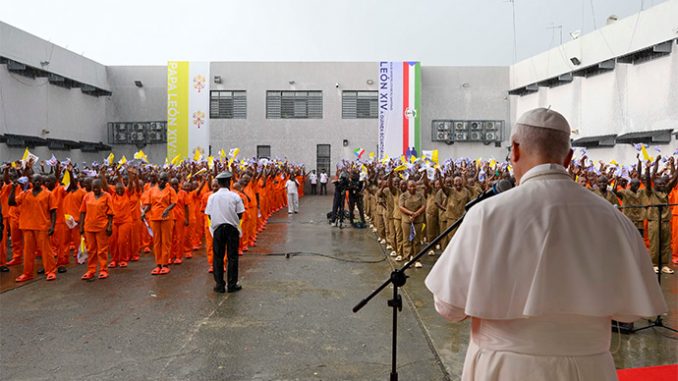
(CWR, Yaoundé) On Wednesday, Pope Leo XVI visited a prison in Equatorial Guinea’s capital city of Batá, and offered words of comfort to inmates who might be tempted to view their lives as worthless.
Under a drizzling rain that the Supreme Pontiff described as “a sign of God’s blessing,” Leo told those incarcerated that their lives retain infinite value.
“No justice without reconciliation”
“Today, I am here to tell you something simple: no one is excluded from God’s love! Each of us, with our unique stories, mistakes, and sufferings, remains precious in the Lord’s eyes,” Pope Leo said.
The Pope anchored his message in the example of Jesus, who, he noted, was “arrested, condemned and put to death through no fault of his own.” Yet, Christ loved humanity “to the very end,” demonstrating a belief in the power of love to change even the hardest of hearts.
While offering spiritual consolation, Pope Leo XIV also delivered a pointed social teaching on the purpose of incarceration. He acknowledged that justice is necessary to protect society but argued that for it to be effective, it “must always promote the dignity and potential of every person.”
“True justice seeks not so much to punish as to help rebuild the lives of victims, offenders and communities wounded by evil,” the Pope told the gathering. He stressed that there is “no justice without reconciliation” and called for a national effort to prevent and heal the wounds caused by injustice.
“Although prison may seem like a lonely and desolate place, as has been said, it can also become a space for reflection, reconciliation, and personal growth. Every effort should be made to ensure that you are given the opportunity to study and to work with dignity while in prison, “Pope Leo said.
“Life is not defined solely by one’s mistakes, which are often the result of difficult and complex circumstances. There is always the possibility to start over, learn and become a new person.”
“You are not alone,” he assured them, speaking of families waiting outside and a Church that stands by their side. “If any of you fear being abandoned by everyone, know that God will never abandon you.”
The Pope reminded the inmates that they remain an integral part of Equatorial Guinea, which he described as a land rich in culture and faith. He called on them to think of the nation’s youth, offering their own lives as examples of “perseverance, responsibility and faith.”
The Pope’s address was preceded by remarks from the prison chaplain and an inmate, who acknowledged the mistakes he had made.
“Although our hands have done bad things in the past, our hearts still dream of doing good,” said the inmate, thanking the Pope for coming to see them in a place where many thought no one would ever go.
The prison administrator also spoke, reinforcing the institution’s commitment to combining security with “rehabilitation” processes.
The Holy Father listened to the testimonies of inmates, thanking them for their sincerity and for showing that “human dignity and hope are never lost, even in the midst of difficulties.”
The Pope extended his gratitude to the prison staff, including the director, officers, and chaplain. He encouraged them to combine security with respect and kindness, noting that their service is essential for the successful reintegration of inmates.
Amnesty International has reported that Bata Prison is home to several people who have spent years without trial, and accused the Central African country of engaging in gross human rights violations.
It’s a charge the country’s Justice Minister, Reginaldo Biyogo Mba Ndong Anguesomo, has denied.
“We are committed to guaranteeing human rights, fundamental rights, and citizenship,” he told Pope Leo.
Pope Leo XIV ended his visit to the prison by leading the crowd to the Our Father. He invoked the Virgin Mary, Mother of Mercy, and offered a final benediction to the inmates.
“Always remember that a person who gets back up after falling is stronger than before,” the Pope said.
Build a ‘City of God’
Pope Leo XVI had earlier met with the country’s political leaders, whom he challenged to look beyond the ambitious construction of a new capital and instead focus on building a “City of God” founded on justice and the eradication of poverty.
On January 3, 2026, President Teodoro Obiang Nguema Mbasogo officially changed the capital of Equatorial Guinea from Malabo, which is an Island to Ciudad de la Paz, in Djibloho province, in the inland.
Ciudad de la Paz is a Spanish phrase for “city of peace”.
The leader of Africa’s only Spanish-speaking nation justified the move with Ciudad de la Paz’s geographic location, calling it “the ideal option to host the capital.”
Pope Leo referenced St. Augustine’s seminal work “City of God” which he said is characterized by love, especially love for the poor. He made the distinction between the City of God and the earthly city, such as the country’s new capital, saying that the earthly city is centered upon the proud love of self, on the lust for power and worldly glory that leads to destruction.”
“You have chosen to give it a name that seems to echo the biblical city of Jerusalem,” Pope Leo said.
“May such a decision prompt every person to ask themselves which city they wish to serve.”
Equatorial Guinea gained independence from Spain in 1968, with Francisco Macías Nguema defeating Bonifacio Ondó Edu in an election to become the first president. Macías Nguema ruled the country with an iron fist until 1979, when Teodoro Obiang Nguema Mbasogo overthrew his uncle in a military coup.
Obiang Nguema has now ruled the country for 47 years and is the world’s longest-serving leader.
The once impoverished country gained global prominence when vast amounts of oil were discovered in the 1990s.
Although the country is now one of Africa’s largest oil producers, the majority of its citizens still live below the poverty line.
Pope Leo didn’t miss the chance to condemn such an economy that excludes the poor.
“We also have to say ‘thou shalt not’ to an economy of exclusion and inequality. Such an economy kills”.
He added that armed conflicts around the world result from the exploitation of oil and mineral resources “with no regard for international law or the self-determination of peoples”.
“The destiny of humanity risks being tragically compromised without a change of direction,” the Pontiff warned.
“God does not want this,” he added.
At the end of his visit to one of Africa’s most Catholic countries (75% of the country’s 1.8 million people identify as Catholic), Leo XIV entrusted everyone to the protection of Our Lady, Mother of Mercy, and renewed his closeness to the people of Equatorial Guinea.
If you value the news and views Catholic World Report provides, please consider donating to support our efforts. Your contribution will help us continue to make CWR available to all readers worldwide for free, without a subscription. Thank you for your generosity!
Click here for more information on donating to CWR. Click here to sign up for our newsletter.
Leave a Reply
You must be logged in to post a comment.