
What does it mean to be human? A simple enough question, right? Until one tries to answer it, or pays careful attention to the host of competing answers in our world.
Genetics could answer this question in one way, physical characteristics another way, religions and philosophies seek to answer the question, and economic calculations often enter in as well. In short, what it means to be human largely depends on the lens individuals and cultures choose to employ.
One might argue that all the wars and human conflict in history, right up to the present day and hour, have proceeded from different beliefs or lenses about what it means to be human. Thus, one could say that war and violence are the natural order of humankind, human entropy that corresponds to the universe’s physical entropy, wherein order regresses to disorder. And just as increasing order in the physical universe requires a countervailing force, so in the human order, such a force is necessary to reverse the human entropy that produces war, violence, and conflict.
Mythology is another (and unique) lens through which to explore what it means to be human. And the best mythology may be the best vehicle to embark on answering this question.
Why? Because the best myths vividly reveal how different ways of answering this question play out in lives, events, and history. And not just in mythical worlds.
J.R.R. Tolkien, a prominent explorer of mythology as a vehicle to answer the question of what it means to be human, employed the word eucatastrophe to signify a sudden turn of events in a story that rescues someone from an inevitable or highly probable doom. Likewise, overcoming human entropy means that an inevitable or highly probable outcome—war and violence—need not occur.
The best modern mythology that seeks answers to what it means to be human includes epic mythology that depicts big events and often reduces those events to a page or so of text; heroic mythology by depicting what humans should and should not do; and granular mythology, where one may feel that the myth describes the real world, or an actual era of human history.
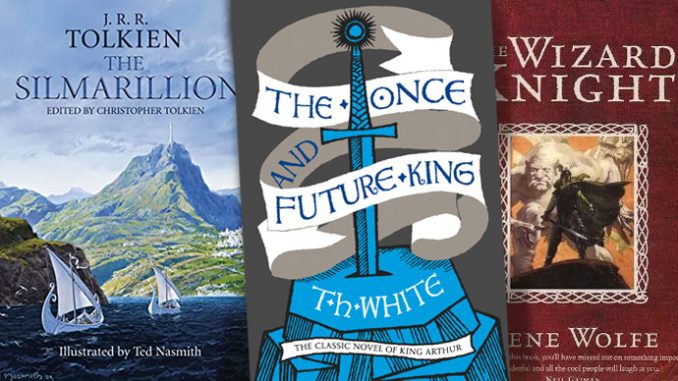
At the epic mythology level, we have Tolkien’s The Silmarillion, which describes the creation of the world and all its creatures, high and low; the rebellion of many of the elves and their age-long war with the rebel angel, Morgoth; and the collaboration of many men in the elves’ disordered enterprise. Tolkien’s myths depict in a profound manner the Creator’s gift of freedom and corresponding consequences, a moral momentum that corresponds to physical momentum in the created universe, where objects in the physical world—apart from the object(s) imparting the initial momentum—are also radically displaced.
So too, the moral momentum of the elves’ disordered use of the gift of freedom produces dire consequences for many elves and men who associate with the rebels. Not only that, the moral momentum of the elves’ original rebellion against their angelic benefactors cascades into more abuses of freedom, including “kin-slaying,” when the rebel elves steal their brethren’s ships to travel to Middle-earth. In the Creator’s lexicon, the radical gift of freedom cannot be true freedom unless consequences somehow correspond to the majesty of the gift itself.
The Once and Future King, T. H. White’s 1958 re-telling of the legend of King Arthur, and Tolkien’s The Lord of the Rings, might be called heroic mythology, in that fully formed individuals complement those mythical tales. One can also say that prominent themes in both works are similar: Might for right, not Might makes right (The Once And Future King), the “irrational” power of self-donation (The Lord of the Rings). Both myths depict what man ought to look like: Arthur, Sir Galahad in White’s story; Frodo, Sam, Aragorn in Tolkien’s; not perfect, or nearly so, except all of them ardently sought truth, beauty, and the good. In Tolkien’s and White’s heroic myths, we are alerted to the human need for formation: Merlin to prepare Arthur for his might for right mission, Gandalf to prepare Frodo for “irrational” self-donation; so “irrational” that an intellectual giant like Sauron, another rebel angel, cannot conceive that someone might embrace misery and hopelessness to destroy rather than wield the Ring themself.
In Tolkien’s myth, what is the force that dispels the inexorable moral momentum that accompanies disordered choices? Eucatastrophe: the sudden turn of events that ensures someone does not meet an inevitable or highly probable doom. And what unleashes eucatastrophe in Tolkien’s myth? The radical, irrational self-donation exhibited by Aragorn, Sam, and, especially, Frodo, who cannot be healed of the wounds he incurs even as he saves his world. Going back to Tolkien’s Silmarillion, you could say that Beren’s and Luthien’s many sacrifices paved the way for the eucatastrophe that occurred when Morgoth was finally cast down, though not in their lifetimes in Middle-earth.
Gene Wolfe’s The Wizard Knight might be called granular mythology in that we may often feel as if we accompany the main character, Able of the High Heart, who has been assigned that name by a mysterious woman and has wholeheartedly adopted the name without understanding it or what it entails. A principle of quantum physics holds that in measuring quantum phenomena, we affect the state of what we are measuring by virtue of the act of measuring, no matter how carefully or remotely we measure. Similarly, the closer Sir Able gets to worlds and creatures within his myth, the harder it is for him to define or describe them. What man ought to look like in Wolfe’s myth is depicted in Sir Able, Sir Ravd, imperfect men of honor who, as with White’s and Tolkien’s heroes, seek truth, beauty, and the good.
Sir Able is a boy inside a colossus of a knight’s body, with strange talents and powers he cannot begin to understand. Yet, he speaks thus about the highest world:
“Then I thought about the highest world. Number One. It seemed to me that living way up there and looking down on the rest of the world would make him proud. After a while I saw that I was wrong, and under my breath I said, ‘No, it wouldn’t. It would make you kind instead, if there was any good in you at all’… What I had thought was what if it was me and I was all alone up there, with just rabbits and squirrels? Or the only grownup, and the rest were little kids?… I decided I would just take care of the kids as well as I could, and I would hope that someday they would get older and be people I could really talk to.”
A kid’s intuition of what God desires for us? A world without war or violence?
The best myths can soften some of the rigid dispositions and ingrained patterns of thinking imposed on us by the time and place we inhabit, from the human entropy that plagues humanity.
What it means to be human is best depicted in Jesus himself. Yet, myths of human origin that depict aspects of the “true myth,” as C.S. Lewis came to understand the Incarnation, can point humankind to the Truth about what it means to be human.
If you value the news and views Catholic World Report provides, please consider donating to support our efforts. Your contribution will help us continue to make CWR available to all readers worldwide for free, without a subscription. Thank you for your generosity!
Click here for more information on donating to CWR. Click here to sign up for our newsletter.
Leave a Reply
You must be logged in to post a comment.