
The bishops of the dioceses of the Canary archipelago shared their concerns regarding immigration just weeks before Pope Leo XIV’s trip to Spain, a journey that will conclude on the islands.
The situation on the Canary Islands, arising from pressure caused by immigration from Africa, was behind Pope Francis’ desire to visit the islands; this wish will now be fulfilled by his successor, Pope Leo XIV, who will visit the islands June 11–12 as well as Madrid and Barcelona on June 6–10.
The bishop of Tenerife, Eloy Santiago, acknowledged that the fact that the archipelago serves as “Europeʼs southern frontier — the point of arrival for immigration coming from the African continent” — is a reality “that often overwhelms us.”
“We lack the human and economic resources to address this dramatic reality. We feel powerless in the face of this deadly Atlantic route,” Santiago explained during a meeting with the press.
Since the arrival of the first boat carrying two immigrants from Africa in 1994 and over the course of more than three decades, thousands of people — generally young men — have reached the shores of the Canary Islands in search of a future. Thousands of others have drowned in the attempt.
The Holy Father’s visit will signify “support and motivation“ and will ”draw attention to this sad drama,” the bishop of the Diocese of Tenerife added.
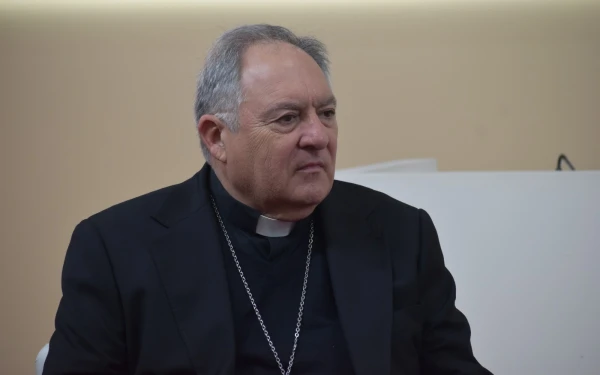
The bishop of Canary Islands (which include the islands of Gran Canaria, Lanzarote, Fuerteventura, and La Graciosa), José Mazuelos, also expressed his hope that “the Holy Father will shed light on the matter, to see if it is possible to put an end to the Atlantic route,” although he also noted that the popeʼs presence in the islands is pastoral in nature and encompasses other aspects of the life of the Church.
“It’s not as if the pope is coming to the Canary Islands to use the issue of migration as a stick to politically beat one side or the other,” he emphasized.
Mazuelos also suggested that for many people “you’d have to put them on a ‘cayuco’ (a large, flat-bottomed wooden boat) spending five days in the Atlantic, day and night, without food so that they can see when [the migrants] get here what it is that we’re doing,” he said in reference to those who criticize the Catholic Church’s work of welcoming migrants, protecting them, and integrating them into society.
Mazuelos noted that if the countries of origin receive development aid intended to help them eliminate the causes that lead so many to leave their homes, “we must hold them accountable, and we must crack down on the mafias.”
Furthermore, he expressed support for “seeking ways for migrants to come to work through alternative channels.” He cited as an example that during the second half of the 20th century, Spaniards legally emigrated to central European countries “with their proper work papers.”
He mused about whether this same outcome could be achieved regarding African migration, though he acknowledged that this approach is “a bit idealistic.”
Caya Suárez, secretary-general of Caritas for the Diocese of Canary Islands who was present at the meeting, said that “the pope’s visit is not only a recognition of the welcome extended but also a call to prayer for the victims who have lost their lives on the Atlantic route,” a figure she estimated is more than 19,000 people since 2020.
Awaiting details on Pope Leo XIV’s visit
Regarding Leo XIV’s visit to the Canary Islands, where so far the celebration of two large Masses has been confirmed, Mazuelos expressed his conviction that personal testimonies will be shared during at least one of the gatherings, as one of the Catholic Church’s priorities is to “put a human face” on the reality of migrants.
The island of El Hierro, part of the Diocese of Tenerife, is one of the places in the archipelago where this reality has become most palpable. Just last year, 25,000 migrants arrived to a local population of 9,000 inhabitants.
The prelate, aware that “the people of El Hierro are eagerly anticipating” the possibility of a visit from the pope, realistically pointed out that given the timing and the necessary logistics, “while not impossible,” it will be “difficult” for such a visit to take place.
This story was first published by ACI Prensa, the Spanish-language sister service of EWTN News. It has been translated and adapted by EWTN News English.
Leave a Reply
You must be logged in to post a comment.