
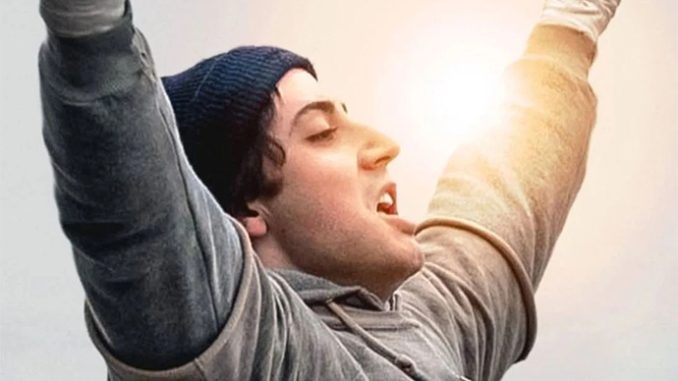
When I watched Rocky with four of my kids for the first time, two older girls and two younger boys, they had a memorable reaction when Apollo Creed had his glove raised in victory as the Italian Stallion embraced Adrian. “He lost the fight?” cried my sons, throwing their hands up. “He won Adrian,” my daughters corrected them, holding their hands to their hearts.
Rocky lost… and he won.
Fifty years running, people still hold Rocky Balboa in their hearts—and their fist-pumps atop the steps at the Philadelphia Museum of Art—and many have been recently reminded of their affection for the character by a new film about the making of Rocky. I Play Rocky is a good time at the movies—even though it doesn’t deliver the same punch that Rocky did regarding a perspective that Catholic audiences can appreciate, where earthly glory and guts, or Thanksgiving and Thursday, don’t always go hand in hand.
Rocky is a movie about a kind-hearted, thick-headed, southpaw boxer, which is extraordinary in a curious way. Though it is well written, well acted, and well directed, it still has little business being as good as it is. And its goodness may have everything to do with how it provides a very authentic, down-to-earth lesson about how we all have to be pounded into a pulp by life to prove ourselves worthy to win love.
It’s a gritty, scrappy, tender film that resonates unmistakably with a Catholic attitude and truth—especially given the iconic opening shot of the resurrected Christ in an old Philadelphia church converted to a seedy gym. Rocky is so real, which is probably why it feels so Catholic. But it’s more than that. The Catholic life isn’t about victory in the rings of the world, but in surviving the fight that is life—not for earthly titles, but for proving oneself strong enough, enduring enough, to win a love that transcends the contests that bruise and batter. That’s Rocky. (Cue the brassy fanfare.)
Rocky is back in the conversation with the highly acclaimed film, I Play Rocky, directed by Peter Farrelly and starring Anthony Ippolito as Sylvester Stallone. Ippolito is mesmerizing as the down-on-his-luck actor who wrote a fantastic script in three and a half days. Despite enormous studio pressure against him, Stallone played the titular character himself, always insisting, “I play Rocky.” Against all the odds brought on by an inexperienced lead, a vindictively sabotaging studio, a low budget, and a punishing shooting schedule, Rocky was completed, captivated the country, and clinched Best Picture in 1976.
They’re worthy stories, both the story of Rocky and the story of how it was made. I Play Rocky deserves the accolades it’s receiving because it’s a decent movie in a cinematic environment of trash and tripe. It’s honest, uplifting, and human. It tells the good story of the telling of a great story, with a process that poetically reflects the poetry that is Rocky. That is, I Play Rocky is like a real-life Rocky story if Balboa were a filmmaker instead of a boxer, creating an incisive dynamic with such a similar story resulting in the familiar movie.
There is something in this film, however, that is qualitatively different from the film that inspired it. Besides the fact that Rocky is much better (naturally) than I Play Rocky, and watching scenes meticulously re-created, I felt I would rather see the original scenes. And as I enjoyed the drama of the making of Rocky, it just made me appreciate and prefer the drama of Rocky by comparison. This is not to take away from I Play Rocky, because it tells a story worth telling. But at the same time, even in its closeness to the source material, there is a disparity or a departure in it that makes the original movie shine even brighter, especially from a Catholic perspective.
I Play Rocky partially reverses a theme that runs through Rocky in a subtle yet significant way. Both Rocky and I Play Rocky are about underdog fortitude, compassion, and overcoming adversity. And as such, they are both charming, visceral, and satisfying. But I Play Rocky is far more about worldly success and personal ambition, while Rocky is far more about staying strong and true to oneself for one’s loved ones till the last bell rings.
Rocky sets a scene of rising to meet unlikely occasions to assert oneself with guts, heart, and endurance—but not necessarily glory. The character of Rocky is unselfish, a rough on the streets of Philadelphia who looks out for others, a thug with a soft spot. He’s great. Ippolito’s Stallone doesn’t project the same qualities in the making of Rocky. Though he says, as Stallone, that he put himself on the page and wrote Rocky as himself for himself—and that may be true—but there’s something a little more on the self-serving side in his purposes, to put it in harsh terms. Though both struggle under desperate living conditions, Stallone and Rocky’s reactions to the chances they are given have different trajectories.
Sylvester Stallone is portrayed as a polite, genuine, hard-working guy, but the battle over his script is all about his shot, his glory, to get his moment—which is fine and fair as far as that goes, but it doesn’t shine as purely as Rocky Balboa’s response to the opportunity to fight the heavyweight champion of the world, to prove to himself and Adrian that he can withstand the test, even if he doesn’t win. Defeating Apollo Creed wasn’t Rocky’s plan—only to “go the distance” and see the fight through the fifteenth round. The Stallone we meet in I Play Rocky, sweet man that he is, who loves his wife and his dog and is trying to make ends meet with a baby on the way, is also trying to make the big time.
These motivations pose the variance in these two movies’ messages: Stallone wanted to conquer and achieve his vision; Rocky wanted to survive standing on his feet. Stallone wanted to be the star; Rocky didn’t want to be “another bum from the neighborhood.” Stallone pursued the success he craved valiantly; Rocky responded valiantly to a chance of a lifetime that came at him. One resonates with a Catholic spirit more than the other.
There’s nothing wrong with working determinedly to create something for yourself or your family and friends. As an artist myself, I admire Sly Stallone for pulling off such a feat and such a fine film. But the overtones of the film he made, though it is practically his own story, tap into a Catholic metaphor of going the distance for love—and that makes Rocky that much more poignant than I Play Rocky.
There’s something in Rocky that rings with “whoever would save his life will lose it, and whoever loses his life for my sake will find it” (Mt 16:25). Rocky is about the glory of the spiritual and eternal over the secular and temporal. It’s about giving oneself over wholly for another, including giving the best, tried-tested-and-truest version of yourself. I Play Rocky holds some of this, but the glittering glory that Stallone’s story concludes with is different than the bloodied fighter who lost the big fight but rejoiced in the love of his wife.
I Play Rocky works out the worldly paradigm, “No guts, no glory.” But the Catholic take on things of this world must always be a little qualified—and by that is meant eternally qualified. Every Catholic needs all the guts that a human being can have, but they should not look for their own glory, but only to magnify the glory of God and enter into His glory once they fight through their last round on earth. “Not to us, O Lord, not to us, but to thy name give glory” (Psa 115). Even Stallone, who is Catholic, has said about Rocky, “I felt as though God was moving me to do this.”
In the end, I Play Rocky serves a strong purpose in celebrating the merits of Rocky, a film that deals with guts and glory in a way that bears up to the Catholic heavyweight fight and roars, “Come on, help me out. I’m standin’ here!”
If you value the news and views Catholic World Report provides, please consider donating to support our efforts. Your contribution will help us continue to make CWR available to all readers worldwide for free, without a subscription. Thank you for your generosity!
Click here for more information on donating to CWR. Click here to sign up for our newsletter.
Leave a Reply
You must be logged in to post a comment.