
“Sentimentality is the progenitor, the godparent, the midwife of brutality.” — Theodore Dalrymple, Spoilt Rotten: The Toxic Cult of Sentimentality1
“Fine emotions can be cheapened, and cheap emotions can be refined, but no emotions can be, with safety, wallowed in.” — Dom Hubert van Zeller, O.S.B., We Die Standing Up (68)2
“The truth is that there is an increase of mental disorders largely because too many people think they are nice, when they are really nasty.” — Blessed Abp. Fulton Sheen, Peace of Soul (1949)3
About twenty years ago, I had a short but memorable conversation with a doctoral student who was studying liturgical theology at a major Catholic university. After he related some of the ups and downs of his educational experience, I asked him: “What is the most surprising thing you’ve encountered?”
“You cannot have debates or arguments with most students,” he said. “They hate disagreement, and they view it as an attack on them personally.” He added, “For many of them, their emotions are the final judge of truth. And if you go contrary to their emotions, they get angry and even accuse you of being hateful.” This was, he noted, not only the case with academic topics, but especially moral and political issues.
That conversation came to mind again after reading a fascinating essay by a longtime university professor about her frustration with how higher education has so quickly devolved into emotional insanity in recent years:
But somewhere along the way, we began replacing education with therapy. Instead of asking students “What do you think?”—we started asking them “How does this make you feel?” … Unfortunately, this therapeutic mentality isn’t limited to students—it’s also extended to faculty.
In 2010, I read Theodore Dalrymple’s Spoilt Rotten: The Toxic Cult of Sentimentality. Dalrymple—the pen name of British doctor and psychiatrist Anthony Malcolm Daniels—chronicles the rise of a cancerous form of sentimentalism that, he argues, had metastasized throughout British culture, causing serious personal and social damage. It was Dalrymple’s book that has, in recent years, led me to use the term “toxic sentimentality” to describe certain words and actions.
What is sentimentality? Dalrymple writes that it “is one of those many qualities that is easier to recognise than to define.”4 It is usually defined as an excessive or “mawkish” emotion; it is sometimes associated with nostalgia. The meaning has morphed and changed over the centuries. It comes by way of medieval Latin (sentimentum) for “feeling, affection, opinion,” and for a long time was not seen as a negative term. During the Romantic era, it was considered quite positive, as Dalrymple notes, “a man who was called sentimental from the middle to the end of the Eighteenth Century would now be called a sensitive and compassionate one, the opposite of a unfeeling philistine brute.”5
He then highlights how modern technology and mass communication—and, I would add, especially social media—has taken sentimentality from the usually private place of the emotions and moved it squarely into the public sphere as an ideological tool, or even, as I believe, an ideology all of its own.
In the post-modern world, actions only occur if seen by others, and emotions are only real if felt by others. As inner lives shrink and private lives fragment, public expressions of emotion are not only encouraged, they become essential. And, then, they become coercive or even tyrannical:
The public expression of sentimentality has important consequences. In the first place, it demands a response from those who witness it. This response has generally to be sympathetic and affirmatory, unless the witness is prepared to risk a confrontation with the sentimental person and be accused of hardness of heart or outright cruelty. There is therefore something coercive or bullying about public displays of sentimentality. Join in, or at least refrain from criticism.6
As displays of sentimentality increase in fervor, they are able to affect—through the power of instant demonstration and access—the political, social, and religious worlds in seismic ways. It is here that Dalrymple makes a vital observation:
Sentimentality is the expression of emotion without judgment. Perhaps it is worse than that: it is the expression of emotion without an acknowledgement that judgment should enter into how we should react to what we see and hear. It is the manifestation of a desire for the abrogation of an existential condition of human life, namely the need always and never-endingly to exercise judgment. Sentimentality is therefore childish (for it is children who live in such an easily dichotomised world), and reductive of our humanity.7
Put another way, toxic sentimentality is not merely surrendering to a moment of emotional irrationality; rather, it is the irrational conviction that one’s emotions are correct and superior—and that they cannot be questioned by facts, arguments, or outside authorities. Furthermore, those who dare question this toxic sentimentality deserve to be denounced and must be cast to the fringes of society.
Consider the case and trial of Lindsay Clancy. On January 24, 2023, the mother of three, living in a Boston suburb, killed her three young children—Cora, Dawson and Callan—using exercise bands, after having sent her husband to the store. She admits that she killed her children. But did she know what she was doing? Was she insane or mentally ill when she committed the horrific act in the family’s basement?
Those are questions that have captivated public attention during a trial in the summer of 2026 that ended in a mistrial because one juror (a Catholic man) was not convinced of her insanity defense and thought she was criminally responsible for the murder of her children. Two of the female jurors said the lone juror “had the hardest time getting off the fact that Lindsay viciously killed her children,” was “very arrogant,” and “really did not take anything that anybody said.” One of them, Paula Devlin, “said the two jurors who initially voted guilty ‘felt attacked,’ adding, ‘There is no way to not do that.’” That, in a nutshell, is toxic sentimentality at work.
Notably, the jurors who commented appeared to have little or no concern for the young children. Furthermore, the highly emotional support for Clancy has taken the matter into another place altogether. This has been summed up well by journalist Caitlin Flanagan in The Free Press:
What began as admirable compassion for a woman who says she was driven by mental illness to commit the world’s greatest form of evil has turned into something strange: an almost exultant, fan-like celebration of Lindsay Clancy.
As is the case again and again, toxic sentimentality turns nearly everything upside down. What is objectively false or evil becomes subjectively—but emphatically—true and good. The mention of “compassion” brings to mind this statement by a Catholic bishop:
The new compassion that has crept into our courts and into our literature and drama is the compassion for the breakers of the law, for the thieves, the dope fiends, the murderers, the rapists. This false compassion for the criminal and the readiness to blame the law and the police, has passed from the “sob-sisters” to black-robed justices who, fearful of restraining a liberty turned into license, pardon the mugger and ignore the mugged. … All of a sudden, protectors of property, life and decency in the community find themselves on the defensive. This does not augur well for our national security and our national peace.8
That bishop was the recently beatified Fulton J. Sheen, writing in the late 1960s. The origins and pathway to that new compassion are undoubtedly complex, and include—first and foremost—our weak and sinful natures, a host of “isms” (nominalism, Protestantism, positivism, Romanticism, secularism, hyper-individualism, etc.), and rapid technological changes.
The novelist and critic Walker Percy, writing in 1989, captured some of this when stating: “Americans are the nicest, most generous, and sentimental people on earth. Yet Americans have killed more unborn children than any nation in history.”9 And in his final novel, Thanatos Syndrome, written two years earlier, the character of Fr. Smith, in a lengthy speech near the end of the dystopian novel, says: “More people have been killed in this century by tender-hearted souls than by cruel barbarians in all other centuries put together.” It’s widely acknowledged that Percy was inspired by a memorable passage penned by Flannery O’Connor:
In the absence of this [Christian] faith now, we govern by tenderness. It is a tenderness which, long since cut off from the person of Christ, is wrapped in theory. When tenderness is detached from the source of tenderness, its logical outcome is terror. It ends in force-labor camps and in the fumes of the gas chamber.10
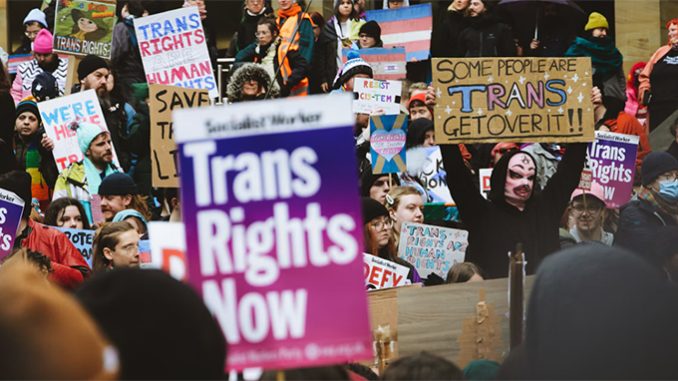
This faux tenderness is especially evident today in the increasingly surreal realm of sexuality and morals. Transgenderism, for example, thrives on it. People who insist that we cannot really define a “man” or a “woman” are equally insistent that if a man claims to now be a woman, we must not only accept it but to embrace and proclaim it. Who are we to question what such a person feels about their “identity”? Furthermore, to not go along with the tyranny of trans will mark you as a bigot. Evidence of the thoroughly subjective and irrational nature of transgenderism can be seen in both its sudden rise and “crash” in the number of youth identifying as “trans”—especially, and not surprisingly, among elite educational institutions.
Sheen, even prior to the riots and social unrest of the late Sixties, remarked on how “protectors of property, life and decency in the community find themselves on the defensive. This does not augur well for our national security and our national peace.” And, on a more theological and even deeper note, he remarked that
in our Christian civilization, we have participated in a great divorce of Christ and the cross. There is a tendency in our times among all Christian religions to divorce the two. We create the great rupture. We tear apart Christ and his cross. We keep Christ, but what kind of Christ? We present an effeminate and emasculated Christ. The Christ that never said a harsh word.11
That is an apt and succinct description of the post-2015 version of synodality, which is almost entirely devoid of any mention of sin, consequence, redemption, conversion, the Cross, and holiness, as I’ve written about on this site many times. The emphasis, instead, is on endless dialogue, “processes,” and especially “lived experience,” the subjectivity of which is both obvious and problematic.
This has been pushed by the usual suspects in ways that are now becoming all to dreary and common. For example, this past summer Cardinal Robert McElroy, in a homily at a Mass for (of course) “LGBTQ Catholics,” insisted:
Pastoral practice is not the understanding of how to apply an already formed and often reified set of principles to concrete situations. It proceeds from the conviction that the concrete situations in which people find themselves are constitutive dimensions of how doctrine should be formed in the light of the kerygma.
Translation: objective doctrine must submit to subjective desires. The sophistic use of “concrete situations” is meant to hide what is really being mentioned: people living in sin (cf. CCC 2337-235). It’s as if Cardinal McElroy was channeling the famous liberal German Protestant theologian Friedrich Schleiermacher (1768-1834), who, in On Religion, Speeches to Its Cultured Despisers (1799), laid bare his capitulation to sentimentalism: “I ask that you turn from everything usually reckoned religion, and fix your regard on the inward emotions and dispositions.”12
How frustrating, then, that St. Pope John Paul II, over thirty years ago, in Veritatis Spendor, wrote a long and detailed document showing exactly why such sentimental and subjective approaches to morality are not just false, but harmful:
In order to justify these positions, some authors have proposed a kind of double status of moral truth. Beyond the doctrinal and abstract level, one would have to acknowledge the priority of a certain more concrete existential consideration. The latter, by taking account of circumstances and the situation, could legitimately be the basis of certain exceptions to the general rule and thus permit one to do in practice and in good conscience what is qualified as intrinsically evil by the moral law. A separation, or even an opposition, is thus established in some cases between the teaching of the precept, which is valid in general, and the norm of the individual conscience, which would in fact make the final decision about what is good and what is evil. On this basis, an attempt is made to legitimize so-called ‘pastoral’ solutions contrary to the teaching of the Magisterium, and to justify a “creative” hermeneutic according to which the moral conscience is in no way obliged, in every case, by a particular negative precept. (par 56; emphasis added)
And yet Cardinal McElroy, Fr. James Martin, SJ, and others not only peddle in this sort of toxic sentimentality, they are emboldened to suggest or outrightly say that criticism of such is homophobic13, intolerant, and mean-spirited. Frankly, it comes off as overtly cynical. Or, in the words of Oscar Wilde, who recognized the error of his sodomic ways and explained so to his former lover:
We think we can have our emotions for nothing. We cannot. … as soon as we have to pay for an emotion we shall know its quality and be the better for such knowledge. Remember that the sentimentalist is always a cynic at heart. Indeed sentimentality is merely the Bank-holiday of cynicism.14 (De profundis)
Much more could be said, especially about the usual Catholic approaches to Islam, liturgy, and immigration. The necessary conversations about these important topics, among others, are increasingly hijacked by toxic sentimentality, which in turn leads to confusion, falsehoods, and even fear. What we need now is for serious Catholics to recognize that this governing by “tenderness”, or toxic sentimentality, has made deep and damaging inroads into the Church.
The Catholic Faith must not be a slave of the age; it must, to reference Chesterton, swim upstream, even if that means angering those who have built their worlds on emotional sands and little else.
(Editor’s note: This essay was first published at “What We Need Now” and is published here with kind permission.)
Endnotes:
1Theodore Dalrymple, Spoilt Rotten: The Toxic Cult of Sentimentality. (Gibson Square Book Ltd, 2010), Kindle edition. Subtitled How Britain is Ruined by Its Children in some editions.
2Dom Hubert van Zeller, O.S.B., We Die Standing Up (Image Books, 1961), 68. The Benedictine spiritual writer offers a short but excellent treatment of the emotions and passions, rooted in Catholic spirituality and anthropology.
3Fulton J. Sheen, Ph.D., D.D., Peace of Soul (Whittlesey House, 1949), 70.
4Dalrymple, Spoilt Rotten.
5Dalrymple, Spoilt Rotten.
6Dalrymple, Spoilt Rotten.
7Dalrymple, Spoilt Rotten.
8 Archbishop Fulton Sheen, Guide to Contentment (Simon & Schuster, 1988; orig. 1967), 144. In a 1966 speech, Sheen used similar language but also included “the pervert, homosexual, to the degenerate, the oddballs and dope pushers.” (The Catholic Transcript, Volume LXVIII, Number 41, 4 February 1966).
9 Walker Percy, “Why Are You a Catholic?” from Signposts in a Strange Land (The Noonday Press, 1991), 310. Percy, writing in 1989 or so, was likely unaware of the abortion numbers from China and the then-Soviet Union. His point still stands. In another essay, he remarks on euthanasia, lamenting the “widespread and ongoing devaluation of human life in the Western world—under various sentimental disguises: ‘quality of life,” ‘pointless suffering,’ ‘termination of life without meaning,’ etc.” (Ibid, 394).
10 Flannery O’Connor, Mystery and Manners (Farrar, Straus & Giroux, 1962, 1991), 227.
11 Sheen, The Catholic Transcript, 1966.
12 Friedrich Schleiermacher, On Religion, Speeches to Its Cultured Despisers (Orig. 1799; accessed online at Christian Classics Ethereal Library, 21),
13 Descriptives including homophobic, bigoted, fascist, Islamophobic, transphobic, etc., have been around for some time, but are now used with an irrational abandon meant only to excite irrational emotions and toxic sentimentality.
If you value the news and views Catholic World Report provides, please consider donating to support our efforts. Your contribution will help us continue to make CWR available to all readers worldwide for free, without a subscription. Thank you for your generosity!
Click here for more information on donating to CWR. Click here to sign up for our newsletter.
Leave a Reply
You must be logged in to post a comment.