
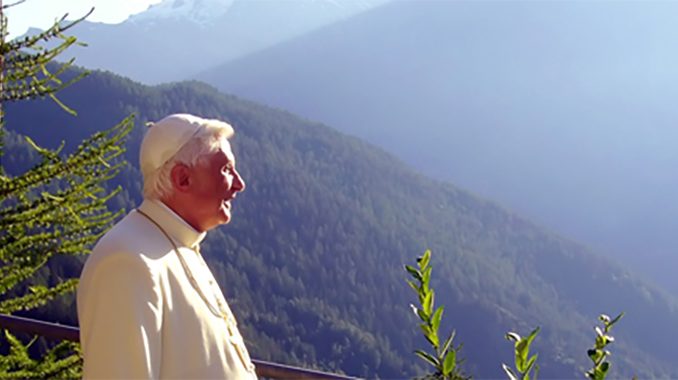
I’ve recently returned from Word on Fire’s New Ressourcement conference on Pope Benedict XVI, where leading scholars from every inhabited continent gathered to explore the key sources that shaped Ratzinger’s thought in anticipation of the upcoming centenary of his birth. A particular highlight for me was hearing from Fr. Joseph Fessio, S.J., one of Ratzinger’s grad students, one of my own grad school professors, and, of course, the Ignatius Press founder who has lived a remarkable life.
My own contribution for the conference focused on a fascinating but somewhat unusual set of “sources” for Benedict’s theology: the natural world and the modern sciences in particular. Preparing that presentation reminded me of something that deserves a wider audience. Ratzinger was a master not only of concepts, but also of images, symbols, and analogies—ways of understanding one reality through its likeness to another. He could take something as ordinary as an ant or a stained-glass window—or as abstract and lofty as quantum physics—and use it to help us see some mystery of the faith with fresh eyes.
In this installment of my “God’s Two Books” column, then, I want to focus on the way Benedict draws on the natural world and modern science to enhance our penetration into the mysteries of faith. Throughout his body of work, we see him take up insights from evolutionary biology, astronomy, and atomic physics in the quest to help the faithful better understand realities such as Scripture, the Eucharist, the way the Church develops throughout history, and the destiny of creation.
Specifically, I want to take a look at a couple of key ideas Benedict gleans from astronomy and from atomic physics.
The foundational insight
One of the things that has always impressed me about Benedict is how he was always looking for ways to model for us a distinctly Christian way of moving through the world: one that is filled with wonder and confident that all truth, no matter where it’s found or who discovers it, is from the Holy Spirit. The examples I want to explore here showcase the late pontiff’s lifelong conviction that faith and reason, revelation and creation, belong within a unified vision of reality—one we could all stand to make more our own, especially in a culture that so often compartmentalizes reality into separate spheres that no longer seem to speak to one another. At least in my own life, I’ve found that a Ratzinger-inspired worldview carries the power to behold the world around us with fresh eyes and to discover depths in ordinary things that I’d never imagined were there.
But, before looking at particular examples, we need to note something more fundamental. Benedict can draw interesting theological analogies from creation because, like the Fathers and medieval masters before him, he already reads creation through a rich tapestry of images and analogies. The cosmos for him is neither brute matter nor a neutral backdrop for salvation but, in the rich imagery he repeatedly employs, a book, drama, poem, and symphony.
The most fundamental and traditional analogy that informs Ratzinger’s understanding of the natural world is the patristic, medieval, and modern papal notion of creation as God’s “first book.” In the course of this tradition that I’ve pondered at length in my most recent book, the Church understands creation as an epiphany of divine love, a “natural revelation” on display from the dawn of time, but a gift that’s able to be gratefully contemplated only with the coming of man on the scene of history.
The people of Israel already recognized this truth centuries before God became man, as seen in memorable passages from the Book of Wisdom with its teaching that every creature embodies “a corresponding perception of their Creator” (Wis 13:1–5). The same vision permeates the teaching of the incarnate Lord himself, for whom lilies of the field and birds of the air, vineyards and fig trees, mustard seeds and grains of wheat, sheep and goats, salt and light, rocks and rain all served as vehicles of catechesis. Little wonder, then, that Ratzinger so often teaches through symbolism drawn from nature: God himself did so first.
But Benedict also develops the traditional “book of creation” motif in creative ways. For instance, his longstanding interest in St. Bonaventure led him to appropriate the Seraphic Doctor’s striking affirmation that “every creature is a word of God.” And the pontiff went on to extend the metaphor to tease out its ethical implications. In his encyclical Caritas in Veritate, he applied the “book of creation” motif to human life itself, writing that “the book of nature is one and indivisible, [embracing] not only the environment but also life, sexuality, marriage, the family, social relations: in a word, integral human development.”
In other words, the world outside us and the moral law within us belong to one and the same God-given order. Because of this, Benedict taught that respect for creation and respect for human dignity are inseparable, and he contended that our responsibilities with respect to God’s creation are intrinsically linked to our duties towards the human person—governed as they are by a unified “grammar” inscribed within the book of creation.1
A hermeneutic of faith, enriched by nature and science
Once creation is understood as a book, its creatures as “words,” and its order a kind of divine “grammar,” then the created order can do more than reveal God’s existence: its patterns contain lessons that can also help deepen our understanding of the mysteries of faith.
Ratzinger repeatedly turns these patterns into aids for theological understanding. Sometimes, his imagery is deeply traditional and its point immediately accessible, as when he draws on the language of spiritual theology to speak of eternal life as “plunging into the ocean of infinite love” and of Purgatory as the purifying fire of Christ who “burns us, transforms and frees us, allowing us to become truly ourselves.” Images like these reflect his sense that creation possesses a sacramental depth, capable of pointing beyond itself to spiritual realities.2
Yet, alongside these more traditional metaphors, many of Ratzinger’s most memorable theological analogies come from modern sciences of biology, astronomy, and physics. In what follows, I’ll focus on how he applies the latter two to draw out catechetical lessons pertinent to the interpretation of Scripture.
Heisenberg’s uncertainty principle and the “experiment” of faith
Benedict rejected the idea that any of us approaches Scripture with perfectly neutral eyes. As he understood, there’s no such thing as a view from nowhere or what an Enlightenment-era figure might refer to as pure reason. In fact, Cardinal Ratzinger wrote that “[p]ure objectivity is an absurd abstraction,” given that “the observer’s perspective is an essential determinant of the outcome of an experiment.”3 Whether we realize it or not, he stressed that we bring assumptions to everything we read. These assumptions are the “spectacles” through which we see reality, and they inevitably shape what we see in the biblical text.
It’s here that Ratzinger finds an unexpected analogy in modern physics, particularly in the questions raised by Werner Heisenberg’s work in quantum theory. Early in his career, Fr. Ratzinger had written that the impossibility of total objectivity is due to the fact that any observer inevitably “enters into the experiment.” He explained: “This means there is no such thing as pure objectivity even in physics. Even here, the result of the experiment, nature’s answer, depends on the question put to it. In the answer there is always a bit of the question and a bit of the questioner himself.”
Ratzinger sees a similar dynamic in theology. Just as the observer of a scientific experiment cannot stand wholly outside his experiment, a believer cannot fully grasp theological truth from the outside as a neutral spectator. Far from it, says Benedict, for Christianity demands what he calls the “experiment of faith”: a lived participation in the reality one seeks to understand. One comes to perceive the intelligibility of Christian existence not simply by dissecting it conceptually, but by entering into its form of life through prayer, worship, discipleship, and communion with Christ.
Although it’s not one he draws from the sciences, I cannot help but mention how Benedict developed this same point with another potent image in a 2008 homily at St. Patrick’s Cathedral in New York. Like any Gothic-style cathedral, he noted, its windows appear dark and dreary from the outside. But once one enters the church, those same windows come alive with light passing through their stained glass. So too with faith, he said: “It is only from the inside, from the experience of faith and ecclesial life, that we see the Church as she truly is.” The pope’s point was that the truth of faith cannot be fully seen from the outside and that one has to be willing to enter the Church—metaphorically and physically—to perceive it.
I think it’s worth noting that a similar logic appears in the work of Ratzinger’s friend Fr. Luigi Giussani, who described what one receives in faith as a working “hypothesis” that can be verified only by “testing” it in the laboratory of life. As both men routinely stressed to seekers of truth, you cannot stand safely outside the Christian form of life and demand the kind of certitude supplied by a mathematical demonstration. On the contrary, they insist, you have to live within the Church’s practices of prayer, worship, and discipleship—and only there from within can you fully understand why the faith is true and why it leads to the fullness of life.
That brings us back to the scientific analogy with which we began. In the empirical sciences, a researcher must not only remain alert to his own biases but also stay open to what the experiment reveals rather than assuming its conclusion in advance. In other words, he must remain open to verification as well as falsification. That can be scary for a believer, but what I’ve found is that it makes room for faith to be faith as opposed to what the medieval tradition would call scientia, a form of knowledge attained by means of demonstration.
This is by no means to say that the truths of the Catholic faith are uncertain. In fact, Aquinas considered faith to be more certain than any form of natural knowledge, even as he acknowledged that the weakness of our finite minds leaves us susceptible to doubt. Again, for the Angelic Doctor, faith is fully in harmony with reason, but embracing revealed truth requires the command of the will—in other words, for the soul to entrust itself to God. Benedict knew this as well as anyone, and in light of it, he considered this language of “experiment” especially apt for proposing this truth in a scientific age.
Every one of us is limited by our own finite range of experience, but I’ve certainly met quite a few people who’ve found the above language helpful—especially those who’ve met Christ in the Communion and Liberation movement founded by Fr. Giussani and dear to Benedict. Having attended the group’s meetings and spoken over the years with those more deeply involved than I am, I’ve come to think that this “experiment” approach has tremendous pastoral value because it expressly allows believers to wrestle honestly with the questions and struggles that inevitably accompany a living faith.
In my ministry and teaching, I’ve found that this approach is especially helpful in situations where someone feels backed into a corner—where he or she has been given the impression by someone (however well-intentioned) that ongoing difficulty with particular Catholic teachings somehow means he no longer has faith. By contrast, the vision advanced by Ratzinger and Giussani presupposes precisely this ongoing journey. Indeed, as I document in my book The Experiment of Faith, Benedict emphasized that confronting one’s “doubts” can actually lead to great good, as it did for the Apostle Thomas whose story “shows us that every doubt can lead to an outcome brighter than any uncertainty.”
The “fixed stars” and “planets” of Christian belief
This same analogical instinct informs Ratzinger’s understanding of historical development within the Church, where astronomy furnishes him with another memorable image that he finds valuable in catechesis. As is well known, Benedict rejected the idea that we must choose between strict continuity and acute rupture when it comes to the development of ecclesial tradition across the ages. In place of these, he famously proposed a “hermeneutic of reform, of renewal in the continuity of the one subject-Church which the Lord has given to us.” Rather than treating Vatican II’s aggiornamento as either a break with the past or a denial that legitimate change has a place in the Catholic tradition, Benedict put it this way in a momentous 2005 Christmas address to the Roman Curia: “It is precisely in this combination of continuity and discontinuity at different levels that the very nature of true reform consists.”
To drive home this distinction between what can develop in the Church and what must remain stable, Ratzinger offered an especially apt analogy in an essay arguing that modern advances in psychology do not eliminate the need to affirm the reality of the devil. Like the fixed stars by which navigators orient themselves, in the Church we have doctrinal realities that remain abiding points of reference across history. The devil is one of those enduring realities, along with a host of others—not least the truths we profess in the Creed.
But for the integrity of our faith, we also need to understand that not everything in the Church is fixed. Think, for example, of changes in ecclesiastical disciplines or the Church’s stance on her relationship to the modern state and her teaching on religious liberty—just a couple of the many areas in which real development has taken place without changing the enduring substance of the faith, as I discuss more fully in The Essential Guide to Ratzinger.
By the grace of God, I cannot tell you how many people I’ve talked to over the years who’ve found clarity and reassurance in this distinction: some realities in the Church are like fixed stars and others are more like planets—contingent matters that can (and sometimes need to) change over the course of history. The image helps Ratzinger avoid two opposite mistakes: treating every change as a betrayal of tradition, on the one hand, and treating every change as progress, on the other. Like a ship weathering the many storms one faces at sea, the Church can move through history and remain herself precisely because she still has fixed stars to guide the way.
Conclusion
The fixed stars offer a fitting place to conclude because they illustrate something I find especially compelling about Benedict’s way of thinking. He repeatedly takes something already before our eyes—a creature, a window, the night sky, even a scientific discovery—and through it helps us see the ancient mysteries of our Catholic faith with fresh eyes.
Behind this way of seeing lies a conviction in Benedict’s theology that’s especially valuable for us today: faith doesn’t require us to avert our eyes from reality or fear where honest inquiry might lead. Quite the opposite. As his entire life and career bore witness, if all truth ultimately comes from the same God, then Christians can approach the world with confidence and contemplative wonder—even when what we discover forces us to refine our understanding of what we’d previously assumed without much thought.
Endnotes:
1 Ratzinger’s creative development of the traditional book of creation analogy invites further extensions of this imagery. For a good example, see Christopher Baglow, Faith, Science, & Reason: Theology on the Cutting Edge, 2nd ed. (Midwest Theological Forum, 2019), 144. Extending the book of creation analogy in his own turn, Baglow describes miracles as “plot twists” in the book of nature. Just as a plot twist in a story doesn’t destroy its fundamental grammar but does introduce something the reader could never have predicted on the basis of the preceding pages, so miracles come from the same Author of the rest of creation, even if they’re unexpected from our point of view. And in this analogy, the Resurrection is the greatest plot twist of all, which reveals where the whole story of creation was headed all along.
3 This line is taken from Ratzinger’s lecture “Biblical Interpretation in Conflict: On the Foundations and the Itinerary for Exegesis Today,” in Opening Up the Scriptures: Joseph Ratzinger and the Foundations of Biblical Interpretation, ed. José Granados, Carlos Granados, and Luis Sánchez-Navarro (Eerdmans, 2008), 9. For a more extensive discussion of that lecture and its implications for Catholic biblical exegesis, see my book The Essential Guide to Ratzinger: The Man and His Message (Our Sunday Visitor, 2025).
If you value the news and views Catholic World Report provides, please consider donating to support our efforts. Your contribution will help us continue to make CWR available to all readers worldwide for free, without a subscription. Thank you for your generosity!
Click here for more information on donating to CWR. Click here to sign up for our newsletter.
Leave a Reply
You must be logged in to post a comment.