
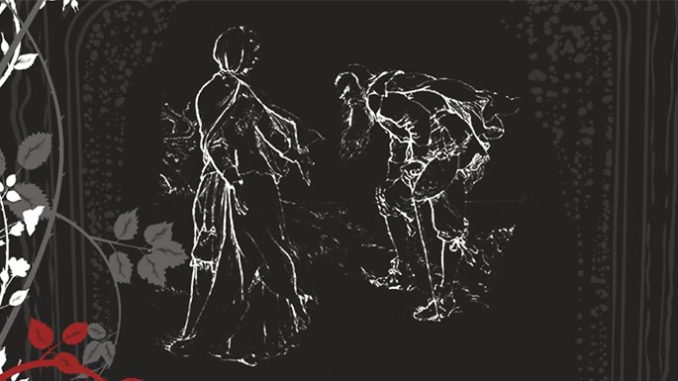
 Nathaniel Hawthorne’s The Scarlet Letter is one of those classics of American literature that many people read in high school or college, but that’s not a prerequisite to enjoying this excellent adaptation. In Mr. Prynne, J.A. Gray gives us a faithful retelling with an important twist: he adopts the point of view of Hester’s estranged husband, Roger Chillingworth, who resumes his true name and relationship to Hester in the book’s title.
Like Nathaniel Hawthorne’s original tale, Gray’s story opens with a purportedly autobiographical frame story. A contemporary young woman searches out Hester’s grave in the rain while her husband is briefly called away. Near the cemetery, she meets a man who promises to show her Hester’s burial spot for the sake of the story he enjoins on her to tell. Who is this elderly man, dressed all in black? Could Hawthorne himself be passing the story along to a new narrator, just as he himself received it in the form of a manuscript left by a predecessor in the custom house, Mr. Pue?
Under the protection of public domain, Mr. Prynne borrows liberally from Hawthorne’s story, sometimes reproducing great swathes of original dialogue (the author’s website attributes these quotations in full). These seamless insertions create touchstones of authenticity at key moments.
For instance, Hester, Pearl, and the Reverend Mr. Dimmesdale join hands on the scaffold in darkness during the minister’s vigil, exactly as they do in Hawthorne’s story. Once again, little Pearl asks, “’Wilt though stand here with mother and me, to-morrow at noon-tide?’”
Such word-for-word quotations pay homage to the felt reality of the original characters; it is almost as though they rise up to speak their own parts.
But Gray expands Hawthorne’s project in at least two significant ways: first, by narrating Hester’s long-suffering in greater detail, and second, by rehabilitating Chillingworth’s character to a remarkable degree. In the first place, Gray reminds us at every opportunity of the gauntlet poor Hester must run at the hands of her hypocritical neighbors. Take, for example, her lascivious erstwhile landlord, who refuses to accept Hester’s hard-earned money in payment:
Fie, mistress! Avaunt, Lady Shame! Would I touch the dirty money that such a thing as thou might’st proffer, secured by the selling of what I would not know? Why, the touch of thy money would pollute a Christian’s hand!
The town’s female gossips and even the children chime in with similar insults each day. But while these improvisations enrich our appreciation of Hester’s plight, the most significant contribution of Gray’s retelling of The Scarlet Letter lies in his treatment of Chillingworth.
Hawthorne leaves the ultimate disposition of Chillingworth’s soul to the bleakest regions of the puritanical imagination, though he does allow Chillingworth to will his fortune to Pearl. Gray builds on this hint to offer Chillingworth a measure of repentance and redemption. Without forswearing the old man’s diabolical quest for vengeance in the original, Gray allows gaps to appear between the blackness of Chillingworth’s thoughts and the gentleness of his speech, particularly as he interacts with Pearl.
Significantly, Gray’s Chillingworth also acknowledges committing a counterpart to Hester’s sin during his period of captivity in the forest. As Gray’s Chillingworth fantasizes about the potential fruit of his marital infidelity, he comes to regard Mr. Dimmesdale as the son he never had; and when he uncovers the “suppurating wound” over Dimmesdale’s heart, he is able to fall to his knees and cry, “I do pity thee!”
Without sacrificing a single stern plot twist, Gray subtly reframes Chillingworth’s actions to allow a more hopeful and redemptive interpretation. In one of several completely original scenes, Chillingworth plots to free a young couple condemned to hang for their own sexual transgressions. As a sinner himself, Chillingworth cannot bear to allow such an unequal punishment to befall them. Later, as Chillingworth realizes that Dimmesdale has escaped his intended revenge, Gray inserts a phrase that explicitly highlights his hope for Dimmesdale’s eternal salvation (the italics represent Gray’s interpolation within Hawthorne’s original text):
there was no one place where thou might’st have gained thy freedom and stood at last in the light—no high place nor lowly place, where thou couldst have escaped me—save on this very scaffold!
To me, this reads as a gloss and not a reversal of Hawthorne’s intention. Gray is not the first to adapt Hester Prynne’s iconic story, and he probably won’t be the last. But his decision to embed Hawthorne’s original text in Mr. Prynne hints at a larger purpose. Perhaps this authorial aside, offered when Pearl is seven years old, might illuminate it:
But about the moral development of this chronicle, let us pose the question now: Has it … matured as it should, and will it behave reasonably and prudently, as it ought? Will it practice virtue, shun vice, and fulfill its responsibilities, of providing a suitable climax, drawing a worthy moral, and effecting a graceful exit?
With these words, Gray attributes moral agency to the story itself, as though it were a living soul whose conscience is answerable to judgment. By the same token, no one, not even Roger Chillingworth, should be cut off from grace so long as he lives to seek mercy.
Dante’s Inferno pictures Satan frozen in ice. But at the end of Gray’s novel, the man known as Roger Chillingworth resumes his real name. It’s hard to imagine a more gracious homage to Nathaniel Hawthorne’s ageless morality tale.
Mr. Prynne: A Novel
by J.A. Gray
Wiseblood Books, Oct. 2026
Softcover, 500 pages
If you value the news and views Catholic World Report provides, please consider donating to support our efforts. Your contribution will help us continue to make CWR available to all readers worldwide for free, without a subscription. Thank you for your generosity!
Click here for more information on donating to CWR. Click here to sign up for our newsletter.
Leave a Reply
You must be logged in to post a comment.