
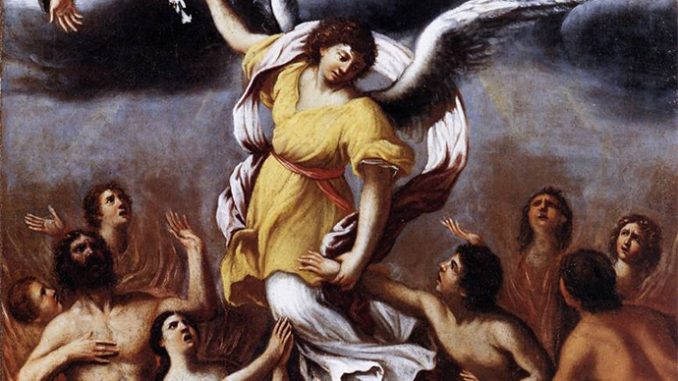
On All Souls Day and throughout the month of November, the Catholic Church encourages her members to visit cemeteries, pray for the faithful departed, and undertake “almsgiving, indulgences, and works of penance” on their behalf (Catechism of the Catholic Church, 1032).
But beyond its personal and devotional significance, this solemnity also invites serious reflection on the doctrine of purgatory: the teaching that many people leave this world “in God’s grace and friendship” but still in need of further “purification” (CCC 1030). And it thereby taps into a broader debate that has been raging in the Church since the Second Vatican Council: How many people will be saved?
On the one side are universalists, who believe that everyone will be saved in the end, regardless of their religious perspective (if any), their sacramental union with the Church, or the moral quality of their lives. Though formally condemned as heretical, this viewpoint increasingly takes hold on the pastoral level, particularly at funerals: the deceased are presumed to be in heaven already, as if to suggest otherwise would be cruel.
On the other side are infernalists, who counter this trend with almost the opposite conclusion: Most people are damned in the end. Though this was also the position of both Saint Augustine and Saint Aquinas, the infernalists evince an obsession with sin and hell. And that obscures the grace of God and the real possibility of salvation for non-Catholics and even non-Christians, which was affirmed by the Second Vatican Council.
Against both sides, Bishop Robert Barron has defended the “dare we hope” view put forward by Hans Urs von Balthasar. That we may hope that all people are saved in the end. As the Catechism itself teaches, “In hope, the Church prays for ‘all men to be saved’ (CCC 1821). Furthermore, this hope is not absurd—a kind of hope against hope—but a reasonable hope; that is, it’s firmly grounded in good reasons: the Cross and Resurrection of Jesus.
Many—and I include myself in their number—have found this to be a compelling resolution to the dilemma, one that honors the tensions of Scripture without succumbing to either presumption or despair. After all, both universalists and infernalists can easily point to passages in the New Testament that lend apparent support to their position. God, it would seem, wants us to dwell in a space of humble unknowing on this question, where both supreme hope and supreme caution can coexist. Indeed, when the disciples themselves asked Jesus if only a few will be saved, he answered the deeper question instead: “Strive to enter through the narrow door” (Lk 13:24).
Yet many critics of the “dare we hope” position counter that it renders our spiritual lives here below meaningless. Why evangelize or proclaim the Faith, if everyone ends up in the same happy state in the end? Why strive for conversion or confession or sanctification if the unrepentant sinner will eventually waltz into heaven scot-free?
Of course, this blurs the distinction between a hope for the salvation of all and the belief that it will happen. Just because we hope (even reasonably) for this outcome doesn’t mean we know or assume it will come to pass. But for the sake of argument, it’s worth posing the possibility: What if everyone is saved in the end, and the hope of the “dare we hope” view is vindicated? Are the critics right that this will have rendered our lives as faithful Christians pointless—that it really didn’t matter, after all, what we believed or how we lived on earth?
This sort of knee-jerk conclusion fails to really imagine what such a scenario might look like. In particular, it purges from the picture a perennial doctrine of the faith, crucial to the conversation—namely, purgatory.
What will this state of final purification be like? The Catechism describes it using only one image: that of a cleansing and purifying “fire” (CCC 1031). We find a scriptural basis for the image in the First Letter to the Corinthians, where Saint Paul proclaims that some will be “saved, but only as through fire” (1 Cor 3:15). This fire isn’t eternal, and it’s imbued with the certainty of heaven beyond; thus, it’s “entirely different from the punishment of the damned.” Yet the Church, interestingly enough, draws on precisely the same image traditionally associated with the pains of hell. Thus, if we can be sure about anything, it’s that purgatory is necessarily marked by incredible, even “hellish” suffering and pain.
The mysticism of the saints bears out this understanding of purgatory. Saint Faustina, in her Diary, writes that the torments of purgatory “are in no way different from the torments of hell; there is only this difference: that they will someday come to an end.” And Saint Catherine of Genoa adds, “It would seem better to suffer for a thousand years every woe possible to this body in this world, than to remain one hour in purgatory.”
Of course, it’s unclear what the “time” spent in this fire—being in fact outside of time—really means. It is, as Benedict XVI puts it in his encyclical Spe Salvi, “the heart’s time,” not chronological time. But presuming something analogous to our own sense of time, we do know that its “temporary” sufferings will be proportionate to the sins and attachments of an individual soul. And as Christ himself taught, after a person has “paid the last penny,” he or she will finally “get out” and enter into God’s presence (Matt 5:26).
It’s at this point in the conversation that the infernalist typically skips right over purgatory, as if never happened at all. Maybe on the far side of that purification, from the perspective of eternity, it will seem this way. But what about from within? What might it be like to suffer such intense pains on the “heart’s time” for the equivalent of a day—never mind a year, or a thousand years? And what about a hundred thousand years? Or a hundred million years? And why stop there? Why not sixty trillion years—and when that “time” has elapsed, realizing that it’s a false peak, and that a further quadrillion years lie between you and the summit of Mount Purgatory? Can we who gnash our teeth at a traffic jam or a stubbed toe really scoff at such unimaginable lengths of suffering just because it isn’t everlasting? Can the same creatures who can’t bear the thought of going to the dentist for a cleaning, never mind a root canal, really look right past purgatory as if it were no big deal?
And what might “happen” there? Dante’s Purgatorio offers a useful lens: We will be chastised by the very things that warped our souls in this life; our sins will remain their own best punishment. Maybe this will mean, in part, seeing with total clarity all the ways we offended God, especially with our cruelty and indifference to the weak and the poor. Maybe we will see, as Father Zossima explains in The Brothers Karamazov, just how connected we all were and how responsible we are for the sins of the world, painstakingly following the ripple effect even our “private” peccadillos had in other people’s lives—out into the lives of people they knew, and of people those people knew, and so on to the very edge of the world, watching as the hollow ugliness of our sin multiplies and desecrates the beauty of God’s creation, perhaps in truly horrifying ways we never realized. Maybe we will see the beauty and joy that could have been had we chose love instead—how much goodness and beauty would have flowered in our spouse, our children, our neighbors, and friends—which might be the even greater torment. Or maybe we will simply suffer such anguish as we can’t even begin to picture now at all—the kind of torments that, as Faustina envisioned, are redolent of hell.
God is merciful, but he is also just; his love is inexhaustible, but so, apparently, is humanity’s appetite for sin. And if everyone does end up saved in the end, it will only be through these awful flames of purgation. As T. S. Eliot wrote, we are “redeemed from fire by fire”—whether in this life or the next. If the impurities in us aren’t burned away, then we will be burned away.
We can and should hope that all men will be saved. But don’t purge purgatory from that picture. It remains a very real possibility for much of humanity before that hoped-for outcome. Indeed, in Spe Salvi, Pope Benedict XVI supposes that “the great majority of people” are headed there. And if the Church and her saints are right, it’s a place of cleansing fire and great pain—one that, though not eternal, otherwise has no time limit for the meting out of divine justice. Its “length” could very well be close to what we temporal creatures imagine when we imagine eternity.
Should we want ourselves, or anyone else, to have even one forefinger graze one small flame of that place for one moment, when Christ has swung the door to the perfect peace of heaven wide open? More importantly, if we truly love God, shouldn’t we strive for the narrow door and invite others to do the same, simply out of that love itself, rather than a fear of the alternative?
Even if the hope for the salvation of all is fulfilled, the impetus to evangelize remains. The need for conversion, repentance, and confession remains. And on All Souls Day and throughout the month of November, our summons to pray for those for whom it’s too late—the souls still suffering that cleansing fire—remains.
If you value the news and views Catholic World Report provides, please consider donating to support our efforts. Your contribution will help us continue to make CWR available to all readers worldwide for free, without a subscription. Thank you for your generosity!
Click here for more information on donating to CWR. Click here to sign up for our newsletter.
Leave a Reply
You must be logged in to post a comment.