
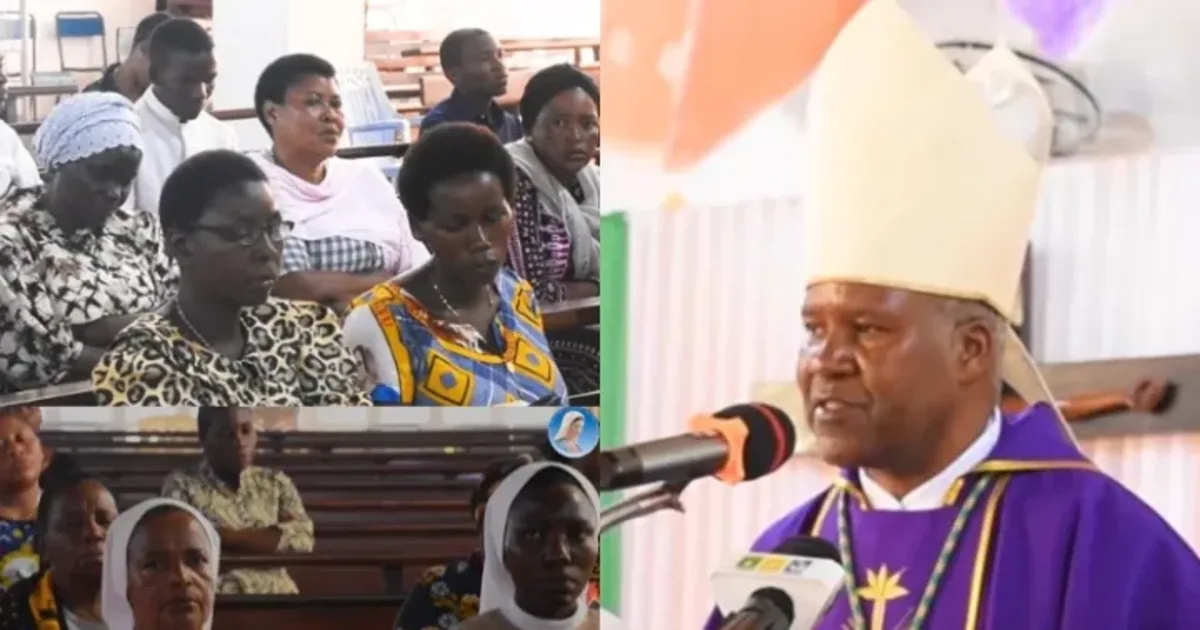
DAR ES SALAAM, Tanzania — The chairman of the Tanzania Episcopal Conference (TEC) has urged Tanzanians to uphold the truth and examine the country’s electoral framework to prevent further election-related violence.
In his homily during Mass on Oct. 29, Bishop Wolfgang Pisa of the Lindi Diocese appealed for forgiveness for those held in connection with the October 2025 election violence, adding that acknowledging difficult realities should guide the country’s response to the violence that followed the disputed elections.
He was speaking at St. Andrew Kaggwa Cathedral in his Diocese of Lindi on the day TEC dedicated national prayers for victims a year after the Oct. 29, 2025, polls.
“If we say that the current electoral law and the present constitution cannot deliver elections that are fair, truthful, peaceful, and secure, then that is the truth that should guide us,” Pisa said.
He added: “We must defend the truth, not protect wrongdoing. Let us do what is good and seek it at all times, so that we may avoid evil and abandon it completely.”
Drawing on the account of John the Baptist in Mark 6:17–29, the TEC chairman called on Tanzanians to acknowledge and defend the truth, even at personal cost.
“John the Baptist acknowledged the truth, even though doing so came at a great personal sacrifice. He was prepared to acknowledge and defend the truth,” he said.
Pisa urged the people of God to allow themselves to “be possessed by the truth and guided by it.”
“Let us not attempt to distort the truth, because it will remain what it is,” the member of the Order of Friars Minor Capuchin (OFM Cap) said.
Turning to the responsibility of those in positions of influence, Pisa recalled how Queen Esther intervened when Haman plotted to destroy the Jewish people. He urged Tanzanians serving in public institutions and other sectors of society to use their positions to prevent further violence.
“The first form of influence is the influence of prayer: fasting and praying. The second is to make use of people who have the ability to influence decisions. They must exercise genuine influence to ensure that such events do not happen again,” he said.
“In all this, we must always seek what is good. But this is not the time merely to complain. It is time to call upon other people like Esther in every institution to do their part: to exercise influence and wisdom.”
The TEC chairman also called for repentance, inviting Tanzanians to examine both acts of wrongdoing and failures to act when others were in danger.
“Through my failure to act, my failure to speak, or my failure to give direction, perhaps killings occurred, people were injured, people went missing, or people were unable to bury their relatives,” he said.
Invoking the biblical account of Cain and Abel, Pisa urged Tanzanians to reflect on their responsibility toward those who suffered during the violence.
“Like Cain, we continue to be asked: ‘Where is your brother Abel?’” the bishop said.
He also appealed for forgiveness for people held, tortured, or arrested for political reasons and in connection with the previous year’s elections.
“If there are others who might also have made mistakes and are being held, tortured, or have been arrested for political reasons and in connection with the previous election, fundamentally, they should not be killed,” he said.
The bishop warned that killing them would not resolve the problem.
“That will not solve the problem; it will bring more hatred and greater division,” he said. “Therefore, just as we ask God to forgive our sins, they too should be granted forgiveness.”
Pisa concluded by calling on the faithful to continue praying for Tanzania and its leaders.
“Let us continue to ask for Godʼs mercy and pray for our nation. Let us pray for all government leaders, asking God, Our Lord, to guide their minds and hearts according to his will, so that all people may enjoy peace, justice, freedom, and truth,” he said.
This story was first published by ACI Africa, the sister service of EWTN News in Africa, and has been adapted by EWTN News.
Leave a Reply
You must be logged in to post a comment.