
All my life, I’ve loved going to the movies partly for the social experience of seeing a movie with an audience. Movies are among the most “catholic” of art forms, and theaters have been called the “church of the masses.” It was strange to go to theaters this week, not once but twice, and to find myself on both occasions the only person in the room, as if that giant screen and I were in my own living room.
The theatergoing experience is in decline for a tangled web of reasons. One factor interacting with the decline is eroding social cohesion and shared trust. In these rancorous times, many Americans no longer feel that they and many or most of the people around them share in a common community, a common story, or that the institutions of society and culture represent us all and belong to us all.
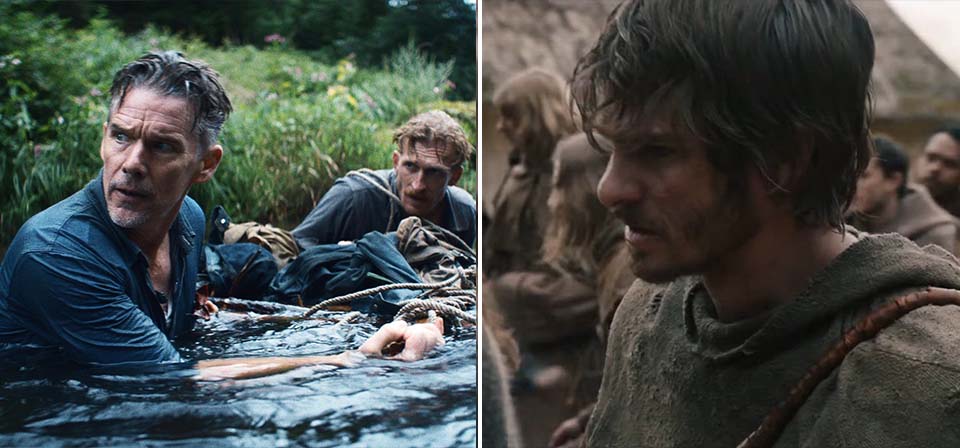
All of which resonates with at least some of the themes common to the two movies I went to see. Both are historically specific period pieces about worlds in socioeconomic crisis, beset by widespread suspicion of society and its institutions. Both are also, in different ways, tales of community and solidarity, of cooperative action in the face of corrupt power, injustice, and oppression. Of course, the movies love a hero, and each film centers on a man at the heart of the collective action: a capable, resilient figure who proves himself through shrewdness, leadership, endurance, and sacrifice.
The movie includes the historical Ball’s famous rhyming slogan advocating egalitarianism against the class system: “When Adam delved and Eve span [spun], who was then a gentleman?”
Padraic McKinley’s The Weight, starring Ethan Hawke and Russell Crowe, is an action-adventure yarn set in 1933, in the thick of the Great Depression. Hawke plays Samuel Murphy, a roguish WWI veteran and widower trying to raise a young daughter in a harsh world. When instigation by police leads to wrongful imprisonment, Crowe’s corrupt warden, Clancy, offers Murphy a deal. If he can help successfully transport a trove of gold bricks for their owner to prevent their seizure by the FDR administration under a controversial provision of the Emergency Banking Relief Act, Clancy will arrange an early release in time to reunite Murphy with his daughter before she becomes a ward of the state.
Paul Greengrass’s The Uprising, starring Andrew Garfield, is a medieval action epic dramatizing the 1381 English protests often called the Peasants’ Revolt or Wat Tyler’s Rebellion. In the disruptive wake of the Black Death, unpopular socioeconomic realities from an oppressive new poll tax to dissatisfaction with official corruption and the feudal system itself lead to demonstrations, popular uprisings, and violence against the royal government of the boy king Richard II (Woody Norman, C’mon C’mon).
Leave a Reply
You must be logged in to post a comment.