
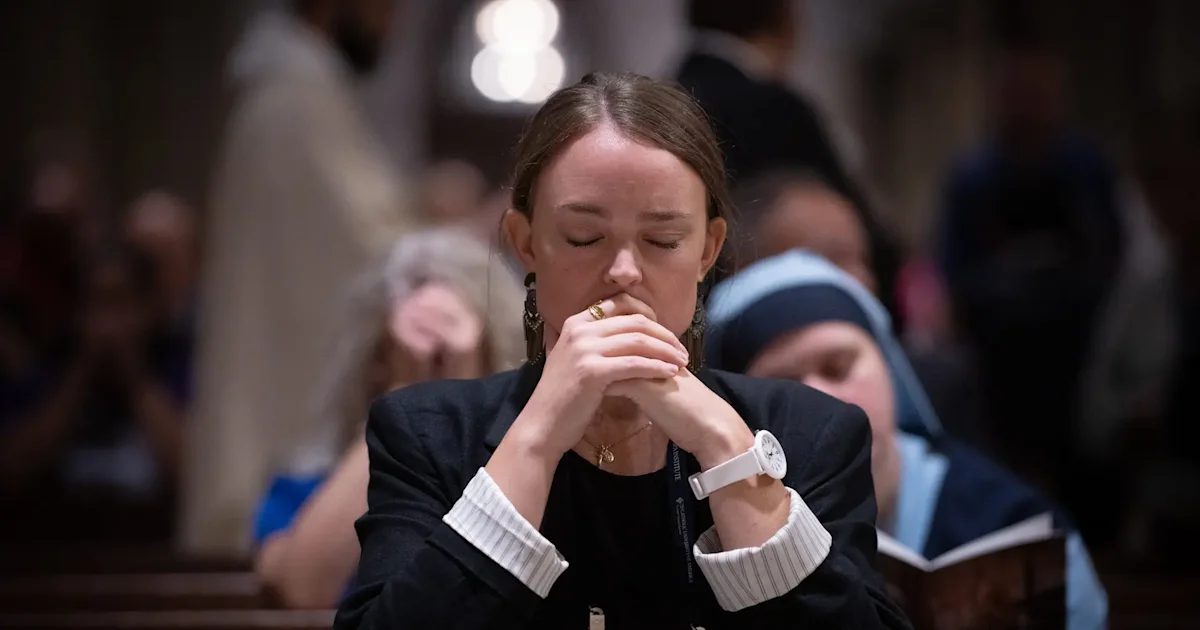
A Pew Research report is pushing back on headlines of religious revival in the U.S. with data showing “mixed signals” among young adults.
The Oct. 28 report from Pew Research Center found that while religious practice in the U.S. has “remained stable” since 2020, a survey of young adults about religious practice uncovered “mixed signals.” The report is based on data from Pew’s probability-based, nationally representative 2026 National Public Opinion Reference Survey (NPORS) and the center’s 2025 Cross-Sectional Engagement Survey.
Based on a June 2026 survey, Pew found that 34% of adults said they attended a religious service in the past month, while 45% said they either attended or watched a religious service online in the past month. “Both numbers are at their highest levels since the Center started asking these questions in July 2020,” the report said.
However, the report said that while young adults born from 2004 to 2008 are reporting “relatively high rates of attendance at religious services,” young adults born from 2000 to 2003 “are the least religious age group when it comes to how often they pray, how important religion is in their lives and how many of them identify with religion.” In addition, the share of the older demographic that say they attend religious services regularly “is among the lowest of any age group.”
The report noted that the youngest Republicans attend religious services at higher rates than older Republicans, but that “they are not solely responsible for the high levels of religious attendance among young adults,” and that younger Democrats also reported higher levels of attendance than older ones.
The youngest men reported higher levels of religious observance than the youngest women, the report said, noting that “this is something we have not seen before in our surveys.” However, the youngest women did report “relatively high rates” of attendance at religious observance compared with older women.
“Moreover, this is not the first time in recent decades that surveys have shown the youngest Americans entering adulthood with relatively high rates of religiousness,” the report said. “When this has happened in the past, the religiousness of the youngest adults has tended to fade with time, leaving them less religious than people in the preceding birth cohort. We have no way of knowing whether today’s youngest adults will follow that pattern or break it.”
The report highlighted how findings from other organizations contrast with their own. While Gallup polls showed an increase in young men who identified religion as important to them and who attend religious services, more so than young women, the report noted that “by contrast, an aggregation of Pew Research Center surveys from 2025 and 2026 finds that among people ages 18 to 29, more young men than women attend services regularly, while roughly equal shares of young men and women say religion is very important to them.”
Leave a Reply
You must be logged in to post a comment.