
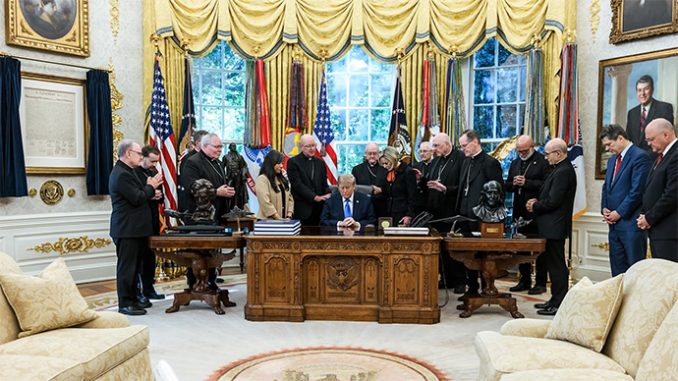
We have reached such an extraordinary degree of political derangement within Catholic discourse in the U.S. that twelve bishops praying over the President of the United States now constitutes a scandal requiring public apologies and elaborate explanations from successors of the Apostles. The recent outrage directed toward bishops who prayed over President Donald Trump in the Oval Office reveals an increasingly disturbing theological illiteracy among those who apparently consider themselves sufficiently qualified to lecture the episcopacy about the appropriate exercise of its sacred responsibilities.
The entire controversy is embarrassing. It demonstrates how thoroughly partisan political allegiances have colonized and corrupted the religious imagination of individuals who should otherwise possess sufficient theological formation to recognize what is an ordinary exercise of episcopal ministry.
According to the Catechism of the Catholic Church, paragraph 894, bishops exercise their pastoral governance through their “counsels, exhortations, and example” alongside the sacred authority entrusted to them for the spiritual edification of the faithful. Consequently, the episcopal office possesses an intrinsically pastoral character; bishops participate sacramentally in the threefold ministry of Jesus Christ as priest and shepherd of His people. They are pastors in the truest sense.
Furthermore, Canon 375 §1 of the Code of Canon Law explicitly teaches that bishops are constituted pastors through divine institution as successors of the Apostles and consequently serve as “teachers of doctrine, priests of sacred worship, and ministers of governance.” Their episcopal consecration confers the sacred responsibility of sanctifying souls through the exercise of their priestly ministry, according to Canon 375 §2.
When twelve Catholic bishops gathered around an elected president and offered prayers for him, they were exercising precisely the spiritual responsibility that their episcopal consecration obliges them to fulfill: literally the hope of the sanctification of an elected leader’s soul.
Apparently, this completely elementary truth of Catholic doctrine has escaped commentators who have somehow convinced themselves that praying over a political leader constitutes an implicit and automatic endorsement of his entire administration and personal conduct. That kind of reasoning requires an astonishing level of theological confusion. Christian intercession has always proceeded from the recognition that every human person is desperately dependent upon divine grace, regardless of his political affiliations, personal conduct, or moral standing.
Indeed, the Church explicitly teaches in paragraph 2234 of the Catechism of the Catholic Church that the Fourth Commandment establishes an obligation to honor those who exercise legitimate authority within human society. This obligation arises from the divinely established moral order within which political authority serves the temporal common good under the judgment of God’s eternal law. Additionally, paragraph 2240 of the Catechism reiterates the apostolic command to offer “prayers and thanksgiving for kings and all who exercise authority” so that society may enjoy peaceful conditions conducive to godliness.
Notice that Saint Paul, when he provides this instruction, is writing within the historical circumstances of the Roman Empire during the first century, when Christians lived under political authorities whose religious convictions and moral practices almost completely contradicted the Gospel.
The apostolic exhortation in 1 Timothy 2:1–4 establishes intercessory prayer as a Christian responsibility precisely because God desires the salvation of every human person and summons and draws all people toward knowledge of the truth. Yes, that includes President Donald Trump.
Furthermore, Paul’s command possesses particular historical significance because the Roman imperial establishment would eventually persecute Christians who refused to participate in the religious worship of the emperor. Nevertheless, the early Christian community understood that intercession for rulers belonged to its priestly and baptismal vocation. Why? Because the Church’s evangelical mission extends even toward those whose exercise of political power threatens its members.
Evidently, the ancient Church possessed a theological understanding of intercession that contemporary political commentators would benefit tremendously from recovering before offering further instruction and commentary concerning episcopal responsibilities. It is truly baffling how many of those commentators have become canon law experts overnight.
The historical Christian tradition consistently recognizes that prayers for political authorities express Christian charity toward persons entrusted with responsibilities, precisely because their responsibility profoundly affects the lives of their fellow citizens. Hence, the moral imperfections of a ruler actually provide additional—not fewer—reasons for Christians to seek divine assistance on his behalf, as his political authority magnifies the consequences of personal decisions.
Indeed, St. Thomas Aquinas explains in the Summa Theologiae (II–II, q. 25, a. 6) that charity extends to sinners because every human person until their natural death is capable of receiving divine grace and attaining eternal beatitude. And that includes political officials.
This theological principle renders this recent controversy particularly absurd because the spiritual welfare of Donald Trump is an entirely legitimate concern for every Catholic bishop, regardless of anyone’s assessment of his political administration. In fact, the suggestion that the intercession of our bishops constitutes political endorsement is a profoundly impoverished understanding of the supernatural purpose of Christian prayer.
When a bishop prays over a person, he invokes divine assistance upon a human soul whose ultimate destiny is subject to God’s judgment, and whose conversion is still possible through divine grace until his dying breath. Therefore, the spiritual significance of this particular encounter is rightly part of the Church’s mission of sanctification, contrary to the weaponized ideological interpretations subsequently imposed upon photographs circulating through political media.
Of course, politicians frequently recognize the public significance of religious encounters and may subsequently employ such images for their political advantage. That has happened often throughout history. Anyone claiming a unique culpability of Trump in this regard is simply ignorant of history.
Upon conquering Egypt, Alexander made an arduous journey to the Oracle of Ammon at the Siwa Oasis. The priests declared him the son of the god Ammon. Alexander heavily promoted this divine encounter to legitimize his rule over Egypt and to cement his authority among his diverse subjects. In the 1950s, Eisenhower actively collaborated with religious leaders to counter the “godless communism” of the Soviet Union. He became the first president to be baptized while in office, instituted the National Prayer Breakfast, and signed the bill adding “In God We Trust” to U.S. currency, effectively linking American patriotism with religious faith during the Cold War. Joe Biden regularly commented on his alleged practice of the Catholic Faith throughout his time in public office.
And the list goes on and on. Religion has always been a much-sought ally in the political agenda. The Trump administration is hardly the first, and it certainly won’t be the last to manufacture political spins about religious encounters.
Nevertheless, in this instance, the possibility of political exploitation is not a reasonable invalidation of a legitimate pastoral action. The moral character of prayer, especially by bishops, derives from its spiritual purpose, not its political image. If this were a reason to not pray for Donald Trump, then our bishops have effectively surrendered their sacred ministry to whichever political faction happens to possess the greatest capacity for manipulating public perceptions. Thankfully, they didn’t do that, and they provided a witness to an act of prayer.
Thus, the demand that bishops apologize for offering prayers over an elected leader introduces a deeply dangerous assumption concerning the relationship between ecclesiastical authority and partisan approval. Under this awful arrangement, bishops apparently require permission from political commentators before exercising their sacred responsibility to intercede for individuals whose public reputations provoke ideological hostility.
One wonders whether the same commentators would demand public apologies from bishops who prayed over President Joe Biden or President Barack Obama during their respective administrations. Would episcopal intercession over George W. Bush or Bill Clinton similarly require elaborate theological defenses concerning the political implications of invoking God’s mercy upon a human soul?
No? Perhaps only for the Trump presidency? Perhaps that speaks to the state of our souls more than the intent of the bishops.
The identity of the president is completely incidental to the fundamental theological character of the action. The Church’s responsibility to pray for those exercising public authority transcends electoral preferences. Accordingly, the bishops who participated in this encounter exercised a legitimate dimension of their pastoral ministry and deserve recognition and intercession themselves for fulfilling their spiritual responsibilities.
The deeper problem concerns a Christian body that is part of a political culture increasingly incapable of recognizing that spiritual fatherhood extends toward every person who requires divine mercy, regardless of political affiliation.
Our bishops are spiritual fathers whose pastoral responsibility encompasses the salvation of souls because Jesus Christ entrusted His Church with the ministry of reconciliation. Consequently, their sacred office obliges them to approach human beings through the supernatural horizon of redemption—regardless of the political controversies surrounding those individuals.
For those that need a wake-up call and reminder: the present President of the United States, Donald J. Trump, is a man created in God’s image, like all others, and whose eternal destiny possesses infinitely greater significance than the temporary political authority entrusted to him.
Personally, I sincerely hope that the prayers offered by these bishops will obtain extraordinary graces for President Trump and inspire him toward deeper conversion through genuine obedience to the Lordship of Jesus Christ. I pray that the Holy Spirit will illuminate his conscience and guide his decisions according to divine wisdom, because the moral responsibilities accompanying presidential authority demand extraordinary humility and prudence before Almighty God.
The poet Francis Thompson famously described divine grace through the evocative imagery of “The Hound of Heaven” in his 1893 poem of the same name. I encountered it in the writings of Archbishop Fulton Sheen. Thompson described God’s relentless pursuit of the human soul as revealing the astonishing persistence of His redeeming love. That divine pursuit also seeks Donald Trump. The saving mission of Jesus Christ extends toward every sinner whom the Father desires to reconcile through the sacrifice of His beloved Son.
Ultimately, the bishops who prayed over the president acted according to their sacred vocation. The Church exists to bring human beings into communion with the living God. The entire biblical covenantal narrative culminates in Jesus Christ as the eternal High Priest, whose intercession reconciles fallen humanity with the Father through His perfect sacrifice. Through baptism, Christians participate in His priestly mission and consequently receive the sacred responsibility of interceding for the salvation of others, even when we don’t like them or their political agendas.
Therefore, our bishops deserve our prayers and our filial respect as they exercise their apostolic ministry within an increasingly hostile political environment. Their prayer for President Trump was an authentically Catholic action requiring neither partisan permission nor public apology. And perhaps those demanding episcopal repentance for an act of Christian charity should seriously consider whether their political indignation has displaced the Gospel within their own hearts.
If you value the news and views Catholic World Report provides, please consider donating to support our efforts. Your contribution will help us continue to make CWR available to all readers worldwide for free, without a subscription. Thank you for your generosity!
Click here for more information on donating to CWR. Click here to sign up for our newsletter.
Leave a Reply
You must be logged in to post a comment.