
Bishops who attended the meeting and the prayer have stated they were invited by the White House Faith Office to discuss issues of importance to Catholics.
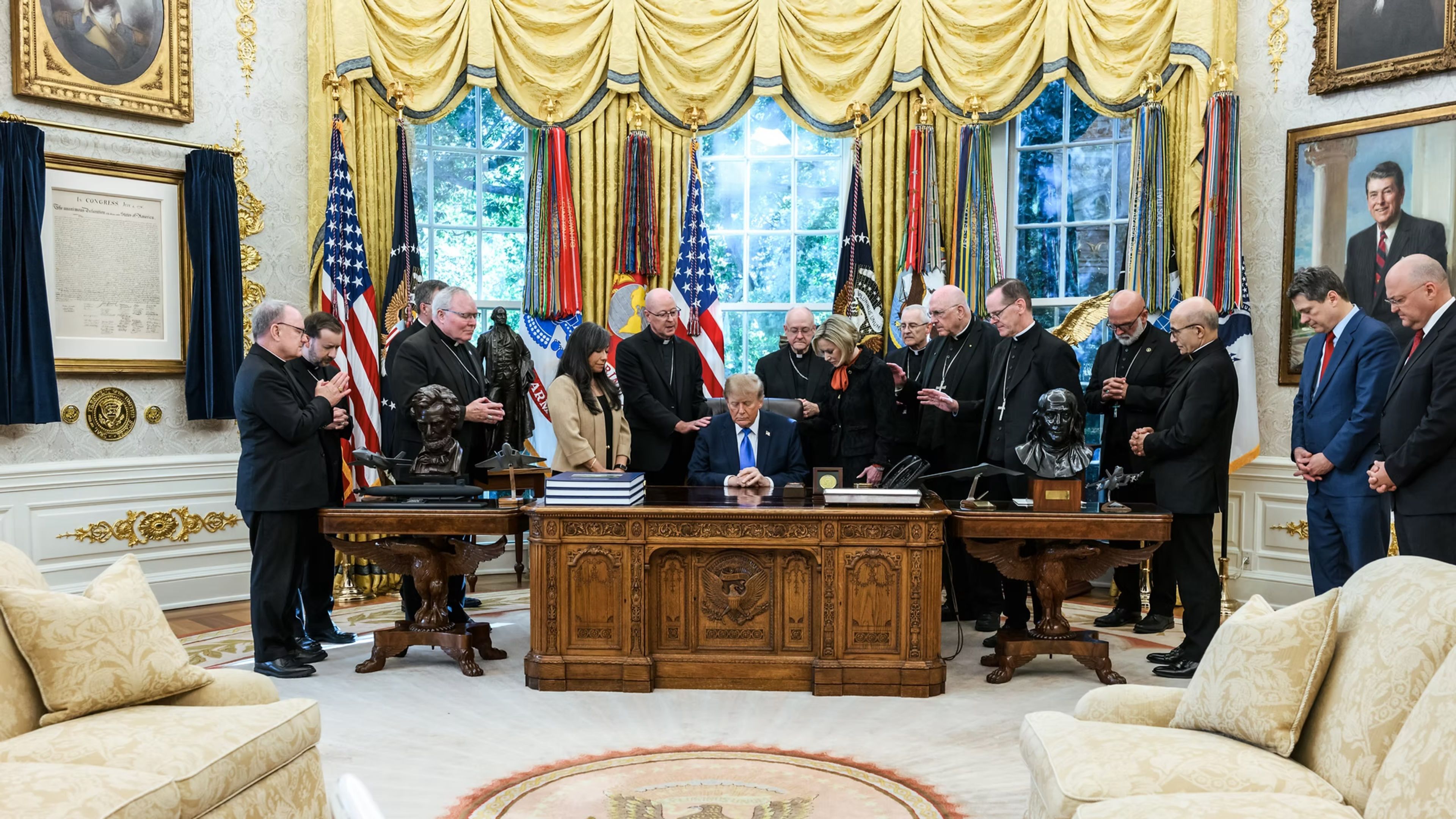
A second bishop is expressing regret over a meeting with President Donald Trump at the White House last week and complained that it has been “exploited” for political gain, while others who attended are clarifying the reasons they went.
On Oct. 22, the White House posted a video that showed Denver Archbishop James Golka leading a prayer with Trump, surrounded by about a dozen other bishops, who stood beside the president’s spiritual advisor Paula White-Cain and White House Faith Office Director Jennifer Korn.
The video was shared by Margo Martin, a White House communications advisor, with no news release to accompany it, nor any description of what was discussed. Golka shared the video on archdiocesan social media and clarified it was not a political endorsement.
Bishops who attended the meeting and the prayer have stated they were invited by the White House Faith Office to discuss issues of importance to Catholics: the right to life, the dignity of migrants, religious liberty, and school choice. Several have echoed Golka, emphasizing the meeting and prayer was not a political endorsement, while two have expressed regret for going.
On Oct. 25, Milwaukee Archbishop Jeffrey Grob issued a “public apology” for any confusion the video caused, saying he did not know it would be shared publicly and it was not meant to be an endorsement of the president.
A second bishop — Des Moines Bishop William Joensen — also emphasized that it was not an endorsement and conveyed regret over the video being used for political purposes.
The U.S. Conference of Catholic Bishops (USCCB) had no role in the meeting.
‘Exploited’ for politics
On Oct. 24, two days after the meeting, Joensen issued a statement saying “I would have done well to be more mindful Jesus’ admonition [in the Gospel of Matthew]: ‘Behold, I am sending you like sheep in the midst of wolves; so be shrewd as serpents and simple as doves.’”
“I wish I had been more shrewd and less simple, like those who exploited our meeting for partisan political purposes,” Joensen said. “I pray I am more prudent and wise going forward, even as I remain resolute in my openness to engaging and praying for political leaders at all levels.”
Joensen did not say who he was accusing of exploiting the meeting and a spokesperson for the diocese did not respond to a request for clarification from EWTN News.
In his statement, Joensen said he was invited by officials associated with the Faith Office to talk about a variety of issues: immigration, the exploitation of the poor, visas for international clergy, advancement of a culture of life as an alternative to abortion, and support for private education.
“There was also a concluding opportunity to pray for and with our president, that God would guide his heart and impel him to lead in a way consistent with the dignity of his office,” he said.
Joensen said “there are many things” linked to the administration “at odds with our Catholic faith.” Yet, he said he attended to “have a conversation” and was informed officials “would be interested in hearing our perspective.”
When reached by EWTN News for comment, White House spokeswoman Taylor Rogers said in a statement, “there has never been a greater president for Catholic Americans than President Trump, and his strong record proves it.”
“He stopped the weaponization of the federal government against Christians, proudly defended and expanded our religious rights, pardoned pro-life activists, stopped the chemical mutilation of our nation’s children, and protected parents’ rights,” Rogers said, but did not respond to a follow up request for a response to the comments made by Joensen and Grob.
Explanations by other bishops
In addition to Golka, Grob, and Joensen, a few other bishops have issued statements about the reasons they met and prayed with Trump in the Oval Office and what they talked about with administration officials.
The Diocese of Rapid City, South Dakota provided a statement to EWTN News on behalf of Bishop Scott Bullock, which said the delegation discussed Catholic priorities: abortion, school choice, and the ethical implications of in vitro fertilization (IVF).
According to the diocesan statement, the bishops’ prayer over Trump is not an “endorsement,” but is rather based in Scripture and following the instruction of St. Paul, who said “supplications, prayers, petitions and thanksgivings be offered for everyone, for kings and for all in authority, that we may lead a quiet and tranquil life in all devotion and dignity.”
“We went there and we prayed, and we asked the Lord to instill our leaders with wisdom and also to help them remain humble,” Bullock said.
A spokesperson for Diocese of Gallup, New Mexico’s Bishop James Wall told EWTN News that “Bishop Wall does want to express that he would accept a meeting with any politician, if invited, to discuss important church matters, regardless of the time of year and the political party, and that he offers prayers for all who hold political office, that they lead with integrity and not division.”
The office of Archbishop Emeritus Joseph Naumann, who led the Archdiocese of Kansas City before retirement, also released a statement indicating that during the meeting the prelate voiced concerns about chemical abortion and IVF, while advocating for pro-life reproductive health care. He also discussed religious liberty, immigration, school choice, and protecting children from pornography.
According to the statement, Trump expressed gratitude to the bishops “for prayers asking God to bless and guide the president, his staff and the nation.” The archbishop’s office emphasized this was not an endorsement and that the bishops “were assured that no photographs would be made public.”
“They came to have a discussion on important policy matters,” the statement indicated. “As Catholic bishops, they pray with everyone, but do not endorse candidates or political parties.”
The following bishops also attended the meeting, according to the White House: Bishop Edward Burns of the Diocese of Dallas, Bishop Steven Raica of the Diocese of Birmingham, Bishop Thomas Hennen of the Diocese of Baker, Bishop Michael Barber of the Diocese of Oakland, Bishop Francis Kalabat of the Chaldean Catholic Church, and Bishop Elias Zaidan of the Maronite Catholic Church.
Bishop of Palm Beach Jesús Rodríguez — who did not attend the meeting — opined on the matter on X, saying any action perceived as a political endorsement by a member of the Church hierarchy “must not be construed as representing the official position of the Catholic Church.”
The meeting was also attended by Mario Enzler of the Heritage Foundation, though the Heritage Foundation has stated it did not organize it.
If you value the news and views Catholic World Report provides, please consider donating to support our efforts. Your contribution will help us continue to make CWR available to all readers worldwide for free, without a subscription. Thank you for your generosity!
Click here for more information on donating to CWR. Click here to sign up for our newsletter.
Leave a Reply
You must be logged in to post a comment.